Sanctity of sacred Pashupatinath temple in Madhya Pradesh violated; Muslim man enters sanctum and attempts to climb idol
 Mandsaur, Madhya Pradesh, India
 18 October, 2026
Case Summary
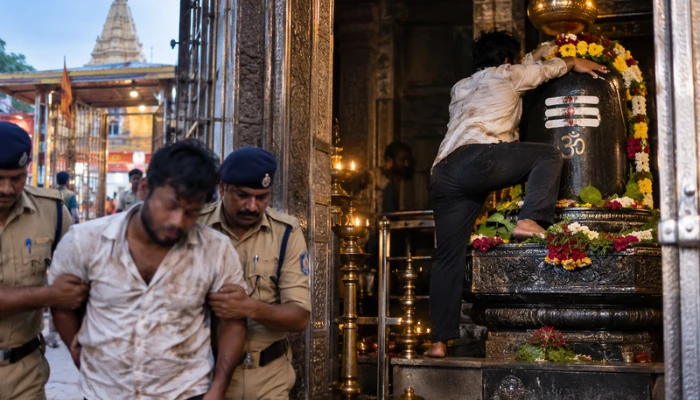
In Mandsaur, Madhya Pradesh, the sacred Hindu temple dedicated to Lord Shiva, the Pashupathinath temple, was desecrated by a Muslim man. He entered its premises after consuming alcohol and attempted to climb the sacred idol. The incident took place on Monday, 19 October 2026, at the Shri Sahastreshwar Mahadev Temple, within the Shri Pashupatinath Mahadev Temple complex, where the accused reached the sanctum and attempted to climb the idol. The accused was identified as Imran Khalifa, son of Abdul Rashid Khalifa, a resident of Nayapura. At around 3 pm on Monday (19 October, 2026), he entered the temple premises in an intoxicated state and reached the sanctum of the Shri Sahastreshwar Mahadev Temple. He attempted to climb the sacred idol and engaged in inappropriate acts inside the temple. When people at the site noticed his behaviour, they called the security guards, who apprehended him and escorted him out. The incident came to wider attention on Tuesday, 20 October, when former BJP MLA Yashpal Singh Sisodia questioned the temple's security arrangements and the committee's failure to respond promptly. He also questioned whether the accused had undergone a medical examination and demanded an investigation into his conduct and intentions inside the temple. He also called for an examination of the CCTV footage and demanded strict legal action. He also sought action against the temple committee manager for failing to respond to the incident on the day it occurred. Afterwards, the security agency deployed at the temple filed a complaint at Nai Abadi Police Station in Mandsaur. The police registered a case against the accused under Section 298 of the Bharatiya Nyaya Sanhita (BNS) and arrested him. According to Nai Abadi Police Station in-charge Kuldeep Singh Rathore, the police also recovered poisonous liquor from the accused. Mandsaur Superintendent of Police Vinod Kumar Meena stated that the security arrangements at the temple would be reviewed and that action would be recommended to the District Collector against anyone found responsible for negligence. Sub-Divisional Magistrate Shubham Patidar also announced a review of the training provided to private security guards and stated that the security agency would be directed to remove untrained personnel.
Why it is Hate Crime ?
The primary category selected in this case is- Attack on Hindu religious representations. The sub-category this case falls under is- Desecration of Hindu religious symbols. Icons and symbols or a religious representation of a spiritual ideal are widely revered in Hinduism. Iconography is of vital significance in the Hindu milieu. It helps connect people’s spiritual beliefs with the real world. Iconography within the Hindu faith takes several shapes and forms. Murtis are of most significance to Hindus, to which daily rituals, prayers and offerings are done. Besides the murtis, there are several other symbols which have deep significance in the Hindu faith – the Om and Swastika for example. Since these Hindu religious symbols hold paramount importance in Hinduism, any desecration of symbols, icons, murtis, religious representations and manifestations, is driven by animosity towards the faith itself which manifests itself through these murtis, icons and symbols. Therefore, any desecration of these Hindu religious symbols and representations is considered religiously motivated hate crimes under this category. The other subcategory selected is- Breaking rules of place of worship. Sanatan Dharma is not a religion of one book, which is to say that while it has religious scriptures that form the central tenets of the faith, there are several traditions followed through thousands of years, mostly passed from generation to generation orally. One of these oral traditions or written traditions is the rules of specific temples. Certain temples have rules which are traditional rules, dependent on the worship of the presiding deities. These rules and traditions have been followed for thousands of years whether they find scriptural mention or not. Such traditions are based on the nature and rules of worship of the presiding deity of that temple. Any non-compliance of these traditions owing to animosity towards the faith or for the sake of activism stems not only from the lack of faith in the presiding deity but also disregard for the faith of the devotees of that deity/temple and implicit bias against the faith, the tradition and the deity itself. Since these specific traditions are central to the faith of the devotees of that specific temple and presiding deity, any non-compliance with these traditional rules would be considered a religiously motivated hate crime. The other subcategory selected is- Defiling religious customs. Sanatan Dharma is not a religion of one book, which is to say that while it has religious scriptures that form the central tenets of the faith, there are several traditions followed through thousands of years, mostly passed from generation to generation orally. There are several such customs and traditions that are followed by various Hindus and Hindu sects. Defiling of these traditions and customs is a breach of an individual or group’s religious practices. Such practices can range from dietary restrictions like not eating non-vegetarian food for a certain period of the year, not eating non-vegetarian food at all, not eating beef since the cow is considered holy in Hinduism, the sanctity of religious customs followed in the house (like many ISCKON devotees), etc. Any malicious action leading to the breach of such traditions or defilement of these traditions owing to animosity towards the faith or for the sake of activism stems not only from the lack of faith in the religion itself but also from disregard for the faith of the devotees who follow the customs/traditions and implicit bias against the faith, the tradition itself. Since these specific traditions are central to the faith of the devotees of that specific sect of Hindus, any non-compliance with these traditional rules would be considered a religiously motivated hate crime. This case was included in the Hinduphobia Tracker because a Muslim man entered a sacred Hindu temple in an intoxicated state, engaged in inappropriate acts and attempted to climb the sacred idol of Lord Shiva. His conduct violated the sanctity of the temple and directly disrespected the religious representation of the deity worshipped by Hindu devotees. The Shri Pashupatinath Mahadev Temple in Mandsaur is a highly revered Hindu pilgrimage site dedicated to Lord Shiva. Its religious significance makes the sanctity and security of its premises especially important. In 2012, the Intelligence Bureau identified the temple as vulnerable and recommended stronger security measures. Against this background, the accused's entry into the temple in an intoxicated state, his arrival at the sanctum and his attempt to climb the sacred idol must be viewed with the seriousness the violation warrants. This was not merely a breach of ordinary public decorum; it was an attempt to violate the sanctity and decency of a revered Hindu place of worship. In Hinduism, a murti is not merely an artistic representation or an ordinary object. It embodies the divine presence of the presiding deity and serves as the focal point of prayers, rituals and offerings. Lord Shiva is revered as a principal deity in Sanatan Dharma, and worshippers devote their devotion and reverence to His sacred murti. Attempting to climb the murti inside the sanctum of a Shiva temple directly violates this religious sanctity. The accused's conduct therefore involved the desecration of a sacred Hindu religious representation and showed disregard for the sentiments of devotees. The accused also violated the sanctity and established rules of the place of worship by entering the sanctum in an intoxicated state and attempting to climb the sacred idol. Hindu temples follow traditions and rules of conduct shaped by the worship of their presiding deities. These practices preserve the sanctity of consecrated spaces and reflect the reverence devotees owe to the deity. Entering the sanctum after consuming alcohol and attempting to climb the murti disregarded these religious norms and the faith of the devotees. Some may argue that the perpetrator carried out the act under the influence of alcohol. However, intoxication does not justify the deliberate desecration of a Hindu place of worship or negate the religious dimension of the offence. The perpetrator specifically entered the sactum sactorium of the temple and attempted to climb the sacred idol. If the act was solely due to intoxication, the perpetrator could have targeted any non-religious property or non-Hindu religious sites such as a mosque, church or gurudwara. The selective targeting of a Hindu temple demonstrates that the act was directed to hurt the religious sentiments of the Hindu community. Overall, this showcases his inherent hostility toward Hinduism and its adherents and warrants inclusion in the tracker.


Case Status
Complaint filed


Perpetrators Details
Perpetrators
Muslim Extremists
Perpetrators Range
One Person
Perpetrators Gender
male
 Sources



