Kattam Maisamma Temple vandalised, premises ransacked, sacred worship items and bells thrown beneath the deity’s idol in Telangana
 Hyderabad, Telangana, India
 17 October, 2026
Case Summary
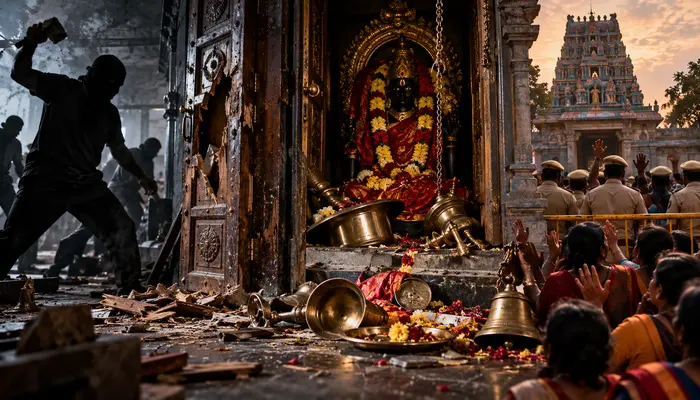
In the Moosapet tank area near Osmania University in Hyderabad, Telangana, a Hindu temple, Kattam Maisamma Temple, was vandalised by unidentified miscreants who breached the temple gates, ransacked the premises, and threw temple items and bells beneath the deity’s idol, prompting outrage among residents and Hindu devotees. Following the incident, local Hindus and devotees gathered in large numbers to protest against the vandalism and demand immediate answers and strict action against those responsible. Tensions escalated as protesters expressed frustration over heavy security measures imposed by law enforcement, which cordoned off the area and restricted public and devotees' access to the shrine. During the police response, police kept the regular temple priest under watch and prevented individuals from approaching the shrine. Community members expressed dissatisfaction with the restrictions and demanded accountability. Authorities requested a two-hour window to handle the situation, further intensifying tensions as the gathered crowd sought swift justice. Residents also expressed concern over a series of similar incidents across multiple locations within the Hyderabad commissionerate. Protesters referred to previous incidents involving a local Shiva temple, where puja items and idols were targeted. They expressed concern that such cases of vandalism at Hindu religious sites were often dismissed or downplayed by authorities because the offenders were claimed to be mentally unstable. These concerns fueled growing anxiety among residents and devotees about protecting Hindu temples and religious sites. With Devi Navaratri approaching, community members warned that repeated attacks on religious structures threatened local peace and caused considerable emotional distress among devotees. Law enforcement agencies appealed to the public to remain calm, avoid spreading unverified rumours or misinformation on social media, and cooperate with the ongoing investigation. Police stated that inquiries were underway to establish the full sequence of events and identify those responsible for the vandalism at Kattam Maisamma Temple.
Why it is Hate Crime ?
The primary category selected in this case is: Attack on Hindu religious representations. The subcategory selected is: Attack on Temples. In Hinduism, a temple is the abode of the Deity. The Deity in the Temple is consecrated, thereby, making it a real, breathing entity. Hindus believe that not just the Deity but the temple premises itself are sacred to Hindus since Hindus hold the faith that the entire Temple space is an amalgamation of the divine energy of the deity. Given the central significance of Temples in Hindu Dharma, any attack against a Hindu Temple or its peripheral premises is an attack on the faith itself and is born out of animosity towards the faith, of which, the Temple is a central tenet. Any manner of attack against a Temple and/or its premises would therefore be considered a religiously motivated hate crime. The other subcategory selected is: Desecration of Hindu religious symbol. Icons and symbols or a religious representation of a spiritual ideal are widely revered in Hinduism. Iconography is of vital significance in the Hindu milieu. It helps connect people’s spiritual beliefs with the real world. Iconography within the Hindu faith takes several shapes and forms. Murtis are of most significance to Hindus, to which daily rituals, prayers and offerings are done. Besides the murtis, there are several other symbols which have deep significance in the Hindu faith – the Om and Swastika for example. Since these Hindu religious symbols hold paramount importance in Hinduism, any desecration of symbols, icons, murtis, religious representations and manifestations, is driven by animosity towards the faith itself which manifests itself through these murtis, icons and symbols. Therefore, any desecration of these Hindu religious symbols and representations is considered religiously motivated hate crimes under this category. This case is a clear example of a religiously driven hate crime, as the perpetrator targeted a Hindu temple, vandalised its premises, and threw sacred worship items and bells beneath the deity’s idol. Such actions demonstrate a deliberate attack on a Hindu religious place of worship, amounting to an act against Hinduism, its sacred traditions, and the religious beliefs of the Hindu community. Hindu temples are sacred institutions that serve as centres of worship, devotion, spiritual learning, and religious practice for Hindus. They are not merely physical structures but represent a sacred ecosystem where deities, religious symbols, rituals, traditions, and centuries-old spiritual practices are preserved and practised. A temple is considered a space where devotees establish a direct connection with the divine through prayers, offerings, rituals, and acts of devotion. Every element within a Hindu temple, including the sanctum sanctorum, idols of deities, sacred worship items, temple bells, and other religious symbols, holds deep spiritual significance and forms an inseparable part of the temple’s religious identity. The vandalism of Kattam Maisamma Temple and the ransacking of its premises constituted a grave violation of the sanctity of a Hindu place of worship and an affront to the religious identity of the Hindu community. Hindu temples are not merely physical structures but sacred spaces where devotees maintain their spiritual connection with the deity and practise their faith. The breaching of the temple gates and the ransacking of the premises violated the dignity of this sacred institution and disrupted the environment in which Hindus gathered for worship. Such vandalism inflicted harm beyond physical damage, as it struck at a place deeply embedded in the spiritual and cultural lives of devotees. The desecration of a Hindu place of worship undermines the community’s sense of religious security, disrespects its sacred traditions, and threatens the protection that every religious institution requires. The incident therefore represented a serious affront to Hindu religious heritage and the ability of Hindus to preserve, maintain, and worship at their sacred institutions. Of particular religious significance was the degrading treatment of temple items and bells, which were thrown beneath the deity’s idol during the ransacking. Hindu religious articles form an integral part of worship, with each object serving a purpose within established rituals and traditions. Temple bells, for instance, accompany prayers and devotional observances, while other worship items support offerings and acts of reverence towards the deity. Their significance derives from their place within the sacred environment and their association with the practices through which Hindus express their devotion. Displacing these objects and throwing them beneath the deity’s idol constituted a serious violation of the temple’s devotional order and the dignity attached to its sacred articles. Such conduct disregarded the religious sentiments of devotees and undermined the sanctity of the shrine. For Hindus, the proper treatment of worship items reflects respect for the deity, the temple, and the traditions maintained within its premises. Their degrading treatment therefore represented an affront to Hindu religious customs and the spiritual values these objects embodied. The incident highlighted the seriousness of the violation of the temple’s sacred environment. Equally troubling was the obstruction of devotees’ access to the shrine following the incident. Preventing devotees from approaching Kattam Maisamma Temple deprived them of access to a shrine that held deep religious and communal significance, compounding the distress caused by the vandalism. For a community already distressed by the ransacking of its temple, being kept away from the shrine further aggravated feelings of helplessness and indignation. The incident underscored the importance of protecting Hindu religious institutions. The police and the media, in many such cases where the crime has been committed against the Hindu faith by a non-Hindu perpetrator, deny that the crime committed was in any way motivated by a religious bias and attribute it to the perpetrator’s mental health. Many a time, the police downplay incidents of low-level communal crime because their jurisdiction comes into question. The police also often say that the crime was committed because the accused was mentally unstable, because they wish to ensure that, owing to the crime already committed, there is no further flare-up in the area. In fact, there are many cases where this strategy has been used by the media to downplay such incidents where the crime was committed by a Muslim perpetrator; for example, the attack on the Gorakhnath temple or the incident in Telangana where two Muslim women wearing burqa tried to damage temple and church idols. Likewise, in this case too, when a Muslim minor was caught vandalising the Hindu idol, the police attributed the act to his mental illness. The use of the "mental illness" trope to justify crimes targeting Hindu temples or idols by Muslim perpetrators raises critical questions. If perpetrators are indeed mentally unstable, why do they specifically target Hindu idols and places of worship, leaving mosques untouched? This selective focus suggests that such acts are not driven by mental health issues but by religious animosity. The repeated use of this narrative to downplay crimes against Hindus reflects a strategic effort to whitewash religious hatred, obscuring the true motivations and intentions behind the attacks. It is also important to mention here that, though the last update was that the miscreants were unknown, regardless, the action stemmed from hatred against Hinduism and resulted in the desecration of the sacred temple and would therefore be considered a religiously motivated hate crime.


Case Status
Complaint filed


Perpetrators Details
Perpetrators
Unknown
Perpetrators Range
Unknown
Perpetrators Gender
unknown
 Sources



