Hindu religious event disrupted: Dussehra and Bathukamma celebrations targeted, devotees brutally assaulted in West Yorkshire
 Wakefield, United Kingdom
 16 October, 2026
Case Summary
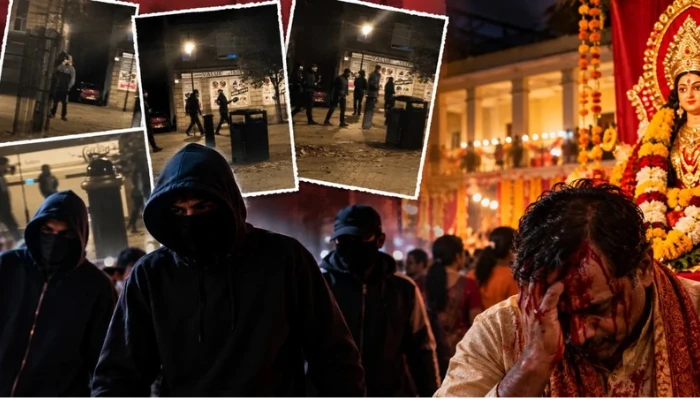
In Ossett, West Yorkshire, United Kingdom, Hindu devotees celebrating Dussehra (festival dedicated to Lord Ram) and Bathukamma (floral festival celebrated in devotion to Goddess Gauri) were targeted and attacked by groups of masked individuals. The attackers disrupted the religious gathering, intimidated organisers and brutally assaulted two devotees, leaving both injured and bleeding. On 17 October 2026, Hindu families, including women and children, gathered at Ossett Town Hall to celebrate the festivals. The event was proceeding as planned until groups of masked individuals began intimidating people outside the venue. At around 8:30 pm, an organiser stepped outside the hall and encountered several individuals wearing balaclavas. They questioned him about the event, the number of attendees and whether children and young people were present. In a separate incident, a volunteer carrying a box outside to collect plates was approached by three individuals riding electric bikes. They questioned him about the contents of the box and attempted to attack him before leaving. The situation escalated when two devotees went to collect their car. They had been warned about the situation outside and advised against leaving with their families at that time. They encountered a group of approximately 10 people, believed to be between 16 and 20 years old. One person shouted at them and demanded to know what they were doing at the venue. The group then attacked them. One devotee was struck in the face and the other on the head. Both fell to the ground bleeding. Meanwhile, another group of approximately 15 to 20 people gathered outside the hall. Some rode bikes, while others attempted to enter the venue and provoked security staff. The organisers contacted the police, and stewards and volunteers remained at the venue while waiting for officers. Several further calls were made over the following hour. Two police officers arrived approximately an hour later and took statements from the injured devotees. Two community officers subsequently arrived and escorted devotees to their parked cars. The organisers later urged West Yorkshire Police to investigate the attacks as a hate crime. They requested crime reference numbers, formal statements from the injured devotees and witnesses, and the preservation of CCTV footage from Ossett Town Hall and nearby streets. They also called on the local council and venue management to formally record the incident and review security arrangements for future events. The Hinduphobia Tracker had previously documented an incident in Harrow, London, on 3 March 2026, in which Hindu families, including women and children, were attacked while peacefully celebrating Holi. The attackers disrupted a legally authorised Holika Dahan celebration, overturned sound-system equipment and returned with additional men to attack the devotees. Leicester witnessed a wider outbreak of unrest in August and September 2022, amid tensions between sections of the Hindu and Muslim communities. During this period, reports emerged of a Hindu household celebrating Ganesh Chaturthi being pelted with eggs, attacks on individuals, and the tearing down and burning of flags outside Hindu temples. Masked groups were also involved in street violence, vandalism and clashes with police. The wider unrest resulted in 47 arrests and injuries to 25 police officers. While violence and provocations were reported on both sides, Hindu religious celebrations and symbols were among the reported targets, with social media contributing to the escalation of tensions. The incident in Ossett reflected a similar pattern of Hindu religious gatherings being disrupted by intimidation and violence, leaving devotees injured and raising serious concerns about the safety of Hindus celebrating their religious festivals in the United Kingdom.
Why it is Hate Crime ?
The primary category selected in this case is: Attack not resulting in death. The subcategory selected is: Attack against Hindu devotees. Hindu devotees are among the easiest targets of religiously motivated hate crimes because, during the festival/procession/puja, etc., for non-Hindus, it is easy to profile their victims based on religion. Hindu devotees come under attack on several occasions by individual non-Hindus or mobs of non-Hindus owing to their animosity against Hinduism, its symbols and tradition/practices. There are several instances of Hindu devotees being attacked while they worship in temples or temporary religious structures, during religious processions, doing bhajan/kirtan/puja in their own homes, in the residential society, etc. These attacks are perpetrated by non-Hindus primarily because of their animosity towards Hindus and their faith. In some cases, the trigger for the violence may be non-religious; however, two elements make these hate crimes. First, the Hindus who come under attack are attacked violently while indulging in religious activity. Whether they are in a place of worship or not is immaterial to the crime. When individuals are attacked while indulging in religious practices, the attack in itself is a hindrance to their freedom to practice religion and therefore constitutes a hate crime. Secondly, religious supremacist doctrines and ideologies deem religious practices of Hindus to be offensive ab initio since they are considered “sinful” by these ideologies, worthy of being annihilated by force or coercion. Driven by these religious supremacist ideologies and doctrines, the attacks against Hindu devotees stem from intrinsic animosity towards Hinduism. In some cases, the trigger for the violence may be non-religious; however, it develops into a religiously motivated crime during the course of the violence. Since these attacks stem from animosity towards Hindus and Hinduism, they are considered religiously motivated hate crimes under this category. The other subcategory selected is: Attack for Hindu identity. In several cases, Hindus are attacked merely for their Hindu identity without any perceived provocation. A classic example of this category of religiously motivated hate crime is a murder in 2016. 7 ISIS terrorists were convicted for shooting a school principal in Kanpur because they got ‘triggered’ seeing the Kalava on his wrist and the tilak that he had put. In this case, the Hindu victim had offered no provocation except for his Hindu religious identity. The motivation for the murder was purely religious, driven by religious supremacy. Such cases where Hindus are targeted merely for their religious identity would be documented as a hate crime under this category. This incident was added to the Hinduphobia Tracker because Hindu devotees were intimidated and brutally assaulted while peacefully celebrating Dussehra and Bathukamma in Ossett, West Yorkshire. The devotees had gathered to observe their religious and cultural traditions without causing any nuisance or disturbing anyone. The attack was meant to disrupt Hindus from practising their faith freely and safely. It reflected hostility towards a Hindu gathering and targeted devotees exercising their religious and cultural freedoms. This incident was added to the Hinduphobia Tracker because Hindu devotees were intimidated and brutally assaulted while peacefully celebrating Dussehra and Bathukamma in Ossett, West Yorkshire. The devotees had gathered to observe their religious and cultural traditions without causing any nuisance or disturbing anyone. The attack was meant to disrupt Hindus from practising their faith freely and safely. It reflected hostility towards a Hindu gathering and targeted devotees exercising their religious and cultural freedoms. In Hinduism, the festival of Dussehra is celebrated to mark the victory of Bhagwan Shri Ram’s over Ravana; it symbolises the victory of good over evil. It represents the triumph of Dharma over Adharma. Similarly, Bathukamma is a floral festival predominantly celebrated by Telugu Hindu women, particularly in Telangana, in devotion to Goddess Gauri. Women arrange seasonal flowers into elaborate floral stacks, sing devotional and folk songs, and gather in collective celebration. Both festivals preserve Hindu religious and cultural traditions and bring communities together through shared devotion. Therefore, attacking devotees during these celebrations disrupted not merely a public gathering but the peaceful observance of Hindu religious and cultural practices. Furthermore, the devotees were not engaging in conduct that justified the intimidation or violence directed at them. They were participating in a religious celebration, yet they were confronted and assaulted while attending the event. The attack was directed at a Hindu gathering and served to intimidate Hindus for assembling to celebrate their festivals. Such violence obstructs the community’s ability to practise its faith openly and safely, turning an occasion of devotion and collective celebration into one of fear and insecurity. Moreover, the consequences extended beyond the two devotees who were injured. The gathering included women and children, exposing families to intimidation and physical danger during a religious event. When Hindu devotees face violence while celebrating their festivals, the wider community is also threatened. Such attacks create fear, discourage participation in future celebrations and pressure Hindu communities to reconsider public religious observances for their safety. In this way, the violence undermines the ability of Hindus to preserve their traditions and participate in collective religious life without fear. The incident also recalled the attack on Hindu families celebrating Holi in Harrow, London, previously documented by the Hinduphobia Tracker. In that case, the attackers disrupted the religious celebration and assaulted devotees. Similarly, the violence in Ossett interfered with a peaceful Hindu festival and endangered the devotees gathered there. These incidents highlight the threat posed when Hindu religious gatherings become targets of intimidation and violence in the United Kingdom. The incident was therefore included in the Hinduphobia Tracker because Hindu devotees were attacked while peacefully celebrating their religious festivals, without causing any nuisance or disturbing others. It exposes a recurring pattern in which Hindus are attacked for celebrating their festivals and practising their faith openly. Whether it is Dussehra, Bathukamma, Holi or another Hindu festival, such attacks disrupt religious celebrations, intimidate devotees and threaten the community’s freedom to observe its traditions. The repeated targeting of Hindu festivals reflects a hostility that seeks to prevent Hindus from celebrating their faith freely and safely. Such violence cannot be dismissed as an ordinary disturbance at a public venue. It threatens the ability of Hindu communities to preserve their religious traditions, gather in devotion and express their identity without fear. Disclaimer: In this case, the total number of perpetrators has not been specified. The available accounts stated that 15–20 masked people were involved in the disturbance. Henceforth, the perpetrator count has been recorded with the highest number, as twenty (20). This is recorded for documentation purposes only, as it represents an estimate based on the available accounts.
Victim Details
Total Victim
2
Deceased
0
Gender
- Male 2
- Female 0
- Third Gender 0
- Unknown 0
Caste
- SC/ST 0
- OBC 0
- General 0
- Unknown 2
Age Group
- Minor 0
- Adult 0
- Senior Citizen 0
- Unknown 2


Case Status
Unknown


Perpetrators Details
Perpetrators
Unknown
Perpetrators Range
From 10 to 100
Perpetrators Gender
male
 Sources



