Sacred Hindu space violated as Muslim youth poses as Hindu and wears tilak to enter garba event in Palghar, Maharashtra
 Palghar, Maharashtra, India
 14 October, 2026
Case Summary
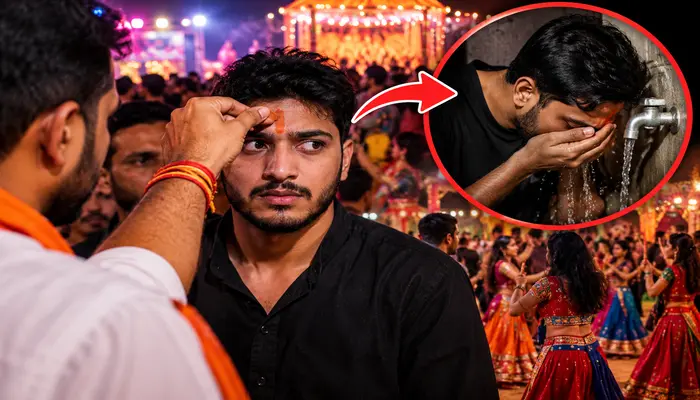
On 15 October 2026, a Muslim youth named Shoaib posed as Hindu, wearing tilak on his forehead, and entered a Garba event in Oswal Nagar, Nalasopara East, in Palghar district, Maharashtra. According to reports, members of Hindu organisations had been applying tilaks to the foreheads of men attending the Garba event in Oswal Nagar as a means of checking their identities. During this time, a Muslim youth entered the Garba event while activists from Hindu organisations applied a tilak to the young man's forehead. The Muslim youth subsequently left the crowd and attempted to wash off the tilak, prompting the activists to become suspicious and question him. When asked his name, he identified himself as Shoaib, after which the activists escorted him out of the venue. No police complaint had been filed regarding the incident, and the matter had not been brought to the police's attention at the time of reporting this incident.
Why it is Hate Crime ?
This case has been added to the tracker under the primary category of - Attack on Hindu religious representation. Within it, the sub-category selected here is - Defiling religious customs. Sanatan Dharma is not a religion of one book, which is to say that while it has religious scriptures that form the central tenets of the faith, there are several traditions followed through thousands of years, mostly passed from generation to generation orally. There are several such customs and traditions that are followed by various Hindus and Hindu sects. Defiling of these traditions and customs is a breach of an individual or group’s religious practices. Such practices can range from dietary restrictions like not eating non-vegetarian food for a certain period of the year, not eating non-vegetarian food at all, not eating beef since the cow is considered holy in Hinduism, the sanctity of religious customs followed in the house (like many ISCKON devotees), etc. Any malicious action leading to the breach of such traditions or defilement of these traditions owing to animosity towards the faith or for the sake of activism stems not only from the lack of faith in the religion itself but also from disregard for the faith of the devotees who follow the customs/traditions and implicit bias against the faith, the tradition itself. Since these specific traditions are central to the faith of the devotees of that specific sect of Hindus, any non-compliance with these traditional rules would be considered a religiously motivated hate crime. The other sub-category selected here is - Breaking rules of places of worship. Sanatan Dharma is not a religion of one book, which is to say that while it has religious scriptures that form the central tenets of the faith, there are several traditions followed through thousands of years, mostly passed from generation to generation orally. One of these oral traditions or written traditions is the rules of specific temples. Certain temples have rules which are traditional rules, dependent on the worship of the presiding deities. These rules and traditions have been followed for thousands of years whether they find scriptural mention or not. Such traditions are based on the nature and rules of worship of the presiding deity of that temple. Any non-compliance of these traditions owing to animosity towards the faith or for the sake of activism stems not only from the lack of faith in the presiding deity but also disregard for the faith of the devotees of that deity/temple and implicit bias against the faith, the tradition and the deity itself. Since these specific traditions are central to the faith of the devotees of that specific temple and presiding deity, any non-compliance with these traditional rules would be considered a religiously motivated hate crime. Sanatan Dharma is not a religion of one book, which is to say that while it has religious scriptures that form the central tenets of the faith, there are several traditions followed through thousands of years, mostly passed from generation to generation orally. One of these oral traditions or written traditions is the rules of specific temples. Certain temples have rules which are traditional rules, dependent on the worship of the presiding deities. These rules and traditions have been followed for thousands of years whether they find scriptural mention or not. Such traditions are based on the nature and rules of worship of the presiding deity of that temple. Any non-compliance of these traditions owing to animosity towards the faith or for the sake of activism stems not only from the lack of faith in the presiding deity but also disregard for the faith of the devotees of that deity/temple and implicit bias against the faith, the tradition and the deity itself. Since these specific traditions are central to the faith of the devotees of that specific temple and presiding deity, any non-compliance with these traditional rules would be considered a religiously motivated hate crime. This case was included in the Hinduphobia Tracker because it involved the deliberate concealment of religious identity to gain entry into a Hindu religious and cultural gathering during Navratri. Garba during Navratri is not merely a form of recreational dance but a religious and cultural tradition closely associated with the worship of Goddess Durga. The nine nights of Navratri are dedicated to the Goddess and her various forms, with devotees participating in prayers, devotional songs, rituals and Garba as expressions of their faith. These gatherings provide Hindus with an opportunity to collectively observe their religious traditions, reaffirm their religious identity and pass their customs on to future generations. A Garba pandal organised during Navratri therefore serves a purpose beyond ordinary entertainment, as it provides a space in which Hindu religious and cultural practices are observed and celebrated. The deliberate misrepresentation of religious identity to gain entry into the gathering demonstrated disregard for the religious customs and arrangements maintained by the Hindu community. Religious gatherings organised during Navratri provide Hindus with a space to observe their traditions and practise their faith according to established customs. By concealing his religious identity to gain entry, Shoaib circumvented the arrangements governing participation in the event and undermined the trust on which they depended. The significance of the act lay not in the presence of a Muslim individual at a Hindu religious gathering, but in the deliberate use of a false religious identity to obtain entry into a venue organised for the observance of Hindu religious and cultural traditions. The significance of the deception was further evident in Shoaib's conduct after the tilak was applied to his forehead. The tilak holds an important place in Hindu religious tradition, symbolising devotion, spiritual auspiciousness and reverence for the divine. It is commonly worn during religious ceremonies, festivals and acts of worship as an expression of faith and religious identity. Shoaib's immediate attempt to wash off the tilak indicated that accepting it was a means of maintaining his assumed Hindu identity to gain entry into the Garba event, rather than an expression of reverence for the religious tradition it represented. His conduct therefore reinforced the distinction between outwardly adopting a Hindu religious marker to facilitate entry and genuinely participating in the religious observance. The circumstances also required a distinction between attendance at a Hindu religious gathering and deliberate deception to gain access to it. Hindu religious and cultural traditions may be shared and appreciated by people from different backgrounds. People from different religious backgrounds may attend or appreciate Hindu religious and cultural celebrations, but they must respect the sanctity of these gatherings and the traditions observed by the Hindu community. Deliberately concealing one's religious identity to gain entry through deception violates the trust of the organisers and disregards the customs governing the gathering. A Hindu religious event is not merely a social venue but a space where devotees observe their faith and uphold their religious traditions. Any participation in such a gathering must therefore be accompanied by respect for its religious significance and the community's customs. The incident was relevant to the Hinduphobia Tracker because it involved the deliberate concealment of religious identity to gain entry into a Hindu religious gathering during Navratri. Shoaib's use of a false religious identity and his immediate removal of the tilak demonstrated that he had used the religious marker as a means of gaining entry rather than as an expression of devotion. Therefore, this case was added to the hate crime database.


Case Status
Complaint not filed


Perpetrators Details
Perpetrators
Muslim Extremists
Perpetrators Range
One Person
Perpetrators Gender
male
 Sources



