Goddess Durga idol desecrated over personal dispute amid sacred Navratri celebrations in Jaunpur, Uttar Pradesh
 Jaunpur, Uttar Pradesh, India
 17 October, 2026
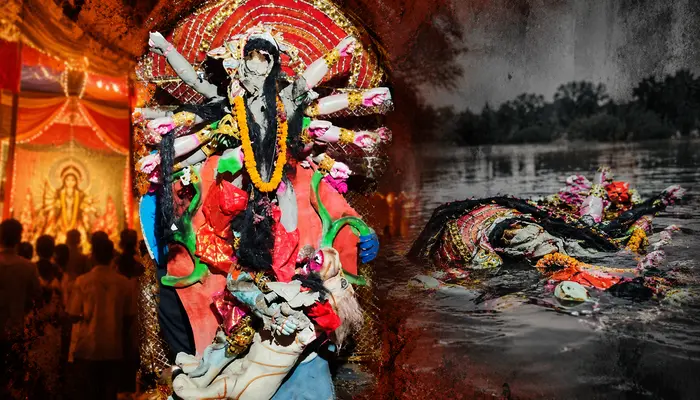
Case Summary
In Ataraura village, under Sarai Khwaja Police Station in Jaunpur district, Uttar Pradesh, people desecrated an idol of Goddess Durga during the sacred period of Navratri, on its seventh day. The idol was immersed in a nearby canal that same night without the customary sacred fire rituals (havan) and worship (puja), disrupting the deity's religious observances and angering residents. Sanjeet Kumar Gautam, son of the late Vijay Raj and a resident of Ataraura village in the Siddikpur area of Jaunpur, installed the idol of Goddess Durga at his home after his sister fulfilled her religious vow (mannat). After the installation, family members had been performing worship and religious observances there. At approximately 9 pm on 18 October 2026, Ravi Gautam, son of Ram Sagar Gautam, arrived at the pandal while under the influence of alcohol. A dispute involving children led to Ravi being reprimanded and slapped by his family members after he began abusing people at the pandal. Despite their attempts to calm him down, Ravi damaged the idol of Goddess Durga. After the idol was damaged, news of the incident spread throughout the village, creating tension and anger among the residents. Villagers gathered at the scene and assaulted Ravi in response to the incident. As concerns grew that the dispute might escalate further, residents contacted the Dial 112 police emergency response service. After the emergency call, a Dial 112 response team and police personnel from Sarai Khwaja Police Station, including Station House Officer Rajesh Kumar Singh, arrived at the scene. The police assessed the situation and intervened to calm the agitated residents. Fearing further confrontation and a deterioration in law and order, the authorities arranged to immerse the damaged idol in a nearby canal later that night, without the customary havan and puja. Locals also debated the decision to carry out the immersion without these religious rituals. The police appealed to the residents to maintain peace and took measures to prevent further escalation. Police personnel were deployed in the village to maintain law and order and monitor the situation. According to Sanjeet Kumar Gautam, the police took Ravi’s family members to the police station. Sanjeet also said the police assured him they would take appropriate action. Ravi’s family members further stated that he frequently engaged in physical altercations. Station House Officer Rajesh Kumar Singh explained that the immersion had been arranged because of concerns that the dispute might escalate and confirmed that the police had brought the situation under control and taken the necessary steps to maintain peace.
Why it is Hate Crime ?
The primary category selected in this case is: Attack on Hindu religious representations. Within this, the subcategory selected is: Desecration of Hindu religious symbol. Icons and symbols or a religious representation of a spiritual ideal are widely revered in Hinduism. Iconography is of vital significance in the Hindu milieu. It helps connect people’s spiritual beliefs with the real world. Iconography within the Hindu faith takes several shapes and forms. Murtis are of most significance to Hindus, to which daily rituals, prayers and offerings are done. Besides the murtis, there are several other symbols which have deep significance in the Hindu faith – the Om and Swastika for example. Since these Hindu religious symbols hold paramount importance in Hinduism, any desecration of symbols, icons, murtis, religious representations and manifestations, is driven by animosity towards the faith itself which manifests itself through these murtis, icons and symbols. Therefore, any desecration of these Hindu religious symbols and representations is considered religiously motivated hate crimes under this category. This incident constituted a religiously motivated hate crime because the perpetrator specifically targeted a sacred Hindu deity and the religious practices surrounding its worship during the sacred period of Navratri. The perpetrator desecrated the Goddess Durga idol and immersed the damaged idol in a nearby canal without sacred fire rituals or worship. These acts went beyond ordinary misconduct or property damage and constituted an assault on the religious identity, dignity and spiritual practices of the Hindu community. Navratri is one of the most significant Hindu festivals, dedicated to the worship of Goddess Durga and her divine forms, symbolising the triumph of good over evil. The festival holds profound spiritual and religious significance for Hindus, with sacred idols serving as focal points of worship, devotion and religious observance. Installing and worshipping Goddess Durga’s idol during this auspicious period reflects devotees’ faith and reverence for the deity. In Hinduism, idols serve as sacred representations of deities and give devotees a tangible focus for worship, through which they offer prayers, perform rituals, and express devotion. They are consecrated, worshipped and incorporated into the ritual life of temples and religious ceremonies. Deliberate damage to or desecration of an idol therefore constitutes an attack on a religious symbol that holds profound significance for Hindu devotees. The damage inflicted on the idol of Goddess Durga constituted a direct act of disrespect towards a sacred representation of Hindu faith, installed for worship after the fulfilment of a family member’s religious vow. An idol of a revered Hindu deity is not an ordinary object that can be damaged in a moment of anger and then dismissed as a personal dispute. It holds profound spiritual significance for devotees, representing their devotion, faith, and connection with the divine. Whatever disagreement, provocation, or anger may have preceded the incident, none of it could justify destroying a sacred object of worship. Goddess Durga’s sacred idol was desecrated during Navratri, a holy period dedicated to her worship and veneration, in a grave act of disrespect towards Hindu faith and religious sentiments. The act therefore represented a serious violation of the religious sanctity associated with the deity and the right of Hindu devotees to practise their faith with dignity. Anger, personal disputes, and family disagreements cannot serve as excuses for violating Hindu religious sentiments or treating a revered deity’s idol with contempt. Such conduct demands serious scrutiny and appropriate legal accountability, so that the sanctity of Hindu worship is respected and acts of desecration are not trivialised as ordinary misconduct. The subsequent immersion of the damaged idol in a nearby canal without the customary havan (sacred fire ritual) and puja (worship) further intensified the religious distress caused by the incident. In Hindu tradition, the worship and eventual immersion (visarjan) of a deity’s idol are meaningful religious observances, often accompanied by prayers, rituals and acts of devotion. In this case, the family installed the idol after a family member fulfilled a religious vow, making its worship particularly significant to the family. Its immersion without the customary rituals, after its desecration during Navratri, deprived devotees of the opportunity to conclude their religious observances as intended. The matter therefore extended beyond physical damage to a sacred object: it involved desecrating a revered representation of Goddess Durga and disrupting Hindu religious practices during an auspicious period. For Hindus, the circumstances surrounding both the damage and the subsequent immersion compounded the sense of disrespect towards their faith and the sanctity of their worship. Collectively, the desecration of the Goddess Durga idol during Navratri and its subsequent immersion without customary religious rituals reflected a serious violation of Hindu religious sentiments and the sanctity of Hindu worship. It underscores the perpetrator's deep-rooted disregard towards Hinduism. The incident disrupted the devotees’ religious observances and undermined the dignity associated with their sacred traditions. Given that the fundamental motivation behind this incident is contempt for the Hindu religion, we have added this instance to the tracker under the following category.


Case Status
Complaint filed


Perpetrators Details
Perpetrators
Others
Perpetrators Range
One Person
Perpetrators Gender
male
 Sources



