Revered Hindu epic mocked as provocative Bollywood song played during Ramleela enactment in Bulandshahr, Uttar Pradesh
 Bulandshahr, Uttar Pradesh, India
 17 October, 2026
Case Summary
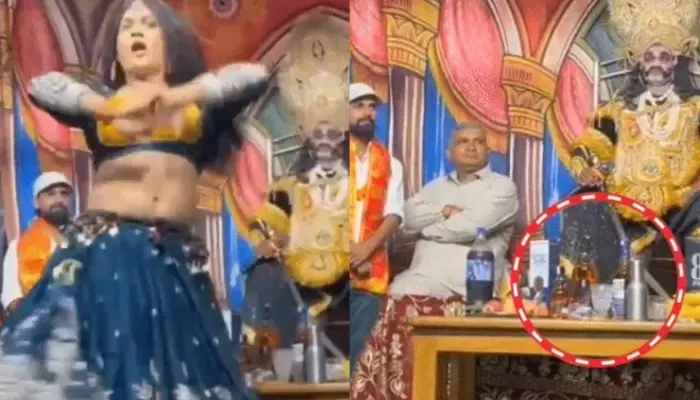
A Ramlila performance in Amarpur village, under the jurisdiction of Khanpur police station in Bulandshahr, Uttar Pradesh, came under scrutiny after a video circulated on social media showing a woman performer dancing during the religious event, with bottles of alcohol displayed on a table in front of the actor portraying Ravana and other members of his court. The video showed a dance performance to the song “Rana Ji, Humein Maaf Karna, Galti Mhaare Se Ho Gayi” from the Bollywood movie Karan Arjun. The scenes raised questions about the decorum and sanctity maintained during Ramlila, a traditional enactment of the Ramayana that holds deep religious and cultural significance for Hindus. After the video circulated, CO Siyana Ramkaran Singh took cognisance of the matter and directed Khanpur police to investigate and take appropriate action. Police said they would take action against those found responsible after the investigation. A separate controversy emerged over a Ramlila performance in the Gandhi Colony area of Muzaffarnagar, where a video showed the actor playing Shurpanakha offering a red rose to the actor portraying Lakshman and expressing romantic feelings in a Bollywood-style performance to the song “ILU”. The staging drew criticism for mocking a traditional Ramayana episode. These incidents prompted broader objections to incorporating Bollywood songs and performances into Ramlila enactments. BJP MLA Amit Agarwal, representing Meerut Cantt, called for a mechanism similar to a film censor board to regulate such performances and preserve the dignity of religious events. Mukesh Agarwal, district president of the Edible Oil and Oilseeds Association, and Anil Jain, president of the Sadar Sarafa Vyapar Sangh, also demanded government action against organisers whose programmes portrayed Lord Ram’s Leela and Sanatan culture in an objectionable manner.
Why it is Hate Crime ?
This incident has been added under the category Hate speech against Hindus, and within this the subcategory selected is- Anti-Hindu slurs, mocking faith. Anti-Hindu slurs and the deliberate mocking of the Hindu faith owing to religious animosity involve the usage of derogatory terms, stereotypes, or offensive references to religious practices, symbols, or figures. One of the common anti-Hindu slurs used against Hindus is “cow-worshipper” and “cow piss drinker”. The intention of using this term is to demean and mock Hindus as a group and their religious beliefs since Hindus consider the cow holy. Additionally, some symbols and the slurs attached to them have a historical context that exacerbates the insult, hate, stereotyping, dehumanisation and oppression against Hindus. Cow worship has been used for centuries to denigrate Hindus, insult their faith and oppress Hindus specifically as a religious group. There has been overwhelming documentation about how cow slaughter has been used to persecute Hindus with cow meat being thrown in temples and places of worship. There has also been overwhelming documentation where cow meat (beef) has been force-fed to Hindus to either forcefully convert them to Islam or denigrate their faith. Apart from cow worship, the Swastika – which holds deep religious significance for the Hindus – has also been misinterpreted and distorted to use as a slur against Hindus. Similarly, the worship of the Shivling has been used by supremacist ideologies and religions to denigrate Hindus owing to religious animosity. Such slurs and denigration stem out of inherent animosity and hate towards Hindus and their faith, therefore, it is categorised as hate speech targeted at Hindus specifically owing to their religious identity. The other subcategory is- Attack on Hindu religious representations. Within this, the subcategory selected is- Defiling religious customs. Sanatan Dharma is not a religion of one book, which is to say that while it has religious scriptures that form the central tenets of the faith, there are several traditions followed through thousands of years, mostly passed from generation to generation orally. There are several such customs and traditions that are followed by various Hindus and Hindu sects. Defiling of these traditions and customs is a breach of an individual or group’s religious practices. Such practices can range from dietary restrictions like not eating non-vegetarian food for a certain period of the year, not eating non-vegetarian food at all, not eating beef since the cow is considered holy in Hinduism, the sanctity of religious customs followed in the house (like many ISCKON devotees), etc. Any malicious action leading to the breach of such traditions or defilement of these traditions owing to animosity towards the faith or for the sake of activism stems not only from the lack of faith in the religion itself but also from disregard for the faith of the devotees who follow the customs/traditions and implicit bias against the faith, the tradition itself. Since these specific traditions are central to the faith of the devotees of that specific sect of Hindus, any non-compliance with these traditional rules would be considered a religiously motivated hate crime. This case has been included in the Hinduphobia Tracker because the performance involved the use of a Bollywood song, dance and the display of liquor bottles during a Ramlila enactment of the Ramayana, a revered Hindu religious epic. Ramlila is not merely a theatrical performance but an important Hindu religious and cultural tradition that brings to life episodes from the life of Lord Ram and the triumph of dharma over adharma. Turning Ravana’s court into a setting for filmi entertainment, with alcohol displayed as part of the performance, reduces a sacred Hindu narrative to a spectacle that disregards the faith and sentiments of Hindu devotees. Knowingly turning a revered Hindu religious enactment into a spectacle that mocks its sanctity is not harmless entertainment; it is an affront to Hindu religious identity and the traditions Hindus hold sacred. Such acts highlight a deeper trend of disdain toward Hinduism, often framed as creative expression but rooted in deliberate animosity towards Hindus and their faith. Though the backlash resulted in the organisers apologising, the intent behind the action could only possibly be that of provoking Hindus and showing disrespect towards their faith. Since such callous behaviour can only stem from a profound contempt for the Hindu religion, this case deserves to be recorded in this hate tracker.


Case Status
Complaint filed


Perpetrators Details
Perpetrators
Unknown
Perpetrators Range
Unknown
Perpetrators Gender
unknown
 Sources



