Sacred Navratri pandal desecrated; Maa Durga, Maa Lakshmi and Lord Ganesha idols vandalised in Ambedkarnagar, Uttar Pradesh
 Ambedkar Nagar, Uttar Pradesh, India
 17 October, 2026
Case Summary
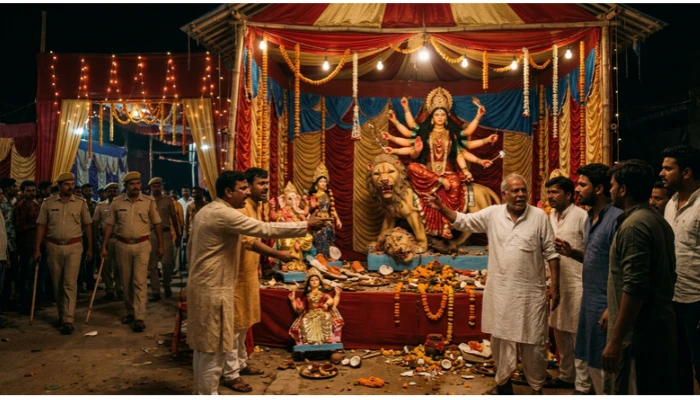
At the Gharwaspur intersection in the Bhiti police station area of Ambedkar Nagar, Uttar Pradesh, an unknown group from a neighbouring village vandalised a Durga Puja pandal, damaging the hand of Goddess Durga's idol and breaking and throwing down the idols of Goddess Lakshmi and Lord Ganesha. When Hindu puja committee members protested the desecration, they were assaulted, leaving several people injured. The incident occurred late on Sunday night (18 October 2026) during a Jagran programme organised as part of Durga Puja at Gharwaspur intersection. A dispute broke out during the programme, following which a large number of people from a neighbouring village arrived at the pandal and vandalised it. The perpetrators damaged one of Goddess Durga's hands and broke and threw down the idols of Goddess Lakshmi and Lord Ganesha. When members of the puja committee protested the vandalism, the perpetrators assaulted them, injuring several people. The incident created tension in the area. Upon receiving information, police arrived at the scene and brought the situation under control. Police arrested three people in connection with the incident and took them to the police station. The Bhiti Station House Officer said a police team reached the scene after receiving information about the fight and took the three people to the police station. Police were investigating the matter and said they had restored peace and order at the scene.
Why it is Hate Crime ?
This case has been added to the tracker under the primary category of Attack on Hindu religious representations. Within it, the sub-category selected here is: Violence against religious structures or centres. In Hinduism, a religious structure is also considered divine. Hindus believe that not just the Deity but the religious structure itself is sacred. In this sub-category, we would document attacks against religious structures that are not consecrated temple spaces. Such religious spaces could be temporary in nature – for example – the religious spaces erected specifically for festivals like Durga Puja, etc. This category would also document cases of attacks against religious centres. These spaces in their own right may not be ‘sacred’ per se; however, they are often spaces where religious gurus live, religious teaching is imparted, or they belong to religious institutions. Any attack against religious structures is a result of animosity towards the religion itself, which manifests itself through the religious spaces; therefore, such attacks are considered religiously motivated hate crimes. Religious centres are also manifestations of the religion, its teachings or gurus and therefore, attacks against such centres would be considered religiously motivated hate crimes. The other sub-category selected here is - Desecration of Hindu religious symbols. Icons and symbols, or religious representations of a spiritual ideal, are widely revered in Hinduism. Iconography is of vital significance in the Hindu milieu. It helps connect people’s spiritual beliefs with the real world. Iconography within the Hindu faith takes several shapes and forms. Murtis are of most significance to Hindus, to which daily rituals, prayers and offerings are done. Besides the murtis, there are several other symbols which have deep significance in the Hindu faith – the Om and Swastika, for example. Since these Hindu religious symbols hold paramount importance in Hinduism, any desecration of symbols, icons, murtis, religious representations and manifestations is driven by animosity towards the faith itself, which manifests itself through these murtis, icons and symbols. Therefore, any desecration of these Hindu religious symbols and representations is considered religiously motivated hate crimes under this category. The other primary category selected here is - Attack not resulting in death. Within it, the sub-category selected here is - Attack against Hindu devotees. Hindu devotees are a few of the easiest targets of religiously motivated hate crimes because during the festival/procession/puja, etc., for non-Hindus it is easy to profile their victims based on religion. Hindu devotees come under attack on several occasions by individual non-Hindus or mobs of non-Hindus owing to their animosity against Hinduism, its symbols and tradition/practices. There are several instances of Hindu devotees being attacked while they worship in temples or temporary religious structures, during religious processions, doing bhajan/kirtan/puja in their own homes, in the residential society, etc. These attacks are perpetrated by non-Hindus primarily because of their animosity towards Hindus and their faith. In some cases, the trigger for the violence may be non-religious; however, two elements make these hate crimes. First, the Hindus who come under attack are attacked violently while indulging in religious activity. Whether they are in a place of worship or not is immaterial to the crime. When individuals are attacked while indulging in religious practices, the attack in itself is a hindrance to their freedom to practice religion and therefore constitutes a hate crime. Secondly, religious supremacist doctrines and ideologies deem religious practices of Hindus to be offensive ab initio since they are considered “sinful” by these ideologies, worthy of being annihilated by force or coercion. Driven by these religious supremacist ideologies and doctrines, the attacks against Hindu devotees stem from intrinsic animosity towards Hinduism. In some cases, the trigger for the violence may be non-religious; however, it develops into a religiously motivated crime during the course of the violence. Since these attacks stem from animosity towards Hindus and Hinduism, they are considered religiously motivated hate crimes under this category. This incident constituted a religiously motivated attack because it targeted a Hindu religious gathering, desecrated sacred representations of Hindu deities and involved violence against Hindus who protested the destruction. The attack went beyond a dispute during a religious programme: it violated a space dedicated to Hindu worship and struck at the religious symbols through which devotees expressed their faith. In Hinduism, a Durga Puja pandal is not merely a temporary structure but a space dedicated to worshipping Goddess Durga and observing sacred rituals. Durga Puja celebrates the Goddess's victory over Mahishasura, symbolising the triumph of righteousness over evil. The pandal serves as a place where devotees gather for prayers, offerings and collective worship. Vandalising it therefore disrupted a Hindu religious observance and desecrated a space established specifically for the community to practise its faith. The murtis of Goddess Durga, Goddess Lakshmi and Lord Ganesha are sacred representations central to Hindu worship. Damaging these murtis strikes at the sanctity of the religious gathering and disrupts the worship for which the pandal was established. The destruction of sacred Hindu representations cannot be justified as an extension of a personal dispute. Even if the disagreement that preceded the incident was personal, it did not justify damaging the idol of Goddess Durga or breaking and throwing down the idols of Goddess Lakshmi and Lord Ganesha. Any disagreement could have been resolved through lawful means. Instead, the destruction was accompanied by violence against the Hindu puja committee members who protested, further affecting the community’s ability to conduct its religious observance peacefully. The incident therefore went beyond a dispute between individuals. The desecration of sacred murtis during a Hindu religious gathering, followed by violence against those who opposed it, violated the sanctity of a space dedicated to worship and affected Hindu devotees’ right to practise their faith without intimidation. Furthermore, the perpetrators assaulted members of the puja committee when they protested the desecration. This extended the attack from the religious space and sacred idols to the Hindus defending them. The committee members were subjected to violence while seeking to protect a place of worship and the deities' representations. The escalation from a dispute during the Jagran programme to the destruction of sacred idols and assaults on committee members demonstrated the severity of the attack on the community's religious observance. Taken together, the vandalism of the Durga Puja pandal, desecration of the idols of Goddess Durga, Goddess Lakshmi and Lord Ganesha, and assault on Hindu committee members who protested the destruction demonstrated hostility directed at a Hindu religious gathering and its sacred representations. The incident violated a space dedicated to Hindu worship, desecrated objects central to Hindu devotion and subjected Hindus defending their religious observance to physical violence. It is important to mention here that, though the last update was that the miscreants were unknown, regardless, the action stemmed from hatred against Hinduism and resulted in the desecration of the sacred pandal and idols and would therefore be considered a religiously motivated hate crime. Disclaimer: Although reports stated that a group of people vandalised the Durga Puja pandal, three individuals were arrested in connection with the incident. Accordingly, the Tracker recorded three (3) perpetrators based on the available information about arrests. This figure does not represent the total number of people involved in the vandalism.


Case Status
Arrested


Perpetrators Details
Perpetrators
Unknown
Perpetrators Range
From 2 To 5
Perpetrators Gender
male
 Sources



