Minor Hindu student forced to conceal sacred Tulsi mala worn while fasting during Kulasekharanpattinam Dussehra festival by Christian headmistress
 Kanniyakumari, Tamil Nadu, India
 16 October, 2026
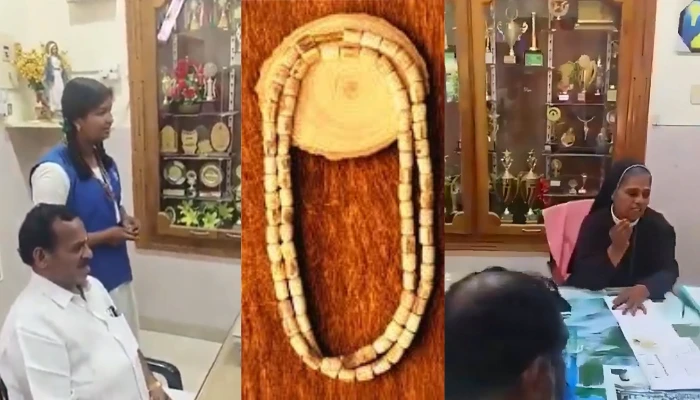
Case Summary
In Thakkalai, Kanyakumari district, a Hindu student was targeted and restricted from practising her faith by a Christian principal, Helen Karuna. She ordered the student to cut the safety cord of her sacred Dussehra Tulsi Mala and conceal it from view. The minor was observing a religious fast as part of her vow for the Kulasekharanpattinam Dasara festival when the principal instructed her to remove the mala or return to school without it. The victim was a Class 10 student at Amala Convent Private Girls School in Thakkalai, Kanyakumari district. On the day of the incident, the victim attended school wearing the mala as usual. The accused called her to her room and told her to cut the safety cord and hide the garland so others could not see it. She also directed the victim to remove the mala and return only after taking it off. Following the incident, the victim’s family and Hindu organisations gathered at the school to protest against the principal’s actions. The Thakkalai police intervened and held discussions with those present. Arumugam, the Kanyakumari district leader of the Hindu Munnani(organisation), stated that the victim had lost her mother and had a younger sister. He also raised concerns about religious conversion and confirmed that he had submitted petitions to the Thakkalai Police Station, the District Collector, and the District Chief Educational Officer, seeking action against the accused for removing the Dussehra garland and harassing the student.
Why it is Hate Crime ?
The primary category selected in this case is: Restriction/ban on Hindu practices. Within this, the subcategory selected is: Restriction on expression of Hindu identity. An example of the state-affected prejudicial and targeted orders against the Hindu community would be a government denying the right of a Hindu or a group of Hindus to hold a religious procession owing to the animosity of non-Hindu groups. Denial of the religious right of Hindus to assuage the non-Hindu group, which harbours animosity to a point where it could lead to violence against Hindus, is not only a failure of law and order but is a prejudicial order against Hindus, denying them their fundamental rights to express their religious identity. An example of a hate crime against Hindus by a non-Hindu would be a non-Hindu institution forcing its Hindu employees to abandon religious symbols that a Hindu would wear as an expression of faith owing to inherent prejudice against the faith professed by the victim, or a non-Hindu group of people restricting a Hindu group from constructing a place of worship simply because the demography of the area in which the temple is being built is dominated by non-Hindus. Such actions are driven by religious animosity and/or prejudice against Hindus and their faith and would therefore be categorised as a hate crime. The other category selected is: Attack not resulting in death. Under this, the subcategory selected is: Attacked for Hindu identity. In several cases, Hindus are attacked merely for their Hindu identity without any perceived provocation. A classic example of this category of religiously motivated hate crime is a murder in 2016. 7 ISIS terrorists were convicted for shooting a school principal in Kanpur because they got ‘triggered’ seeing the Kalava on his wrist and the tilak that he had put. In this case, the Hindu victim had offered no provocation except for his Hindu religious identity. The motivation for the murder was purely religious, driven by religious supremacy. Such cases where Hindus are targeted merely for their religious identity would be documented as a hate crime under this category. This case was included in the Hinduphobia Tracker because a Christian school principal targeted a Hindu student's religious expression by ordering her to conceal or remove her sacred Dussehra Tulsi Mala, which she wore as part of a religious vow. The incident involved interference with the victim's ability to visibly practise and express her Hindu identity within an educational institution, where the principal exercised authority over her as a student. In Hinduism, a Tulsi Mala is not considered a mere accessory but a sacred object associated with devotion and religious observance. Tulsi holds religious significance in Hindu Dharma, and wearing a Tulsi Mala forms part of a devotee's spiritual discipline and religious vows. In this case, the victim wore the mala while observing a fast as part of her religious vow associated with the Kulasekharanpattinam Dasara festival. By directing the minor to cut the safety cord and conceal the mala so that others could not see it, the principal sought to hide a Hindu religious practice that the student was voluntarily observing. The instruction therefore went beyond regulating a student's appearance and directly interfered with her expression of Hindu religious identity. The principal's instruction specifically targeted the visible expression of the victim's faith. The student was not disrupting the school's functioning by wearing the mala; she was observing a religious vow. Requiring her to conceal it or return without it imposed a condition on her ability to attend school while continuing her voluntary religious practice. A Hindu child does not cease to be Hindu at the school gate, and compelling a student to hide a harmless religious marker interferes with the expression of her faith. The conduct also disregarded a sacred representation of Hindu religious observance. A sacred symbol derives its significance from the faith and religious meaning attached to it, not from its physical size or material. The instruction to cut the mala's safety cord and conceal it communicated that the school did not welcome the student's visible religious observance. When an authority figure issues such an instruction, its significance extends beyond the immediate inconvenience imposed on the child: it places her religious identity itself under restriction. The interference was particularly consequential because the mala formed part of a religious vow the victim had voluntarily undertaken. The victim's age and position as a student further intensified the power imbalance. Schoolchildren operate within an institutional hierarchy in which principals and teachers exercise disciplinary and administrative authority. A minor receiving direct instruction from a principal cannot be treated as an equal. The principal's position gave her instruction added force, placing the victim in a situation where she was expected to choose between following the demand to conceal her religious observance and continuing to wear the mala as part of her vow while attending school. Taken together, the specific targeting of the sacred mala, the demand to conceal or remove it, and the authority under which the instruction was issued established direct interference with the victim's expression of Hindu religious identity. The case was therefore relevant to the Tracker because a Hindu student was instructed to hide a religious practice she was voluntarily observing. While the documented conduct established the discriminatory impact on her religious expression, the available facts did not independently establish the principal's personal religious motive. The case's significance rests on the specific religious practice targeted and the restriction imposed on its visible expression. Here, it is important to mention that in 2022, a massive controversy erupted in Karnataka, India, which took a national form, after Muslim women insisted that they should be allowed to wear burqas and hijabs in their schools and classrooms. At that time, the argument given by several politicians, social commentators, Hindu activists, and even the judiciary was that schools have the right to enforce uniform rules, since wearing uniforms brings harmony and equality in the classroom, and therefore, schools not allowing girls to wear hijabs in the classroom is not religious discrimination, but merely an enforcement of widely accepted uniform norms. The pseudo-seculars and leftist groups may argue that a similar line of reasoning should be applied in this case. However, most uniform codes focus on standardising clothing and accessories like shoes, belts, and hair. A sacred mala does not change the uniform's appearance. This religious symbol is benign and causes no disruption or harm, raising serious concerns about the motivations behind such enforcement. Disclaimer: The Hinduphobia Tracker records incident dates based on when the victim’s ordeal or discriminatory conduct began, not when the matter was reported. In this case, we could not ascertain the exact date the interference with Hindu students’ Mala began. Therefore, 17th October 2026, the date the matter was reported, has been selected as the indicative incident date for documentation purposes.
Victim Details
Total Victim
1
Deceased
0
Gender
- Male 0
- Female 1
- Third Gender 0
- Unknown 0
Caste
- SC/ST 0
- OBC 0
- General 0
- Unknown 1
Age Group
- Minor 1
- Adult 0
- Senior Citizen 0
- Unknown 0


Case Status
Complaint filed


Perpetrators Details
Perpetrators
Christian Extremists
Perpetrators Range
One Person
Perpetrators Gender
female
 Sources



