Hindu man lured with promises of medical treatment, employment and financial benefits for religious conversion by Christian pastors
 Betul, Madhya Pradesh, India
  26 September, 2026
Case Summary
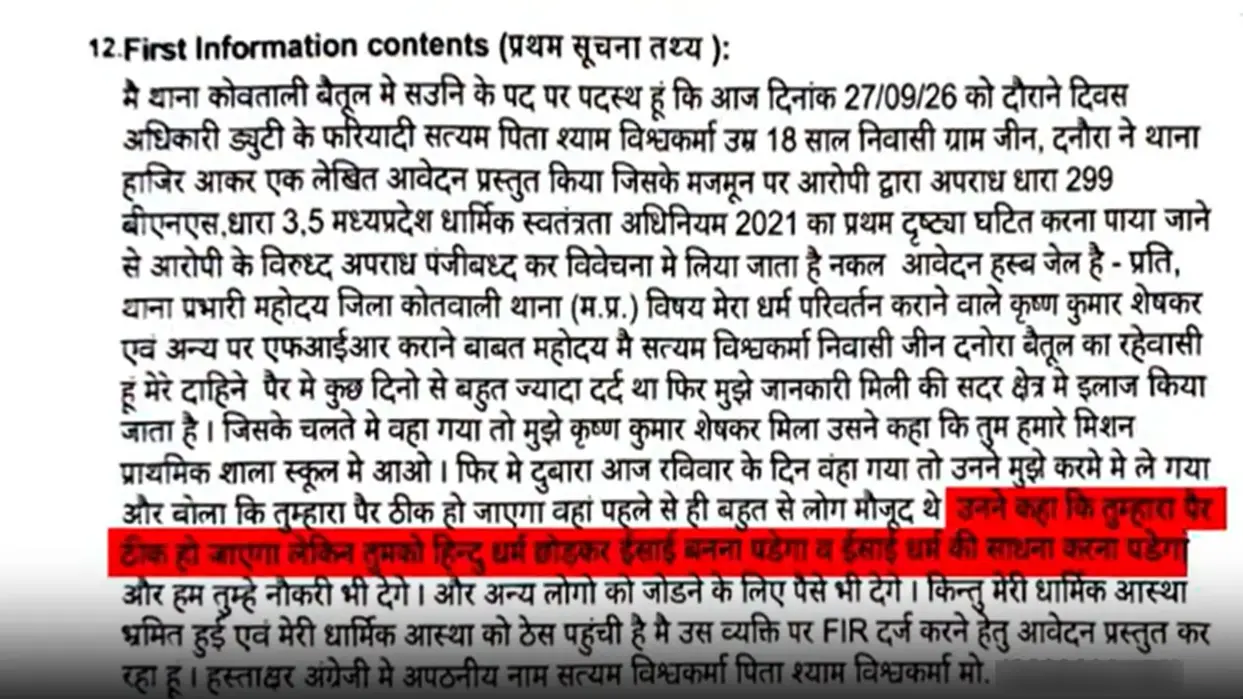
In Betul, Madhya Pradesh, a Hindu man, Satyam Vishwakarma, was offered inducements such as promises of a medical cure for his persistent leg pain, employment, and financial benefits for religious conversion by Christian pastors. He was lured to a Christian prayer gathering where he was pressured to turn away from Hindu deities and convert to Christianity. On 27 September 2026, Kotwali Police in Betul registered a case following a complaint by Satyam Vishwakarma. According to the complaint, Vishwakarma had approached Krishnakumar Sheshkar for relief from persistent leg pain and was taken to Mission Primary School in the Sadar Bazaar area, where a prayer gathering was underway. Around 250 people, mostly residents from Hindu and tribal communities, attended the gathering. Police registered the case under Section 299 of the Bharatiya Nyaya Sanhita (BNS) and Sections 3 and 5 of the Madhya Pradesh Freedom of Religion Act. Following the complaint and information from activists associated with the Rashtriya Hindu Sena and other local Hindu organisations, Kotwali Police raided the school premises and detained individuals connected with the case. The names mentioned included Pastor Raglin Immanuel and two others. Police initiated legal proceedings and continued their investigation, with further action dependent on the evidence gathered. The incident prompted protests by local Hindu organisations, including the Rashtriya Hindu Sena, whose state president, Deepak Malviya, was identified in connection with the demonstrations. Activists gathered at the police station, chanted the Hanuman Chalisa and demanded strict action against those involved. During the protests, members of the Hindu organisation stated that more than 100 people had been converted through inducements. A separate gathering of approximately 250 people surrounded the police station and demanded the immediate release of the pastors, causing a temporary traffic disruption. Additional police personnel and the Additional Superintendent of Police intervened to manage the situation. Following the incident, representatives of various social and religious organisations visited the Betul Collector's office and submitted a memorandum to the District Collector. They sought an investigation into construction carried out on the Mission Primary School premises after the school had closed, the permissions obtained for the construction, the institution's registration, fire-safety compliance and electrical approvals. The memorandum also requested information about previous criminal cases involving Raglin Immanuel and Krishnakumar Sheshkar and called for action in accordance with the law wherever warranted. During the subsequent judicial proceedings, two other criminal cases registered against Pastor Raglin Immanuel were mentioned. These cases were associated with Kotwali Police Station in Betul and Bhainsdehi Police Station in Betul district. Raglin Immanuel subsequently applied for regular bail before the court of the Second Additional Sessions Judge, Sachin Kumar Ghosh. Advocate Roshan Magarde, who represented the prosecution, provided information about the proceedings. The court considered the nature of the offence, the accused's previous criminal record, the possibility of witnesses being influenced and other relevant factors before rejecting the regular bail application.
Case Images
Why it is Hate Crime ?
In this case, the primary category selected is: Predatory Proselytisation. The subcategory selected is: Conversion/attempts to convert by inducement. Predatory Proselytisation is not just limited to threats, harassment, force and violence, but it also has contours of stealth. In several cases, the Hindu victim is exploited to convert, with non-Hindus taking advantage of their poverty. In such cases, the Hindu victim who is suffering financially is offered monetary benefits, including lucrative offers for jobs, health treatment, education, etc, to induce the victim into changing his/her religion. In such cases, the religious identity of the victim and the aim to disenfranchise him from his faith form the heart of the crime. Also, taking advantage of and exploiting an individual’s economic vulnerabilities is widely acknowledged as exploitation, forms of which are often penalised by law. Such cases therefore are considered religiously motivated hate crimes since the victim’s religious identity forms the very heart of the crime itself. In this case, a Hindu man, Satyam Vishwakarma, was targeted for religious conversion by Christian pastors at a prayer gathering held at Mission Primary School in Betul, Madhya Pradesh. He was lured with promises of a medical cure for his leg pain, employment and financial benefits, alongside pressure to turn away from Hindu deities and convert to Christianity. The use of material inducements and health-related assurances to influence a Hindu man to abandon his faith reflected a religious motive directed at changing his religious identity. These circumstances made the incident a case of religiously motivated conversion targeting a Hindu individual. Firstly, a Hindu man was targeted with inducements with the intention of converting him to Christianity. The focus on changing his religious affiliation placed his Hindu identity at the centre of the conversion effort. Seeking to influence a Hindu man's decision to abandon his faith through material inducements represented a direct attempt to interfere with his religious commitment. Such conduct treated his existing Hindu identity as something to be displaced in favour of another religion. The targeting of a Hindu individual for conversion therefore constituted a serious affront to his religious convictions and demonstrated a disregard for the significance of Hindu faith in his life. Secondly, promises of curing the Hindu man's persistent leg pain, providing employment and offering financial benefits were used as inducements in the conversion effort. Linking relief from physical suffering and the prospect of economic security to a change in religion exploited matters of fundamental importance to an individual's well-being. For someone facing health concerns or seeking employment, such promises placed material needs at the centre of a decision that should have rested on his own religious convictions. Using assurances of healing and financial advancement to encourage a Hindu to abandon his faith crossed the boundary between religious persuasion and the exploitation of personal circumstances for conversion. This form of inducement was particularly concerning because it attached tangible benefits to a departure from Hindu religious identity, turning vulnerability and material need into instruments of religious influence. Thirdly, the complaint stated that individuals at the prayer gathering attempted to persuade him to turn away from Hindu deities and embrace Christianity. This represented the most direct challenge to his Hindu faith, as it involved an attempt to undermine his existing religious beliefs and redirect his spiritual allegiance towards another religion. Reverence for Hindu deities forms a central part of worship and devotion for Hindus, connecting them to longstanding religious traditions and practices. Seeking to turn a Hindu man away from deities was therefore not simply a matter of introducing him to a different faith; it directly challenged the religious beliefs he already held. In the context of the inducements, the effort to distance him from Hindu deities reinforced the conversion-oriented nature of the interaction. The conduct struck at the heart of his religious identity by combining material incentives with an attempt to replace his Hindu convictions with Christian beliefs. The Christian faith, by its very theological foundations, places a strong emphasis on proselytisation. In pursuit of conversion objectives, Christian evangelists often employ unethical means, ranging from psychological pressure and misinformation to inducements such as money or jobs. These tactics are designed not as acts of charity but as tools to engineer religious change under the guise of social upliftment, particularly among vulnerable and underprivileged communities. This systematic attempt to erode the religious foundation of individuals and replace it with allegiance to another faith reflects deep religious malice and animus against the Hindu identity. Because the core motivation of the act stems from hostility toward the victim’s religion, it meets the threshold of a hate crime. Hence, categorised as a hate crime in the database. Disclaimer: The Hinduphobia Tracker records incidents based on when an event occurred or when the victim's ordeal began. None of the media reports covering this case has specified the exact date on which the incident occurred. Therefore, for documentation purposes, the date has been recorded as 27 September 2026, when the case was registered following the complaint by Satyam Vishwakarma.
Victim Details
Total Victim
1
Deceased
0
Gender
- Male 1
- Female 0
- Third Gender 0
- Unknown 0
Caste
- SC/ST 0
- OBC 0
- General 0
- Unknown 1
Age Group
- Minor 0
- Adult 0
- Senior Citizen 0
- Unknown 1


Case Status
Complaint filed


Perpetrators Details
Perpetrators
Christian Extremists
Perpetrators Range
From 2 To 5
Perpetrators Gender
male
 Sources




