Revered Hindu deity mocked during Navratri; Muslim woman dressed as Goddess Durga utters “Assalam Alaikum” in Instagram video
 Muzaffarpur, Bihar, India
 16 October, 2026
Case Summary
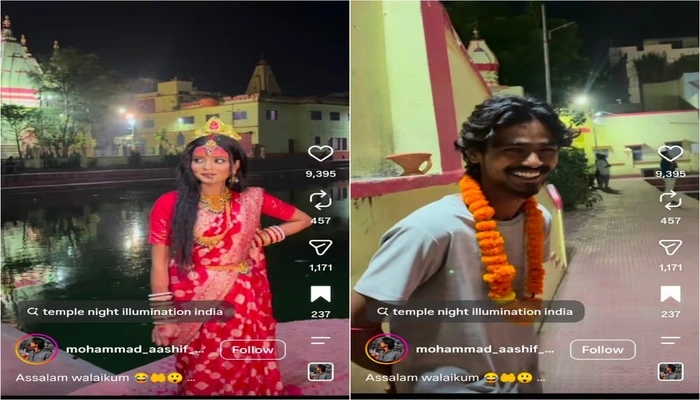
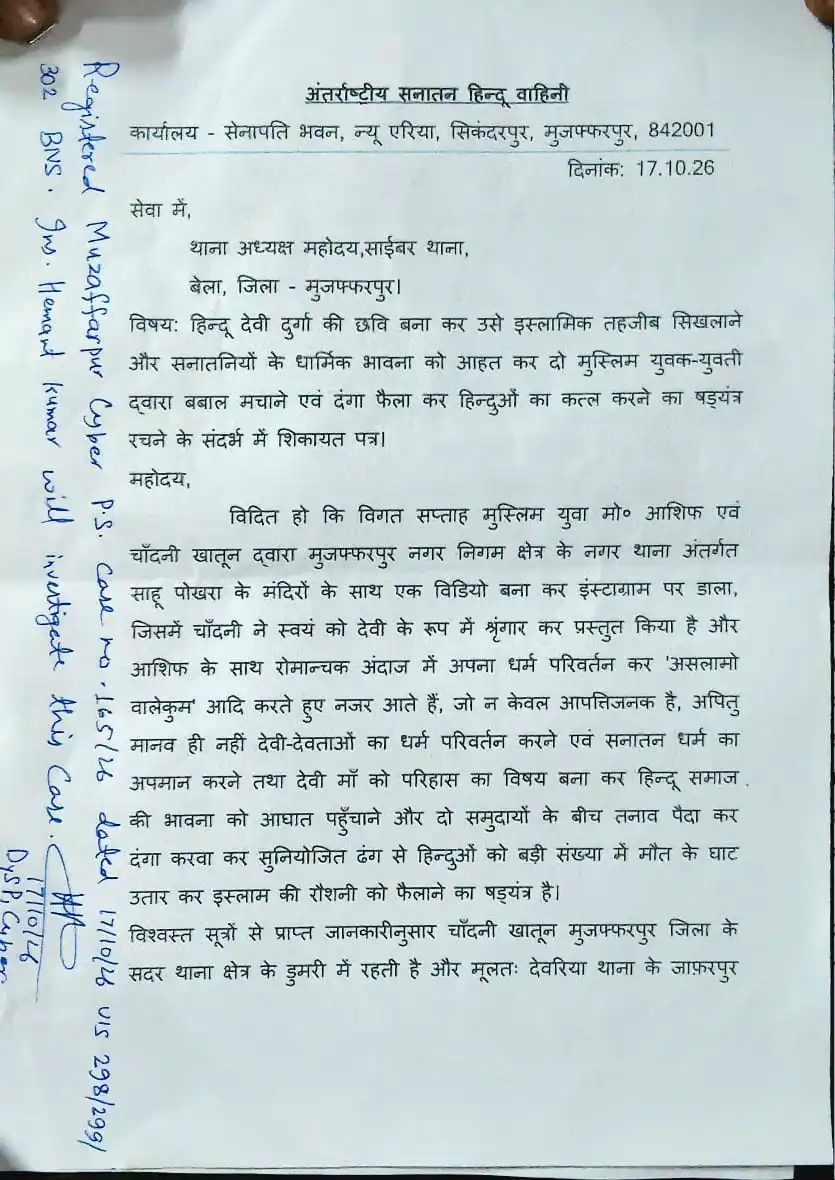
In Muzaffarpur, Bihar, a Muslim woman, Chandni Khatun, dressed as the revered Hindu goddess Maa Durga and uttered “Assalamu Alaikum” while addressing her Muslim friend, Mohammad Asif, in an Instagram video, sparking outrage over the portrayal of a Hindu deity. The video prompted the International Sanatan Hindu Vahini to file a complaint, describing the act as a grave insult to Maa Durga’s sacred form and Hindu religious sentiments. According to the complaint submitted by the International Sanatan Hindu Vahini, the video had circulated across various social media platforms for approximately one week before the organisation approached the authorities. The video spread through mobile phones and the internet in Muzaffarpur and surrounding areas. The organisation’s central president, Acharya Chandra Kishore Parashar, said Chandni Khatun and Mohammad Asif deliberately insulted Maa Durga’s dignity. The organisation also described the incident as an attempt to portray the goddess as undergoing religious conversion. Its press release further stated that the incident formed part of a wider conspiracy to spread Islam, provoke communal riots and cause mass killings of Hindus. On 17 October 2026, Acharya Chandra Kishore Parashar led a delegation comprising Dilip Kumar, Gautam Kumar and Anil Kumar to the Cyber Police Station in Bela, Muzaffarpur. The delegation submitted a detailed joint written complaint to the station in-charge, along with digital evidence of the video and other supporting documents. The representatives expressed dissatisfaction with the earlier inaction of the district administration and local police, arguing that no preliminary action had been taken despite the video’s circulation for approximately one week. The police recorded the complainants’ statements and initiated legal proceedings. Following the submission of the complaint, the Muzaffarpur Cyber Police Station registered First Information Report (FIR) No. 165/2026 against Mohammad Asif and Chandni Khatun. The organisation’s press release cited Sections 298, 299 and 302 of the Indian Penal Code, while suggesting that corresponding provisions of the Bharatiya Nyaya Sanhita might apply. The precise legal provisions remained subject to verification against the original FIR. The organisation also approached the district administration on the same day. Under the leadership of Acharya Chandra Kishore Parashar, the delegation visited the office of the Sub-Divisional Officer (East), Muzaffarpur, and submitted a formal memorandum demanding a high-level investigation and strict punitive action against the individuals named in the complaint. The organisation stated that decisive action was necessary to prevent similar incidents, uphold the law and preserve communal harmony in the district. Following the registration of the FIR, Acharya Chandra Kishore Parashar praised the Cyber Police for initiating legal proceedings and expressed confidence in the country’s judicial system. He stated that he trusted the courts to deliver justice to the Hindu community and ensure appropriate punishment for those found guilty. The Muzaffarpur Cyber Police proceeded with the investigation, examining technical evidence and seeking to establish when and where the video had been recorded, the circumstances surrounding its creation and whether evidence supported the existence of a wider conspiracy. The specific roles of Mohammad Asif and Chandni Khatun remained matters for investigation.
Case Images
Why it is Hate Crime ?
This case has been added to the tracker under the primary category of: Attack on Hindu religious representations. Within it, the sub-category selected is: Iconoclastic representation of Hindu Gods/Goddesses. An icon is a symbol of someone or something that is revered, or a religious representation of a spiritual ideal. Iconography is of vital significance in the Hindu milieu. It helps connect people’s spiritual beliefs with the real world. Iconography within the Hindu faith takes several shapes and forms. Murtis are of most significance to Hindus, to which daily rituals, prayers and offerings are done. Besides the murtis, there are several other symbols which have deep significance in the Hindu faith – the Om and Swastika for example. Any iconoclastic representation of these symbols, images and murtis is an affront to the religious beliefs and faith of the Hindu community itself since the symbols and icons are deeply religious in nature. In this sub-category of crime, we would record hate crimes and iconoclastic representations, in words, art, or any other form of representations of symbols that hold religious significance for the Hindu community. Since these symbols, icons and murtis are central to the Hindu faith, any iconoclastic representation of these symbols is born out of animosity towards the faith itself, manifesting itself through these symbols and therefore, these representations would be considered religiously motivated hated crimes. The other primary category selected here is - Hate speech against Hindus. Within it, the sub-category selected is - Anti-Hindu slurs, mocking faith. Anti-Hindu slurs and the deliberate mocking of the Hindu faith owing to religious animosity involve the usage of derogatory terms, stereotypes, or offensive references to religious practices, symbols, or figures. One of the common anti-Hindu slurs used against Hindus is “cow-worshipper” and “cow piss drinker”. The intention of using this term is to demean and mock Hindus as a group and their religious beliefs since Hindus consider the cow holy. Additionally, some symbols and the slurs attached to them have a historical context that exacerbates the insult, hate, stereotyping, dehumanisation and oppression against Hindus. Cow worship has been used for centuries to denigrate Hindus, insult their faith and oppress Hindus specifically as a religious group. There has been overwhelming documentation about how cow slaughter has been used to persecute Hindus with cow meat being thrown in temples and places of worship. There has also been overwhelming documentation where cow meat (beef) has been force-fed to Hindus to either forcefully convert them to Islam or denigrate their faith. Apart from cow worship, the Swastika – which holds deep religious significance for the Hindus – has also been misinterpreted and distorted to use as a slur against Hindus. Similarly, the worship of the Shivling has been used by supremacist ideologies and religions to denigrate Hindus owing to religious animosity. Such slurs and denigration stem out of inherent animosity and hate towards Hindus and their faith, therefore, it is categorised as hate speech targeted at Hindus specifically owing to their religious identity. This case has been included in the tracker because a Muslim woman, Chandni Khatun, dressed as the Hindu goddess Maa Durga and uttered “Assalamu Alaikum” while addressing her male friend, Mohammad Asif, in an Instagram video in Muzaffarpur, Bihar. The act insulted Maa Durga’s sacred form and hurt Hindu religious sentiments, prompting outrage and a police complaint by a Hindu organisation. Firstly, the portrayal of Maa Durga in a manner that demeaned her sacred form constituted a direct affront to Hindu religious beliefs and the profound reverence Hindus held for their deity. Maa Durga symbolises divine power, courage, righteousness, protection and the ultimate triumph of good over evil. She is worshipped as the embodiment of Shakti, the supreme feminine divine energy, and occupies an exalted position in Hindu religious traditions, particularly during Navratri. Her image is not an ordinary costume or decorative representation but a sacred manifestation of divine power, maternal protection and spiritual strength. Using her revered appearance in a manner that ridiculed her religious identity violated the dignity associated with Hindu worship and insulted the devotion of millions of Hindus who regard her as their divine protector. The act reduced a deeply venerated religious symbol to a vehicle for provocative social media content, disregarding the sanctity that her form represents to Hindu devotees. Such conduct strikes at the heart of religious reverence by treating a worshipped deity as an instrument of ridicule rather than an embodiment of faith. The incident demonstrated the deliberate misuse of Hindu religious imagery and the desecration of symbols of profound spiritual significance to Hindus. The disrespectful portrayal of Maa Durga was a direct insult to the goddess’s sacred form and an affront to Hindu religious beliefs, devotional traditions and cultural identity. Secondly, Chandni Khatun’s portrayal of Maa Durga while uttering “Assalamu Alaikum” constituted a form of religious appropriation in which the sacred image of a revered Hindu deity was used to convey an expression associated with the Islamic faith. Maa Durga’s traditional appearance holds profound religious significance for Hindus and represents divine power, protection and the spiritual essence of Shakti. Using her sacred form to utter an Islamic greeting disregarded the religious identity she represented and the reverence Hindus held for her. The portrayal placed Hindu sacred imagery in a religious context that was inconsistent with the goddess’s identity and devotional significance. Furthermore, portraying Maa Durga while uttering words associated with the Islamic faith conveyed the impression of the goddess adopting an Islamic religious identity. This amounted to a subtle attempt to portray religious conversion through the appropriation of a revered Hindu deity’s image. Such a portrayal trivialised the sanctity of Maa Durga’s form and turned a deeply revered religious symbol into a vehicle for a representation that offended Hindu religious sentiment. The incident misused Hindu religious imagery to portray Maa Durga as adopting an Islamic religious identity, implying a transformation of the goddess’s sacred Hindu identity. The incident demonstrated the misuse of a revered Hindu deity’s sacred image to portray a religious identity inconsistent with her place in Hindu worship. By presenting Maa Durga in this manner, the video trivialised Hindu religious beliefs, disrespected the goddess’s sacred form and offended the religious sentiments of Hindu devotees. Disclaimer: The Hinduphobia Tracker records incidents based on when an event occurred or when the victim's ordeal began. It is important to clarify that none of the media sources covering this case has specified the exact date when the incident occurred. Therefore, for documentation purposes, we have recorded the date based on when the incident was reported to the police, 17 October 2026.


Case Status
Complaint registered


Perpetrators Details
Perpetrators
Muslim Extremists
Perpetrators Range
From 2 To 5
Perpetrators Gender
both
 Sources



