Idol of revered Hindu deity desecrated with axe by Muslim man during Durga Puja in Naogaon, Bangladesh
 Naogaon District, Bangladesh
  16 October, 2026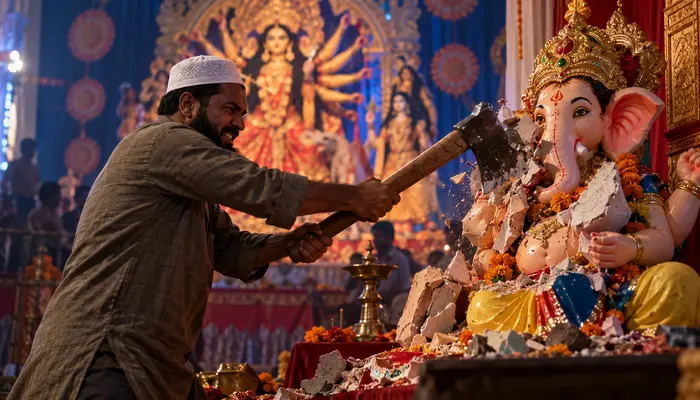
Case Summary
In Hatas Kharapara, Hasai Gari Union, Sadar Upazila, Naogaon District, Bangladesh, an idol of the revered Hindu deity Lord Ganesha was desecrated by a Muslim man, Golam Rabbani, with an axe during Durga Puja. The idol was struck two to three times, leaving it damaged and disrupting Hindu religious worship at the Hatas Kharapara Sarbojanin Puja Mandap. The incident occurred on 17 October 2026, the seventh day of Durga Puja, known as Saptami. At around 10 am, Golam Rabbani, son of Mohammad Musa and a resident of Madhya Hatashpara village in the same union, entered the pavilion carrying an axe. He struck the idol of Lord Ganesha two to three times in quick succession before attempting to leave the scene. At the time, four members of the Ansar force, including two women, were assigned to security duty at the pavilion. According to Mosha Fatema Begum, an Ansar member stationed there, the two female personnel had gone to a nearby field when Golam Rabbani entered and desecrated the idol. Residents and Ansar members subsequently detained him along with the axe and alerted the police. Officers arrived at the scene and took him into custody. Fatema Begum said the security personnel had seen Golam Rabbani visiting the pavilion several times since they began their duties. Some residents claimed that the accused was mentally unstable; however, others stated that he was pretending to be so. Fatema Begum herself rejected the suggestion that he was mentally unstable and said he was feigning such behaviour. The incident left the Puja organisers and local members of the Hindu community angered, turning the festive atmosphere, filled with the rhythmic beats of dhak drums, conch-shell sounds and religious chants, into one of anxiety and uncertainty. Nikhil Pramanik, organisational secretary of the Hatas Kharapara Sarbojanin Puja Mandap, said all Puja activities had been suspended following the vandalism. Pramanik said representatives of the administration, the police and local political leadership had assured the organisers of their support. Those offering assistance included the president of the union unit of the Bangladesh Nationalist Party. They promised to arrange for an artisan to repair the damaged idol and provide the necessary assistance to resume the celebrations. The local Member of Parliament was also expected to visit the scene that afternoon. Pramanik called for legal action against Golam Rabbani and urged the authorities to investigate whether anyone else had been involved. Madhab Chandra Karmakar, president of the Sadar Upazila Puja Celebration Council, described the vandalism as deeply distressing and called for an investigation to establish who was responsible and what motivated the act. He demanded appropriate legal action against those found responsible. Karmakar emphasised that Durga Puja was the largest festival of the Hindu community and stressed the need for cooperation from law-enforcement agencies and local political representatives to ensure that worshippers celebrate the remaining days of the festival without disruption. Pradip Kumar Kundu, convener of the District Puja Celebration Front, said he had contacted the Upazila Nirbahi Officer (Sub-district Executive Officer) after learning about the incident. He also said he planned to visit the scene with the Assistant Commissioner (Land). Kundu called for a fair investigation and justice, stressing that those responsible for such acts had to be held accountable to deter similar incidents of religious idol vandalism in the future. Mohammad Asaduzzaman, officer-in-charge of Naogaon Sadar Police Station, said police personnel and senior officers had visited the scene after receiving information about the incident. Golam Rabbani remained in police custody, and the officer-in-charge confirmed that legal action would be taken against him. Police presence helped restore order at the pavilion, and the situation subsequently returned to normal. This incident occurred against the broader backdrop of the historical persecution faced by Hindus in Bangladesh. While the Hindu minority has endured discrimination, targeted violence, and religious hostility over decades, such persecution has intensified in distinct spurts during periods of political and social instability. The latest major escalation began after the ouster of Sheikh Hasina’s government in August 2024, continued after the death of Sharif Osman Bin Hadi in December 2025, and resurfaced in the immediate aftermath of the 13th National Parliamentary Election in 2026. Following the ouster of Sheikh Hasina, multiple incidents involving attacks on Hindu homes, temples and religious institutions were documented, alongside intimidation, arson and mob violence targeting Hindu localities. The Hinduphobia Tracker recorded 336 incidents involving the Hindu minority during this period, reflecting the scale of the escalation and the continuing vulnerability of Hindus in Bangladesh. A further spurt of violence followed the death of Sharif Osman Bin Hadi, a Muslim political activist and student leader known for his anti-Hindu and anti-India rhetoric, in December 2025. In the aftermath, Hindu communities were subjected to retaliatory violence, with Hindu homes and properties selectively attacked and several families forced to flee. Among the victims was Dipu Chandra Das, who was lynched and whose body was subsequently set ablaze by a Muslim mob over false blasphemy allegations. The Hinduphobia Tracker documented 51 incidents of anti-Hindu violence in the period following Hadi’s death alone, further illustrating how existing hostility towards the Hindu minority intensified during moments of communal mobilisation. During the same period, posters and written material calling for the extermination of Hindus were also displayed in public spaces. Such rhetoric, when viewed alongside incidents of arson, vandalism, assault and targeted intimidation, reflected an environment in which hostility towards Hindus was not merely episodic but repeatedly resurfaced in more intense forms during periods of unrest. The most recent escalation followed the 13th National Parliamentary Election in 2026. In the immediate aftermath of the election results, Hindu families in districts including Noakhali, Rangpur, Nilphamari, Sylhet, Thakurgaon and Dinajpur faced attacks involving arson, looting, assault and vandalism of Hindu homes and temples. In several instances, Hindu properties were selectively targeted, and families were threatened with displacement. The present incident therefore occurred within a much longer history of persecution of Hindus in Bangladesh, where hostility towards the community has persisted over time and intensified in repeated spurts. The latest cycle began after the ouster of Sheikh Hasina and continued through subsequent periods of political and communal upheaval, leaving the Hindu minority increasingly vulnerable to targeted violence, intimidation and religious hostility.
Why it is Hate Crime ?
The primary category selected in this case is: Attack on Hindu religious representations. The subcategory selected is: Desecration of Hindu religious symbol. Icons and symbols or a religious representation of a spiritual ideal are widely revered in Hinduism. Iconography is of vital significance in the Hindu milieu. It helps connect people’s spiritual beliefs with the real world. Iconography within the Hindu faith takes several shapes and forms. Murtis are of most significance to Hindus, to which daily rituals, prayers and offerings are done. Besides the murtis, there are several other symbols which have deep significance in the Hindu faith – the Om and Swastika for example. Since these Hindu religious symbols hold paramount importance in Hinduism, any desecration of symbols, icons, murtis, religious representations and manifestations, is driven by animosity towards the faith itself which manifests itself through these murtis, icons and symbols. Therefore, any desecration of these Hindu religious symbols and representations is considered religiously motivated hate crimes under this category. This case is a clear example of a religiously driven hate crime because a sacred idol of Lord Ganesha was desecrated inside a Hindu Puja pavilion during Durga Puja. The deliberate destruction of the religious idol constituted an attack on sacred Hindu religious representations and hurt the religious sentiments of devotees. Firstly, the idol of Lord Ganesha, one of the most revered deities in Hinduism, was deliberately struck and desecrated with an axe. The deliberate destruction of Lord Ganesha's idol constituted a direct violation of a sacred Hindu religious symbol. Repeatedly striking the idol with an axe demonstrated a physical act of desecration against a deity that held profound spiritual significance for Hindu devotees. Such destruction inflicted more than material damage; it violated a sacred representation of Hindu faith, affronted the religious sentiments of worshippers and desecrated an idol central to their religious observance. The act struck at the sanctity of Hindu worship and represented a serious violation of the religious reverence that devotees attached to the idol. Hindu temple idols hold profound religious significance and are deeply revered as sacred manifestations through which devotees offer worship, prayers and devotion. They are central to Hindu religious practice and are not merely objects of artistic or cultural value. Therefore, vandalising these sacred representations amounted to an affront to Hindu faith and sentiments, constituting deliberate disrespect towards objects held sacred by the Hindu community and reflecting hostility towards Hinduism and its traditions. Secondly, the desecration took place inside the Hatas Kharapara Sarbojanin Puja Mandap during Durga Puja, one of the most important religious festivals of the Hindu community. The location made the incident particularly significant because the pavilion served as a dedicated space for Hindu worship, prayer, rituals and collective religious observance. Durga Puja brings Hindu devotees together to honour the divine, uphold religious traditions and express their faith through shared ceremonies and celebrations. The pavilion was therefore not an ordinary public space but a place dedicated to the practice and expression of Hindu religion. The destruction of Lord Ganesha's idol within this sacred setting constituted an intrusion into a Hindu religious gathering and a violation of the sanctity associated with the festival. The act disrupted an occasion of religious devotion and celebration, turning a place of worship into a scene of destruction and distress. Thirdly, the suspension of worship following the incident constituted a direct disruption of Hindu religious observance. The vandalism interrupted the Puja activities and prevented the organisers from continuing the celebrations, and this is what the perpetrator must have wanted. The destruction of the idol disrupted this process and forced the organisers to confront the consequences of the desecration instead of carrying on with the scheduled religious activities. Hindu devotees who had gathered to participate in the festival were left distressed, while the organisers faced the additional responsibility of arranging for the damaged idol to be repaired before the celebrations could resume. The interruption therefore extended the harm beyond the physical destruction of the idol and affected the community's collective expression of faith. Disrupting these observances during a major religious festival consequently struck at an important aspect of Hindu religious life. The vandalism not only desecrated a sacred representation but also disrupted the worship taking place around it, leaving Hindu devotees to bear the immediate religious and emotional consequences of the act. It is important to note here that some might argue that the accused was mentally unstable. However, it is important to note here that in several cases, where Muslims vandalise and desecrate Hindu places of worship, a usual trope to shield the perpetrator is to attribute the crime to the mental health of the accused, claiming that the crime was committed since the perpetrator was ‘mentally ill’ or ‘mentally unstable’. In many such cases, when a non-Hindu perpetrator commits a crime against the Hindu faith, attempts are made to deny that the crime was motivated by religious bias and instead attribute it to the perpetrator’s mental health. In fact, there are many cases where this strategy has been used by the media and others to downplay such incidents where the crime was committed by a Muslim perpetrator, for example, the attack on the Gorakhnath temple or the incident in Telangana where two Muslim women wearing burqa tried to damage temple and church idols. Likewise, in this case too, when a Muslim man was caught vandalising the Hindu idol, residents attributed the act to his mental illness. The use of the "mental illness" trope to justify crimes targeting Hindu temples or idols by Muslim perpetrators raises critical questions. If perpetrators are indeed mentally unstable, why do they specifically target Hindu idols and places of worship, leaving mosques untouched? This selective focus suggests that such acts are not driven by mental health issues but by religious animosity. The repeated use of this narrative to downplay crimes against Hindus reflects a strategic effort to whitewash religious hatred, obscuring the true motivations and intentions behind the attack. Accordingly, this case has been documented in the Hinduphobia Tracker's Hate Crime Database as an instance of religiously motivated hostility directed against Hinduism and the religious identity of the Hindu community.


Case Status
Arrested


Perpetrators Details
Perpetrators
Muslim Extremists
Perpetrators Range
One Person
Perpetrators Gender
male
 Sources




