Hindu religious event defiled; Muslim men enter Garba pandal wearing tilak to conceal their religious identity
 Bhopal, Madhya Pradesh, India
 15 October, 2026
Case Summary
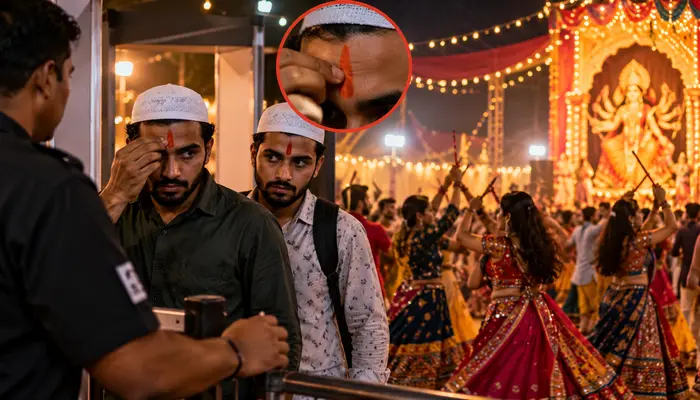
In Bhopal, Madhya Pradesh, a Hindu religious Garba event was defiled when two Muslim men entered the function wearing tilaks on their foreheads to conceal their religious identities and gain entry to the pandal. Their presence violated the sanctity of the Hindu religious gathering and triggered a confrontation after their identities came to light. The incident took place on 16 October 2026 during a Garba programme at the SAM College campus on Raisen Road. At around 8.30 pm, Pushpraj Yadav, Bajrang Dal’s student head in Bhopal, received information about the event and went to the venue with his associates. The two Muslim men were apprehended after questions arose about their identities. The students caught them and handed them over to Bajrang Dal workers. They then took them outside the venue. The Muslim men were not SAM College students. The confrontation escalated as the dispute over the men’s presence intensified. Pushpraj Yadav stated that the men used abusive language during the argument. He said college personnel were siding with them and specifically named Neeraj Gupta, a college faculty member. Yadav stated that Gupta had instructed bouncers to remove Bajrang Dal workers from the premises. The confrontation involved students, Bajrang Dal members, other Hindu organisation workers and college personnel. Following the commotion, the police were informed and arrived at the college campus. Officers intervened and attempted to bring the situation under control. Bajrang Dal workers subsequently handed the two men over to the police. Pushpraj Yadav submitted a complaint or written application at Bilkhiria Police Station concerning the incident. The complaint addressed the men’s presence at the Garba event, the confrontation and the conduct of college personnel. Bajrang Dal members and other Hindu organisation workers demanded that a First Information Report (FIR) be registered against the two Muslim men and the event organisers. They sought action over the men’s entry and what they considered failures in the organisers' arrangements.
Why it is Hate Crime ?
This case has been added to the tracker under the primary category of: Attack on Hindu religious representation. Within this, the subcategory selected here is: Defiling religious customs. Sanatan Dharma is not a religion of one book, which is to say that while it has religious scriptures that form the central tenets of the faith, there are several traditions followed through thousands of years, mostly passed from generation to generation orally. There are several such customs and traditions that are followed by various Hindus and Hindu sects. Defiling of these traditions and customs is a breach of an individual or group’s religious practices. Such practices can range from dietary restrictions like not eating non-vegetarian food for a certain period of the year, not eating non-vegetarian food at all, not eating beef since the cow is considered holy in Hinduism, the sanctity of religious customs followed in the house (like many ISCKON devotees), etc. Any malicious action leading to the breach of such traditions or defilement of these traditions owing to animosity towards the faith or for the sake of activism stems not only from the lack of faith in the religion itself but also from disregard for the faith of the devotees who follow the customs/traditions and implicit bias against the faith, the tradition itself. Since these specific traditions are central to the faith of the devotees of that specific sect of Hindus, any non-compliance with these traditional rules would be considered a religiously motivated hate crime. The other sub-category selected here is - Breaking rules of places of worship. Sanatan Dharma is not a religion of one book, which is to say that while it has religious scriptures that form the central tenets of the faith, there are several traditions followed through thousands of years, mostly passed from generation to generation orally. One of these oral traditions or written traditions is the rules of specific temples. Certain temples have rules which are traditional rules, dependent on the worship of the presiding deities. These rules and traditions have been followed for thousands of years whether they find scriptural mention or not. Such traditions are based on the nature and rules of worship of the presiding deity of that temple. Any non-compliance of these traditions owing to animosity towards the faith or for the sake of activism stems not only from the lack of faith in the presiding deity but also disregard for the faith of the devotees of that deity/temple and implicit bias against the faith, the tradition and the deity itself. Since these specific traditions are central to the faith of the devotees of that specific temple and presiding deity, any non-compliance with these traditional rules would be considered a religiously motivated hate crime. This case was included in the Hinduphobia Tracker because it involved deliberate concealment of religious identity by two Muslim men who wore tilaks on their foreheads to gain entry into a Hindu religious and cultural gathering during Navratri. The incident took place at a Garba pandal organised at SAM College on Raisen Road in Bhopal, Madhya Pradesh. Garba during Navratri is not merely a dance event or a commercial outing. It is closely associated with the worship of Goddess Durga and the celebration of her nine forms over the nine nights of Navratri. The dances, devotional songs and rituals performed during Garba form part of a religious tradition through which devotees express their reverence for the Goddess. Although Garba events may also serve as public cultural gatherings, their religious significance remains central to their observance. A Garba pandal established for Navratri therefore provides a setting for collective Hindu worship and the expression of religious identity. Deliberately misrepresenting one's identity to gain entry into such a gathering goes beyond an ordinary breach of event regulations, as it constitutes a deceptive intrusion into a space organised around the religious practices and traditions of the Hindu community. The fact that the Muslim men wore tilaks on their foreheads to gain entry further heightened the violation of the sanctity of the Hindu religious gathering and the disregard for Hindu religious customs. The tilak holds deep religious and cultural significance within Hinduism and served as a visible marker of faith, devotion and spiritual identity. Its use to conceal the men’s religious identities and facilitate their entry into the Garba pandal turned a sacred Hindu symbol into a means of gaining access under circumstances that directly challenged the religious character of the gathering. This conduct struck at the dignity of Hindu religious traditions by exploiting a recognisable symbol of Hindu faith to gain entry to an event centred on Hindu worship and cultural observance. The concealment of religious identity through the use of tilaks therefore directly affronted the expectations of religious respect and transparency that governed the gathering. By entering under an identity concealed through a Hindu religious symbol, the men compromised the trust underpinning participation in the event and provoked a confrontation over the protection of its Hindu character. The deliberate concealment of religious identity, the calculated use of a Hindu religious symbol, and the choice of a Garba gathering during Navratri establish the incident's religious dimension. The act was not simply about entering an event; it involved exploiting a symbol of Hindu faith to gain access to a gathering rooted in Hindu religious observance. By misusing the tilak in this manner, the men displayed disregard for Hindu religious traditions and the sanctity of a gathering organised to celebrate them. The Hinduphobia Tracker has therefore documented this incident as an instance of anti-Hindu hate crime.


Case Status
Complaint filed


Perpetrators Details
Perpetrators
Muslim Extremists
Perpetrators Range
From 2 To 5
Perpetrators Gender
male
 Sources



