Hindu religious festival and Hindu community targeted through derogatory social media posts in Ramgarh, Jharkhand
 Ramgarh, Jharkhand, India
  15 October, 2026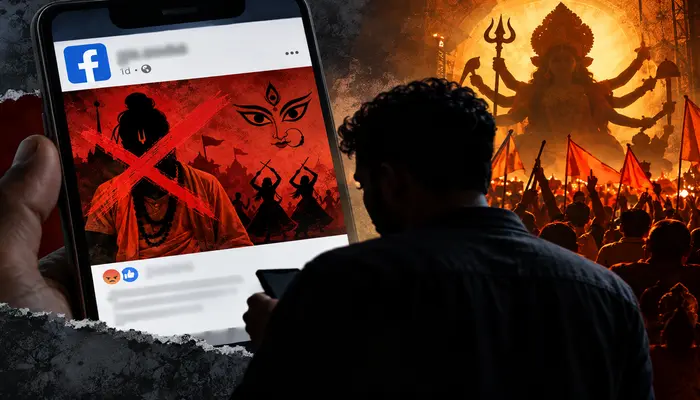
Case Summary
Hindu sentiments were outraged after an objectionable post targeting saffron-clad Hindus and the Hindu festival of Navratri was posted on social media. The case was registered on 16 October 2026, following a written complaint by Pankaj Bharti, the Ramgarh district president of the Hindu Tiger Force, against Basant Munda, who operated a Common Service Centre (CSC) near Koiri Tola Middle School. According to the complaint, Munda had shared an objectionable post on Facebook that hurt the religious sentiments of Hindus. The complaint also expressed concerns that the post could disturb social harmony in the area. It further stated that Munda had previously made objectionable remarks about Hindu deities and religious festivals and had continued to do so despite repeated warnings. Following the complaint, Ramgarh police registered an FIR and initiated an investigation into the matter.
Why it is Hate Crime ?
This case is being added to the tracker under the primary category: Hate Speech against Hindus. The subcategory selected is: Anti-Hindu slurs, mocking faith. Anti-Hindu slurs and the deliberate mocking of the Hindu faith owing to religious animosity involve the usage of derogatory terms, stereotypes, or offensive references to religious practices, symbols, or figures. One of the common anti-Hindu slurs used against Hindus is “cow-worshipper” and “cow piss drinker”. The intention of using this term is to demean and mock Hindus as a group and their religious beliefs since Hindus consider the cow holy. Additionally, some symbols and the slurs attached to them have a historical context that exacerbates the insult, hate, stereotyping, dehumanisation and oppression against Hindus. Cow worship has been used for centuries to denigrate Hindus, insult their faith and oppress Hindus specifically as a religious group. There has been overwhelming documentation about how cow slaughter has been used to persecute Hindus with cow meat being thrown in temples and places of worship. There has also been overwhelming documentation where cow meat (beef) has been force-fed to Hindus to either forcefully convert them to Islam or denigrate their faith. Apart from cow worship, the Swastika – which holds deep religious significance for the Hindus – has also been misinterpreted and distorted to use as a slur against Hindus. Similarly, the worship of the Shivling has been used by supremacist ideologies and religions to denigrate Hindus owing to religious animosity. Such slurs and denigration stem out of inherent animosity and hate towards Hindus and their faith, therefore, it is categorised as hate speech targeted at Hindus specifically owing to their religious identity. This case was included in the Hinduphobia Tracker because it involved hostility directed at Hindu religious identity, visible expressions of faith and religious observances. The objectionable Facebook post targeted saffron-clad Hindus and the Hindu festival of Navratri, making Hindu religious identity the central focus of the incident. The targeting of Hindus on the basis of their religious appearance, alongside disparagement of a Hindu festival, went beyond an ordinary disagreement and reflected contempt towards expressions of Hindu faith. Saffron holds deep religious and cultural significance in Hindu traditions and is widely associated with Hindu identity, spirituality and religious observance. Saffron clothing can serve as a visible expression of an individual's faith and affiliation with Hindu religious traditions. Targeting saffron-clad Hindus through objectionable remarks therefore amounted to hostility towards people visibly expressing their religious identity. Such conduct contributes to an environment in which Hindus are subjected to ridicule or hostility for expressing their faith openly. Religious identity should not become a reason for individuals to face contempt or targeted abuse in public or online spaces. Navratri is a major Hindu festival dedicated to the worship of Goddess Durga and her various forms. The festival holds profound significance for Hindu devotees, who observe it through prayers, fasting, devotional gatherings and other religious traditions. Disparaging Navratri strikes at a religious observance central to Hindu spiritual and cultural life. When a Hindu festival is targeted alongside people displaying visible markers of Hindu identity, the hostility extends to both the community and the religious traditions through which its members practise and express their faith. Such conduct undermines the dignity of Hindu religious observance and shows contempt for beliefs and practices held sacred by devotees. The repeated nature of the conduct further strengthened the basis for examining this incident as anti-Hindu hostility. The complaint stated that Basant Munda had previously made objectionable remarks about Hindu deities and religious festivals and had continued this behaviour despite repeated warnings. Hindu deities occupy a central place in the faith and worship of devotees, while religious festivals sustain the community's spiritual traditions across generations. Repeatedly directing objectionable remarks at Hindu deities and festivals, alongside targeting saffron-clad Hindus, demonstrated a pattern of conduct focused on Hindu religious beliefs and their public expression. This context distinguished the incident from an isolated disagreement or an incidental remark unrelated to religion. The use of Facebook also gave the conduct a wider public dimension. Social media enables religiously targeted content to reach audiences beyond a private exchange, exposing members of a religious community to disparagement of their beliefs and practices. Such content can normalise contempt towards religious symbols and observances, deepen communal mistrust and make the open expression of faith a target for hostility. Targeting Hindu religious identity through an online platform therefore carries significance beyond the immediate individuals involved, particularly when the content concerns religious symbols and festivals shared by a wider community. The incident constituted an instance of anti-Hindu hostility because the conduct centred on Hindu religious identity, targeted people visibly expressing that identity, and disparaged a major Hindu festival. The complaint's account of repeated remarks about Hindu deities and religious festivals further established the religious focus of the conduct. The case was therefore relevant to the Hinduphobia Tracker as an instance of hostility directed at Hindu beliefs, religious observances and the visible expression of faith.


Case Status
Complaint registered


Perpetrators Details
Perpetrators
Unknown
Perpetrators Range
One Person
Perpetrators Gender
male
 Sources




