Durga Pandal set ablaze by unknown miscreants amid sacred festival of Navratri in Jamtara, Jharkhand
 Jamtara, Jharkhand, India
  13 October, 2026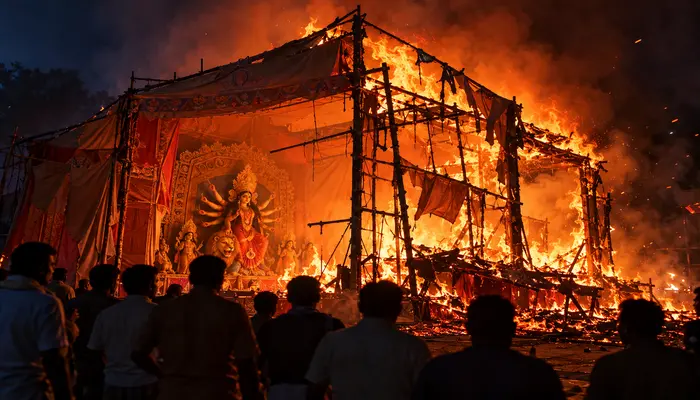
Case Summary
In Charkapahari village, near Gorainala, in the Mihijam police station area of Jamtara district, Jharkhand, a Durga Puja pandal was set ablaze by unknown miscreants amid the sacred festival of Navratri, disrupting the first-ever Durga Puja celebrations in the area. The incident occurred during the intervening night of 14 and 15 October 2026, at approximately 1:30 am. The village had been preparing enthusiastically for its first Durga Puja celebration, but the fire damaged a substantial portion of the pandal, with part of the Durga Mandap burnt to ashes. Haripad Mandal noticed the fire and informed the Puja Committee members, including Manoj Dutta, Raju Dutta and Jaynandana Dutta. Residents and committee members gathered at the scene and attempted to extinguish the flames by pouring water from buckets. A fire brigade vehicle subsequently arrived, and the fire was brought under control after considerable effort. The incident caused disappointment, distress and anger among villagers, who had placed considerable hopes on the inaugural celebration. Following the incident, residents demanded the identification of the miscreants responsible and strict legal action against those found guilty. Members of the Puja Committee, including Jayanto Dutta, Manoj Dutta and Jaynandana Dutta, called for an impartial investigation. The committee also sought clarification regarding the circumstances surrounding the Section 107 notice and the discrimination associated with the organisation of the puja. Upon receiving information about the fire, Police Inspector and Circle Inspector Abdul Rahman and Mihijam Police Station Officer-in-Charge Pradeep Rana arrived at the scene with additional police personnel. They inspected the affected pandal, assessed the situation and gathered information about the incident. The police began investigating the cause of the fire and examined the possibility of both accidental and deliberate ignition. Following a complaint from villagers, a suspect named Saikat Majumdar was taken into custody for questioning. Additional security measures were implemented in the area to prevent further disturbances and maintain law and order. A substantial police force, including personnel from the India Reserve Battalion (IRB) and the district police force, was deployed at the scene. The police administration continued monitoring the situation amid heightened tensions and demands for accountability. Circle Inspector Abdul Rahman stated that the situation was under control and that the cause of the fire remained under investigation. The police examined all relevant aspects of the incident to establish the circumstances in which the fire had started and determine whether anyone had been involved in deliberately setting the pandal ablaze.
Why it is Hate Crime ?
The primary category selected in this case is: Attack on Hindu religious representations. Within this, the subcategory selected is: Violence against religious structures or centres. In Hinduism, a religious structure is also considered divine. Hindus believe that not just the Deity but the religious structure itself is sacred. In this sub-category, we would document attacks against religious structures which are not consecrated temple spaces. Such religious spaces could be temporary in nature – for example – the religious spaces erected specifically for festivals like Durga Puja etc. This category would also document cases of attacks against religious centres. These spaces in their own right may not be ‘sacred’ per se, however, are often spaces where religious gurus live, religious teaching is imparted, or belong to religious institutions. Any attack against religious structures is a result of animosity towards the religion itself, which manifests itself through the religious spaces and therefore, such attacks are considered religiously motivated hate crimes. Religious centres are also manifestations of the religion, its teachings or gurus and therefore, attacks against such centres would be considered religiously motivated hate crimes. The other sub-category selected here is - Desecration of Hindu religious symbol. Icons and symbols or a religious representation of a spiritual ideal are widely revered in Hinduism. Iconography is of vital significance in the Hindu milieu. It helps connect people’s spiritual beliefs with the real world. Iconography within the Hindu faith takes several shapes and forms. Murtis are of most significance to Hindus, to which daily rituals, prayers and offerings are done. Besides the murtis, there are several other symbols which have deep significance in the Hindu faith – the Om and Swastika for example. Since these Hindu religious symbols hold paramount importance in Hinduism, any desecration of symbols, icons, murtis, religious representations and manifestations, is driven by animosity towards the faith itself which manifests itself through these murtis, icons and symbols. Therefore, any desecration of these Hindu religious symbols and representations is considered religiously motivated hate crimes under this category. This case is a clear example of a religiously driven hate crime, as a Durga Puja pandal was set ablaze by unidentified miscreants during preparations for Navratri. Targeting a religious structure prepared for one of the most significant Hindu festivals demonstrated hostility towards a distinctly Hindu religious celebration. Durga Puja is a major Hindu festival centred on the worship of Goddess Durga and commemorating her victory over the demon Mahishasura, symbolising the triumph of righteousness over evil. During the festival, devotees gather at specially constructed Puja pandals, where the idol of Goddess Durga is installed and worshipped through prayers, rituals, offerings and other religious observances. The pandal therefore serves as an important sacred space for Hindu worship and religious congregation, particularly during the festival when devotees gather to celebrate and participate in religious rituals. Setting such a pandal on fire amounts to a direct attack on a space associated with Hindu worship and demonstrates clear hostility towards Hinduism and the Hindu community. The act also showed disregard for Hindu religious sentiments and caused fear and insecurity among members of the Hindu community. Setting fire to a Durga Pandal structure goes beyond damaging a temporary physical installation; it strikes at a space established for Hindu worship and disrupts the community’s opportunity to observe an important religious occasion. The destruction also affects the emotional and spiritual investment of the organisers and devotees who contribute their time, resources and efforts towards creating a place of worship. When a place prepared for religious worship is deliberately destroyed, it undermines the sense of security with which devotees practise their faith and raises serious concerns about the protection of Hindu religious spaces. The incident consequently carries significance as an act of destruction affecting a distinctly Hindu religious setting. The incident disrupted preparations for the first-ever Durga Puja celebration, undermining an occasion that holds particular importance for the local Hindu community. The inaugural celebration represented an opportunity for residents to establish a shared religious tradition, bring families and neighbours together, and participate collectively in the worship of Maa Durga. The preparations reflected the community’s enthusiasm and commitment to observing Navratri through a dedicated pandal and organised festivities. The fire damaged those preparations before the celebration could proceed as intended, replacing anticipation and devotion with disappointment, distress and anger. For the organisers and devotees, the damage meant more than the loss of a physical structure; it interrupted a religious occasion into which they had invested their time, effort and expectations. The disruption also affected the collective experience of worship, as the pandal was intended to provide a common setting for prayers, religious observances and community gatherings. The freedom to organise religious festivals and worship without intimidation or interference remains an important aspect of religious expression. Accordingly, this case has been documented in the Hinduphobia Tracker's Hate Crime Database as an instance of religiously motivated hostility directed against Hinduism and the religious identity of the Hindu community. At the time of documentation, the identities of the perpetrators remained unknown. Nevertheless, the deliberate desecration of a sacred Hindu idol demonstrated hostility towards Hinduism and the Hindu community. Therefore, this case is being recorded in the hate crime database of the Hinduphobia Tracker.


Case Status
Complaint filed


Perpetrators Details
Perpetrators
Unknown
Perpetrators Range
Unknown
Perpetrators Gender
unknown
 Sources




