Anti-Hindu hate speech; Muslim transgender persons made abusive remarks against Hindu deity during Ram Barat procession
 Bijnor, Uttar Pradesh, India
  8 October, 2026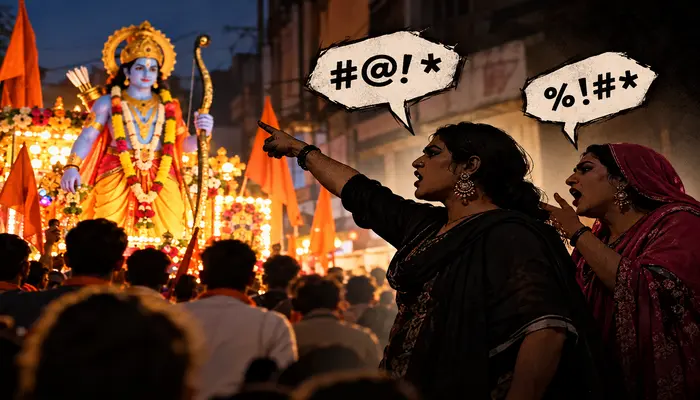
Case Summary
On 9 October 2026, during a Ram Barat procession in Najibabad, Bijnor district, Uttar Pradesh, two Muslim transgender persons, Zoya alias Ajju and Hamza alias Sweety, made indecent remarks about a Hindu deity. According to the complaint, the two Muslim transgender persons, residents of Alipura in Najibabad, made the disparaging and abusive remarks against a Hindu deity during an altercation near Dr Atul Saxena's clinic. Following the incident, Shiv Sharma, a resident of Majid Ganj in Najibabad, submitted a complaint stating that the remarks had hurt the religious sentiments of the Hindu community. The Vishwa Hindu Parishad (VHP) and Bajrang Dal also sought action in the matter. On Wednesday, 14 October 2026, a complaint was submitted to Sub-Divisional Magistrate (SDM) Shailendra Kumar Singh, who directed the Najibabad police station in-charge to investigate the matter and take appropriate action.
Why it is Hate Crime ?
The primary category selected for this case is: Hate speech against Hindus. The subcategory selected is: Anti-Hindu slurs, mocking faith. Anti-Hindu slurs and the deliberate mocking of the Hindu faith owing to religious animosity involve the use of derogatory terms, stereotypes, or offensive references to religious practices, symbols, or figures. One of the common anti-Hindu slurs used against Hindus is “cow-worshipper” and “cow piss drinker”. The intention of using this term is to demean and mock Hindus as a group and their religious beliefs, since Hindus consider the cow holy. Additionally, some symbols and the slurs attached to them have a historical context that exacerbates the insult, hate, stereotyping, dehumanisation and oppression against Hindus. Cow worship has been used for centuries to denigrate Hindus, insult their faith and oppress Hindus specifically as a religious group. There has been overwhelming documentation about how cow slaughter has been used to persecute Hindus, with cow meat being thrown in temples and places of worship. There has also been overwhelming documentation that cow meat (beef) has been force-fed to Hindus to either forcefully convert them to Islam or denigrate their faith. Apart from cow worship, the Swastika – which holds deep religious significance for Hindus – has also been misinterpreted and distorted to be used as a slur against Hindus. Similarly, the worship of the Shivling has been used by supremacist ideologies and religions to denigrate Hindus owing to religious animosity. Such slurs and denigration stem from inherent animosity and hate towards Hindus and their faith; therefore, it is categorised as hate speech targeted at Hindus specifically owing to their religious identity. This case was included in the Hinduphobia Tracker because the use of indecent and abusive language against a Hindu deity during a Ram Barat procession constituted the denigration of a figure central to Hindu faith. The remarks targeted a religious figure being honoured during a public Hindu religious observance, making the incident an instance of disrespect towards Hindu religious beliefs and practices. The religious significance of the target distinguished the incident from an ordinary verbal altercation. Lord Ram holds a central place in Hindu religious belief, worship and tradition. A Ram Barat procession is a public expression of devotion associated with him, bringing together devotees to celebrate and honour the deity. Disparaging a Hindu deity in this context directly undermined the religious significance of the occasion. Such conduct treated a figure held sacred by Hindus with contempt in the very setting where devotees had gathered to celebrate their faith. The incident therefore involved the denigration of Hindu religious beliefs in a public setting, rather than merely an exchange of offensive language between individuals. The targeting of a revered deity also had implications for the wider Hindu community because religious figures hold collective significance beyond individual worshippers. Hindu religious observances depend on the ability of devotees to express their faith and participate in shared traditions with dignity. The disparagement of a deity during a procession dedicated to a deity affronted the religious sentiments associated with the observance and disrespected the beliefs of the community participating in it. The incident was therefore recorded in the Hinduphobia Tracker as a case involving the denigration of Hindu religious beliefs. Its defining feature was the reported use of abusive language against a Hindu deity in the context of a religious procession held in the deity's honour.


Case Status
Complaint registered


Perpetrators Details
Perpetrators
Muslim Extremists
Perpetrators Range
From 2 To 5
Perpetrators Gender
third
 Sources




