Hindu temple desecrated, Maa Kali vandalised and thrown out of temple in Prayagraj, Uttar Pradesh.
 Prayagraj (Allahabad), Uttar Pradesh, India
  9 October, 2026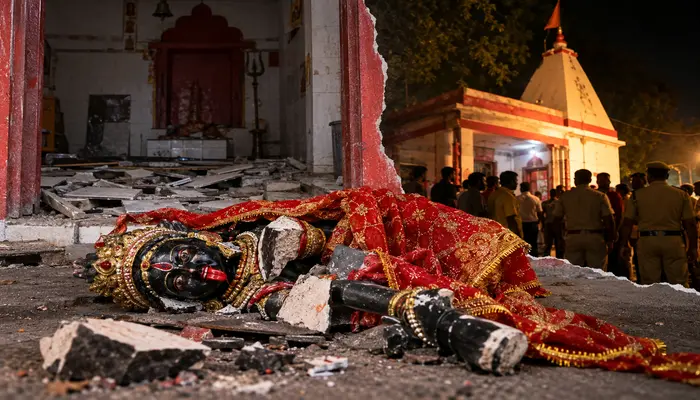
Case Summary
On the first day of Navratri, an idol of Maa Kali was vandalised and thrown out of a Hindu temple in Dando village, under the Karchana police station area in Prayagraj, Uttar Pradesh. The incident occurred at around 3 am on 10 October 2026, when the Hindu temple was vandalised, and its idol was broken and thrown onto the street. The vandalism led to a dispute and a physical altercation between two groups. The temple’s floor tiles were also uprooted during the incident, The temple was built by one of two families involved in an ongoing land dispute, with the other family claiming that the land belonged to them. When the family visited the temple in the morning, they found the tiles broken and the idol of Maa Kali lying on the ground, wrapped in a chunari. A cutter machine and broken tiles were also found at the site. The incident angered villagers, who said that the desecration had hurt their religious sentiments and demanded an impartial investigation and action against those responsible. The dispute subsequently escalated into a confrontation between the two sides, prompting the deployment of police personnel. According to Karchana police station in-charge Bharat Singh, the two sides involved in the dispute were cousins, and the temple stood on community land. The Karchana police arrived at the scene and pacified the villagers, assuring them that a replacement idol would be installed in the temple. The dispute was eventually resolved following police intervention.
Why it is Hate Crime ?
The primary category selected in this case is: Attack on Hindu religious representations. The subcategory selected is: Desecration of Hindu religious symbols. Icons and symbols or a religious representation of a spiritual ideal are widely revered in Hinduism. Iconography is of vital significance in the Hindu milieu. It helps connect people’s spiritual beliefs with the real world. Iconography within the Hindu faith takes several shapes and forms. Murtis are of most significance to Hindus, to which daily rituals, prayers and offerings are done. Besides the murtis, there are several other symbols which have deep significance in the Hindu faith – the Om and Swastika for example. Since these Hindu religious symbols hold paramount importance in Hinduism, any desecration of symbols, icons, murtis, religious representations and manifestations, is driven by animosity towards the faith itself which manifests itself through these murtis, icons and symbols. Therefore, any desecration of these Hindu religious symbols and representations is considered religiously motivated hate crimes under this category. The other subcategory selected in this case is: Attack on Temples. In Hinduism, a temple is the abode of the Deity. The Deity in the Temple is consecrated, thereby, making it a real, breathing entity. Hindus believe that not just the Deity but the temple premises itself are sacred to Hindus since Hindus hold the faith that the entire Temple space is an amalgamation of the divine energy of the deity. Given the central significance of Temples in Hindu Dharma, any attack against a Hindu Temple or its peripheral premises is an attack on the faith itself and is born out of animosity towards the faith, of which, the Temple is a central tenet. Any manner of attack against a Temple and/or its premises would therefore be considered a religiously motivated hate crime. This case was added to the Hinduphobia Tracker because the desecration of a Hindu religious site and the destruction of an idol of Maa Kali constituted an attack on objects of religious reverence, underscoring hostility towards Hindu religious practices and beliefs. Maa Kali is a revered Hindu deity, and her idol held religious significance for devotees who worshipped at the temple. The act of removing the idol from its place of worship and throwing it onto the ground went beyond an ordinary act of property damage, as it directly affected an object central to Hindu worship. In Hinduism, idols of deities hold profound religious significance as sacred representations through which devotees worship and connect with the divine. They are not merely physical objects but consecrated forms that occupy a central place in Hindu religious practices and temple worship. The deliberate destruction of sacred representations of Hindu deities is an attack on symbols central to Hindu religious practice. The desecration of these idols therefore constitutes an act of hostility towards Hindu religious beliefs and the community that reveres them. The uprooting of the temple’s floor tiles further demonstrated the deliberate disruption of a place dedicated to Hindu religious observance, extending the damage beyond the removal of the deity’s idol to the temple premises themselves. Such interference with a place of worship undermined the sanctity of the religious space and disrupted an environment where devotees gathered to offer prayers and express their faith. The desecration of sacred spaces can also create a sense of insecurity among worshippers, raising concerns about whether their religious sites and objects of reverence will be respected and protected. The timing of the incident also warranted consideration. The vandalism took place on the first day of Navratri, an important Hindu festival dedicated to the worship of the Goddess in her various forms, including Maa Kali. This period carries particular religious significance for Hindu devotees, making the desecration of a Goddess’s idol especially consequential for the worshipping community Although the incident arose amid a land dispute between two families, such disagreements should have been resolved through lawful means, with the intervention of the police or relevant administrative authorities where necessary. Instead, one side resorted to uprooting the temple tiles and removing the idol of Maa Kali from its place of worship. The deliberate interference with a sacred Hindu site in the course of a property dispute demonstrated disregard for the religious significance of the temple and the beliefs of the devotees who worshipped there. Disagreements over land ownership did not justify the desecration of Hindu religious objects or the disruption of a place of worship. Such conduct risked conveying contempt for Hindu religious practices and undermining the sanctity and security of Hindu places of worship. Taken together, the removal of Maa Kali’s idol, the damage to the temple premises, and the timing of the incident during Navratri underscored the disrespect shown towards Hindu religious beliefs and places of worship. The incident disrupted a sacred space and affected the sentiments of the devotees for whom the temple held religious significance. Therefore, this case has been added to the hate crime database.


Case Status
Unknown


Perpetrators Details
Perpetrators
Unknown
Perpetrators Range
Unknown
Perpetrators Gender
unknown
 Sources




