Hindu students' religious symbols targeted at Chhattisgarh school; Muslim teacher accused of harassing girls for conversion
 Kawardha, Chhattisgarh, India
  12 October, 2026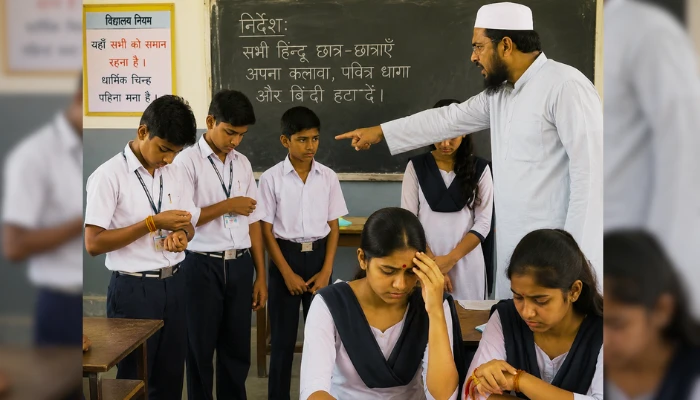
Case Summary
In Kawardha, Chhattisgarh, Hindu students at the Government Higher Secondary School in Polmi were targeted by Muslim teacher Mohammad Firoz Khan, who repeatedly objected to their wearing Mauli (Kalava) threads and tilaks and attempted to remove these sacred Hindu symbols. He was also accused of harassing female students, with efforts to draw them into relationships and facilitate their religious conversion. The matter reached the authorities after the village sarpanch, deputy sarpanch, School Development and Management Committee chairman, and local villagers submitted a written complaint against Khan. The complaint detailed his repeated interference with Hindu students wearing visible religious symbols, particularly the kalava and tilak, along with his conduct towards school-going girls. Following the complaint, the District Education Officer constituted a two-member inquiry team on 6th October 2026. The team recorded statements from students, teachers and residents. The inquiry subsequently found the complaints prima facie true, following which the District Education Officer recommended Khan’s immediate suspension to the Directorate of Public Instruction. Pending further action, District Education Officer F.R. Verma ordered Khan’s attachment to the District Education Office in Kabirdham. Villagers and members of the Vishwa Hindu Parishad and Bajrang Dal maintained that merely transferring him away from the school was insufficient and demanded his dismissal, arrest and registration of an FIR. On 14th October 2026, villagers and Hindu organisations intensified their protest in Polmi by pitching tents and parking tractors on the road, resulting in a prolonged blockade. Naib Tehsildar Pooja Singh and Block Education Officer Deepak Thakur reached the protest site and assured further action. The protesters continued the agitation, demanding criminal and departmental action against Khan over the targeting of Hindu students through interference with their religious symbols and the complaints concerning his conduct towards female students and religious conversion.
Why it is Hate Crime ?
The primary category selected in this case is: Restriction/ban on Hindu practices. Within this, the subcategory selected is: Restriction on expression of Hindu identity. An example of the state-affected prejudicial and targeted orders against the Hindu community would be a government denying the right of a Hindu or a group of Hindus to hold a religious procession owing to the animosity of non-Hindu groups. Denial of the religious right of Hindus to assuage the non-Hindu group, which harbours animosity to a point where it could lead to violence against Hindus, is not only a failure of law and order but is a prejudicial order against Hindus, denying them their fundamental rights to express their religious identity. An example of a hate crime against Hindus by a non-Hindu would be a non-Hindu institution forcing its Hindu employees to abandon religious symbols that a Hindu would wear as an expression of faith owing to inherent prejudice against the faith professed by the victim, or a non-Hindu group of people restricting a Hindu group from constructing a place of worship simply because the demography of the area in which the temple is being built is dominated by non-Hindus. Such actions are driven by religious animosity and/or prejudice against Hindus and their faith and would therefore be categorised as a hate crime. The second primary category selected in this case is: Predatory Proselytisation. The subcategory selected is: Proselytisation by grooming, brainwashing, manipulation or subtle indoctrination. Religious brainwashing essentially means the often subtle and forcible indoctrination to induce someone to give up their religious beliefs to accept contrasting, regimented ideas. Religious grooming or brainwashing also involves propaganda and manipulation. It involves the systematic effort, driven by religious malice and indoctrination, to persuade “non-believers’ to accept allegiance, command, or doctrine to and of a contrasting faith. Cases of such grooming or brainwashing are far more nuanced than direct threats, coercion, inducement and violence. In such cases, it is often seen that there is repeated, subtle and continual manipulation of the victim to induce disaffection towards their own faith and acceptance of the contrasting faith of the perpetrator. While subtle indoctrination is widely acknowledged as predatory, an element which is often understated in such conversions or in the attempts at such conversion is the role of loyalty and trust which might develop between the perpetrator and the victim. Fiduciary relationships are often abused to affect such religious conversion. For example, an educator transmitting religious doctrine of a competing faith to a Hindu student. The Hindu student is likely to accept what the teacher is transmitting owing to the existence of the fiduciary relationship. The exploitation of the fiduciary relationship to religiously indoctrinate victims would also be included in this category. Since the underlying animosity towards the victim’s faith forms the basis of predatory proselytisation, such cases are considered religiously motivated hate crimes. The other subcategory selected is: Harassment, threat, coercion for conversion. Harassment covers a wide range of behaviours of an offensive nature. It is commonly understood as behaviour that demeans, humiliates, and intimidates a person, including threats and coercion. Harassment and threats, in this case, find their root in discriminatory grounds, which have the effect of nullifying a person’s rights or infringing upon his freedom to exercise his rights specifically owing to the victim’s religious identity. Verbal and physical threats and psychological or physical harassment are often used against Hindu victims because they choose to practice their professed religion. Religious harassment also includes forced and involuntary conversions by harassment, threats or coercion. Coercion includes intimidatory tactics like force-feeding a Hindu victim beef to convert to another religion, forceful circumcision, etc. In several cases, non-Hindu perpetrators or those who harbour specific animosity towards Hinduism harass victims simply based on their religious identity. Such cases often also include harassment to ensure the Hindu victim abandons his/her professed religion and adopts the religion of the perpetrator. Such cases where Hindu victims are harassed to convert to the perpetrator’s religion are rooted in animosity towards the victim’s religious identity and are therefore documented as religiously motivated hate crimes. This case has been added to the Hinduphobia Tracker because Hindu students were specifically targeted for displaying visible symbols of their Hindu identity inside a government school. Muslim teacher Mohammad Firoz Khan repeatedly interfered with students wearing tilaks and Mauli threads, attempting to remove these sacred markers while also engaging in conversion-oriented conduct towards school-going girls. The targeting therefore operated on two levels: suppressing the outward expression of Hindu identity and simultaneously creating pressure that could weaken or replace that identity. The tilak and Mauli are not ordinary accessories. Both have an established place in Hindu religious life and are worn after worship, rituals, temple visits and auspicious ceremonies as visible expressions of devotion and religious belonging. A Mauli is a sacred thread tied during Hindu rituals and carries spiritual and ritual significance, while the tilak placed on the forehead visibly communicates adherence to Hindu tradition. When these symbols are deliberately removed from Hindu students, the action targets not merely their appearance but the religious identity they represent. The repeated attempts to remove these symbols therefore directly restricted the expression of Hindu identity. The students were not creating disorder or interfering with the school's functioning by wearing a tilak or Mauli. The teacher targeted their religious identity itself. A Hindu child entering an educational institution does not cease to be Hindu at the school gate, and forcing that child to erase harmless religious markers imposes a discriminatory condition on the exercise of his faith. The conduct simultaneously amounted to desecration of Hindu religious representations. A sacred symbol derives its significance from the faith and religious meaning attached to it, not from its physical size or material. Wiping away a tilak or attempting to remove a Mauli communicates that the symbol is something unwanted and unworthy of respect. When this is done to a Hindu student by an authority figure, the act becomes an affront not only to the individual child but to the religious tradition represented by that symbol. The fact that the victims were school-going children substantially aggravates the incident. Children operate within a clear hierarchy in which teachers hold disciplinary, academic, and psychological authority. A student subjected to repeated interference by a teacher cannot respond as an equal. When an educator uses this authority against a child’s religious expression, the pressure carries far greater force than an objection made by an ordinary stranger. This authority imbalance becomes still more serious when considered alongside the conversion-related conduct involving female students. A teacher occupies a fiduciary position built upon trust, access and influence. Using that relationship to draw Hindu students into personal relationships and facilitate religious conversion transforms educational authority into a vehicle for religious influence. Such conduct represents precisely the form of predatory proselytisation in which trust and repeated access are exploited to alter the religious allegiance of a vulnerable person. Such acts are carried out by Muslim perpetrators due to indoctrination by Islamic theology, which advocates that all non-Muslims (referred to as kafirs) are inferior and subject to subjugation unless they convert to Islam or live under Islamic rule (dhimmitude). These ideas are not mere abstractions; they manifest in actions where non-Muslims, especially Hindus in India, are seen as targets for religious domination, coercion, or humiliation. This theological framework fosters an "us versus them" mindset, in which any assertion of Hindu identity or religious freedom is seen not only as undesirable but as a threat to Islamic supremacy. As a result, perpetrators who are shaped by such teachings feel justified, even morally obligated, to harass, suppress, or violently attack Hindus, particularly when Hindus assert their religious rights or resist conversion. As a result, Muslim perpetrators invoke such doctrines to justify coercive attempts to convert non-Muslims, particularly Hindus, portraying conversion as a means of abandoning Kufr (a state of disbelief in Islam or disbelief in Islam) and attaining salvation. Such acts, therefore, are not isolated but driven by a broader ideological hostility towards Hindus as non-believers and reflect an attempt to impose religious dominance. Since this case was also not a random, isolated incident of grooming of a minor but a premeditated attack motivated by bias and hatred against the Hindu community, which is a defining feature of hate crimes, this has been added to the tracker. The conversion of a minor cannot be treated as an ordinary exchange of religious ideas. Children are especially susceptible to prolonged influence from adults whom institutions have taught them to obey and trust. When religious influence enters through such a relationship, the student’s consent cannot be viewed the same way as an independent adult encountering religious preaching in an open environment. Exploiting educational authority for conversion therefore carries an inherently predatory character. Targeting the tilak and Mauli also complements conversion-oriented conduct. These visible symbols connect students to their Hindu identity, while conversion requires weakening or abandoning that identity. Suppressing those symbols creates a setting in which Hindu religious expression is first made uncomfortable or unacceptable, after which competing religious influence can operate more effectively. The attack on outward identity and the effort to change religious allegiance therefore form parts of the same continuum. Harassment and coercive pressure are equally relevant. Repeatedly interfering with a student’s sacred symbols communicates that continuing to display Hindu identity will invite confrontation from an authority figure. For a minor, repeated reprimand or intervention can itself become a powerful form of psychological pressure. The child is effectively forced to choose between complying with the teacher and openly practising his or her faith. Such treatment can have consequences beyond the immediate removal of a tilak or sacred thread. A Hindu child who repeatedly experiences reprimand because of religious symbols can begin associating the visible practice of Hinduism with humiliation, disciplinary trouble or social disadvantage. This creates pressure to self-censor: the student may stop wearing the symbol not because the faith has changed, but because openly expressing it has become burdensome. That process also makes conversion-related grooming especially dangerous. Weakening confidence in a child’s existing religious identity can make them more susceptible to competing religious influence. When a trusted teacher simultaneously interferes with Hindu symbols and engages students in conversion-oriented conduct, the educational environment ceases to be religiously neutral and becomes a space in which Hindu identity is suppressed while an alternative religious direction is facilitated. Taken together, the case involved the suppression of Hindu religious expression, physical interference with sacred Hindu symbols, abuse of the teacher-student relationship for religious influence, conversion-oriented targeting of minors and harassment capable of pressuring children away from their professed faith. The incident therefore has been documented as a hate crime, warranting inclusion in the tracker. Disclaimer: The Hinduphobia Tracker records incident dates based on when the victim’s ordeal or discriminatory conduct began, not when the matter was reported. In this case, the exact date on which the interference with Hindu students’ tilaks and Mauli threads and the conversion-related conduct began could not be ascertained. Therefore, 13th October 2026, the date the matter was formally documented through the District Education Officer’s communication and entered the public domain, has been selected as the indicative incident date for documentation purposes.


Case Status
Complaint filed


Perpetrators Details
Perpetrators
Muslim Extremists
Perpetrators Range
One Person
Perpetrators Gender
male
 Sources




