Durga idol installation opposed during Navratri in Sagar, Madhya Pradesh; Hindu devotees subjected to brutal assault and abuse
 Sagar, Madhya Pradesh, India
  11 October, 2026
Case Summary
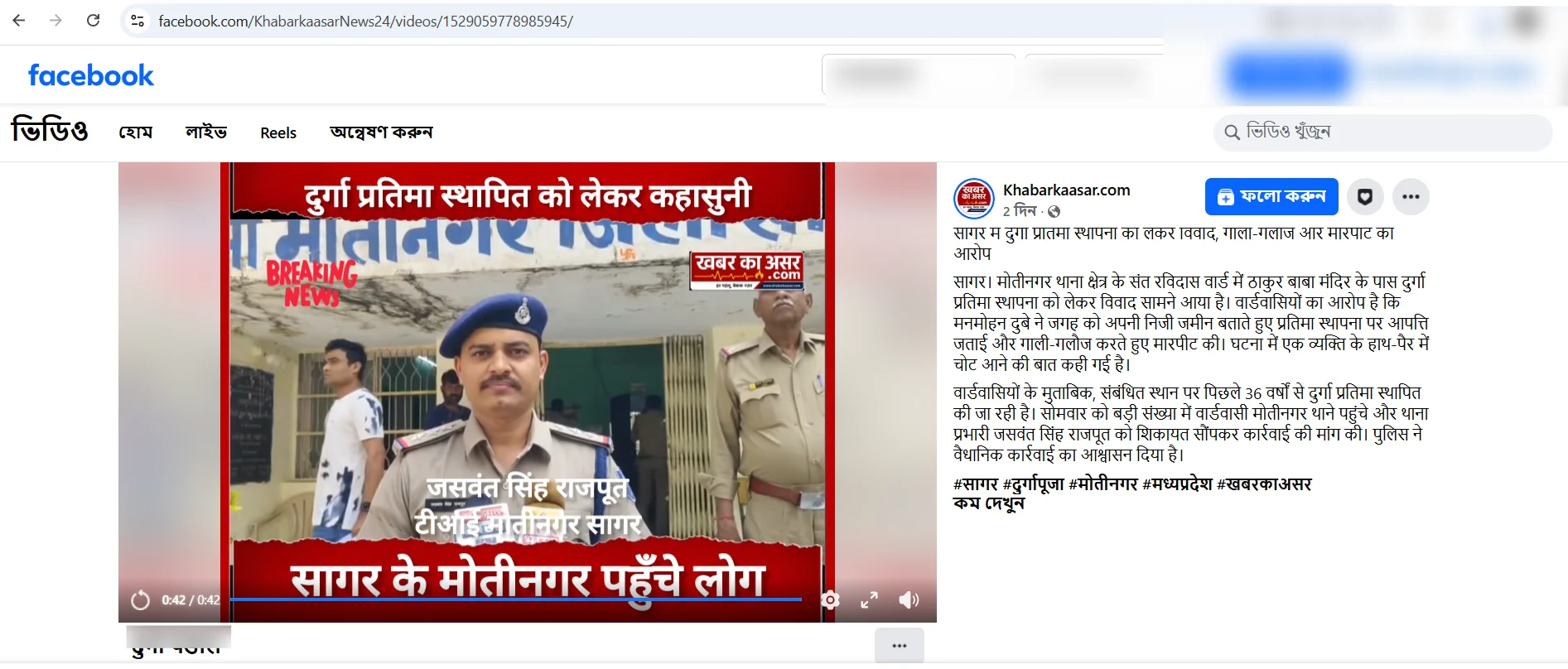
In Sagar, Madhya Pradesh, Navratri celebrations were targeted when a man objected to a Durga idol installed near the Thakur Baba Temple. The accused also subjected Hindu devotees to verbal abuse and physical assault. One person sustained injuries to their arms and legs in the incident. According to media reports, the incident took place in Sant Ravidas Ward, under the jurisdiction of Moti Nagar Police Station. Local residents stated that a Durga idol had been installed at the site for the past 36 years as part of the religious celebrations. However, this longstanding tradition was disrupted when the accused objected to the idol after its installation for the 2026 Navratri celebrations. The man objected to the Durga idol, claiming that the site was his private property. During the dispute, Hindu residents stated that he had verbally abused and physically assaulted the devotees. Following the incident, a large number of residents from the ward gathered at Moti Nagar Police Station on 12 October 2026 to demand action against the accused. They submitted a complaint to Station In-Charge Jaswant Singh Rajput, seeking action over the incident and the objection to the Durga idol. The police identified the perpetrator as Manmohan Dubey. At the time of writing, the police had assured the Hindu residents that appropriate legal action would be taken in the matter.
Case Images
Why it is Hate Crime ?
This case is being added to the tracker under the primary category: Attack not resulting in death. The subcategory selected is: Attacked for Hindu identity. In several cases, Hindus are attacked merely for their Hindu identity without any perceived provocation. A classic example of this category of religiously motivated hate crime is a murder in 2016. 7 ISIS terrorists were convicted for shooting a school principal in Kanpur because they got ‘triggered’ seeing the Kalava on his wrist and tilak that he had put. In this, the Hindu victim had offered no provocation except for his Hindu religious identity. The motivation for the murder was purely religious, driven by religious supremacy. Such cases where Hindus are targeted merely for their religious identity would be documented as a hate crime under this category. The other subcategory selected is: Attack against Hindu devotees. Hindu devotees are a few of the easiest targets of religiously motivated hate crimes because during the festival/procession/puja etc, for non-Hindus it is easy to profile their victims on the basis of religion. Hindu devotees come under attack on several occasions by individual non-Hindus or mobs of non-Hindus owing to their animosity against Hinduism, its symbols and tradition/practices. There are several instances of Hindu devotees being attacked while they worship in temples or temporary religious structures, during religious processions, doing bhajan/kirtan/puja in their own homes, in the residential society etc. These attacks are perpetrated by non-Hindus primarily because of their animosity towards Hindus and their faith. In some cases, the trigger for the violence may be non-religious, however, there are two elements that make these hate crimes. First, the Hindus who come under attack are attacked violently while indulging in religious activity. Whether they are in a place of worship or not is immaterial to the crime. When individuals are attacked while indulging in religious practices, the attack in itself is a hindrance to their freedom to practice religion and therefore constitutes a hate crime. Secondly, religious supremacist doctrines and ideologies deem religious practices of Hindus to be offensive ab initio since they are considered “sinful” by these ideologies, worthy to be annihilated by force or coercion. Driven by these religious supremacist ideologies and doctrines, the attacks against Hindu devotees stem from intrinsic animosity towards Hinduism. In some cases, the trigger for the violence may be non-religious, however, it develops into a religiously motivated crime during the course of the violence. Since these attacks stem from animosity towards Hindus and Hinduism, they are considered religiously motivated hate crimes under this category. This case is being added to the Hinduphobia Tracker because the perpetrator opposed the installation of a Durga idol, claiming that the site was his private property, and subsequently subjected Hindu devotees to brutal physical assault and verbal abuse while they were celebrating a Hindu religious festival. Navratri is one of the most significant festivals in Hinduism, celebrated across India with immense devotion, vigour and joy. Dedicated to the worship of Goddess Durga and her nine forms, the festival commemorates the triumph of good over evil and the victory of divine feminine power over demonic forces. Hindu devotees celebrate Navratri by installing Durga idols in pandals, offering prayers, performing religious rituals and gathering for collective worship to seek the blessings of the Goddess. These celebrations are an important expression of Hindu faith, devotion and cultural identity, bringing communities together in reverence for the divine feminine. The perpetrator's opposition to the installation of a Durga idol during Navratri, followed by physical assault and verbal abuse against Hindu devotees, demonstrates hostility towards Hindu religious practices and the community's expression of faith. By targeting devotees participating in a major religious festival, the perpetrator's actions infringed upon their religious observance and made their Hindu identity a central aspect of the hostility. The assault and abuse, occurring in the context of opposition to a Hindu religious celebration, indicate intolerance towards Hinduism and its adherents, making this a case of religiously driven hate crime. Some might argue that the incident stemmed solely from a property dispute, as the perpetrator claimed that the site belonged to him. However, a disagreement over ownership could have been addressed through lawful means, such as approaching the relevant authorities or seeking legal recourse. Instead, the perpetrator opposed the installation of the Durga idol and resorted to physical violence and verbal abuse against Hindu devotees during their religious celebrations. This conduct cannot be viewed merely as a dispute over property, as the opposition to a Hindu religious observance was accompanied by violence against those participating in it. The circumstances demonstrate hostility towards the devotees' religious practices and identity, turning the incident into an attack on both the worshippers and their expression of Hindu faith. Since the incident meets the parameters of a religiously driven hate crime, it is being added to the hate crime database of the Hinduphobia Tracker. Disclaimer: The Hinduphobia Tracker records incident dates based on when the crime occurred rather than when it was reported by the media. However, in this case, media reports did not specify the exact date on which the crime took place. They only stated that the victim submitted a police complaint on 12 October 2026. Hence, this date has been selected as the indicative incident date for documentation purposes only. Although multiple Hindu devotees were assaulted in this incident, the available reports specifically mentioned only one injured victim and did not specify the total number of victims. Hence, the victim count has been conservatively recorded as one for documentation purposes only.
Victim Details
Total Victim
1
Deceased
0
Gender
- Male 0
- Female 0
- Third Gender 0
- Unknown 1
Caste
- SC/ST 0
- OBC 0
- General 0
- Unknown 1
Age Group
- Minor 0
- Adult 0
- Senior Citizen 0
- Unknown 1


Case Status
Complaint filed


Perpetrators Details
Perpetrators
Others
Perpetrators Range
One Person
Perpetrators Gender
male
 Sources




