Hindu deities denigrated as Muslim man portrays them as perverts, rapists and paedophiles on social media, distorts sacred Hindu scriptures
 Delhi, Delhi, India
  11 October, 2026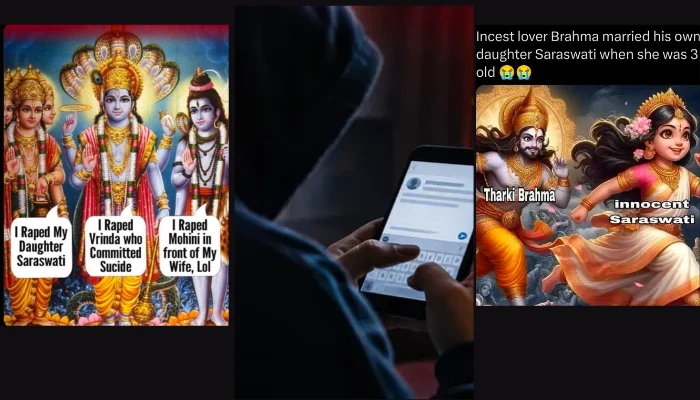
Case Summary
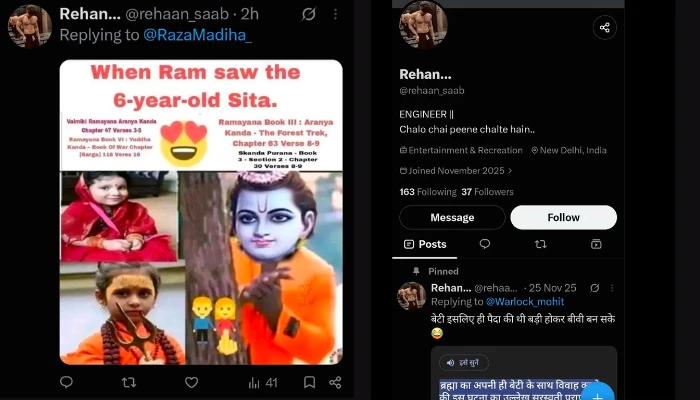
Hindu deities and the Hindu faith were denigrated through abusive posts and morphed images by a social media account. The social media account, named @Rehab_saab, was reportedly operated by a Muslim man, Rehaan, based in Delhi. He shared posts attributing sexually derogatory conduct to revered Hindu deities and used profane language to demean their character and religious significance. In some posts, the account portrayed Lord Brahma as a paedophile, claiming that he married his young daughter, Goddess Saraswati, and depicting him as a pervert who did not spare even his own daughter. Other posts portrayed Lord Shiva as a rapist who assaulted his wife and depicted Lord Rama as a lustful paedophile who targeted six-year-old Sita, while misquoting sacred scriptures. The posts also portrayed Lord Vishnu as a rapist and a lustful man. The Hinduphobia Tracker team could not access the Instagram account maintained by Rehaan, who had joined the platform in 2025, as the account had been deleted. However, the team secured a video that documented the objectionable posts originally published on the account. It showed several instances of content that denigrated Hindu deities and distorted Hindu religious narratives to portray revered figures in a derogatory manner. The incident came to light when a social media account named Lazybrattt highlighted the objectionable content online. The post subsequently went viral, bringing attention to the abusive material targeting Hindu deities and religious beliefs. Following the online backlash, the accused deleted his account.
Case Images
Why it is Hate Crime ?
This case is being added to the tracker under the primary category: Hate Speech against Hindus. The subcategory selected is: Anti-Hindu slurs, mocking faith. Anti-Hindu slurs and the deliberate mocking of the Hindu faith owing to religious animosity involve the use of derogatory terms, stereotypes, or offensive references to religious practices, symbols, or figures. One of the common anti-Hindu slurs used against Hindus is “cow-worshipper” and “cow piss drinker”. The intention of using this term is to demean and mock Hindus as a group and their religious beliefs, since Hindus consider the cow holy. Additionally, some symbols and the slurs attached to them have a historical context that exacerbates the insult, hate, stereotyping, dehumanisation and oppression against Hindus. Cow worship has been used for centuries to denigrate Hindus, insult their faith and oppress Hindus specifically as a religious group. There has been overwhelming documentation about how cow slaughter has been used to persecute Hindus, with cow meat being thrown in temples and places of worship. There has also been overwhelming documentation that cow meat (beef) has been force-fed to Hindus to either forcefully convert them to Islam or denigrate their faith. Apart from cow worship, the Swastika – which holds deep religious significance for the Hindus – has also been misinterpreted and distorted to be used as a slur against Hindus. Similarly, the worship of the Shivling has been used by supremacist ideologies and religions to denigrate Hindus owing to religious animosity. Such slurs and denigration stem from inherent animosity and hate towards Hindus and their faith; therefore, it is categorised as hate speech targeted at Hindus specifically owing to their religious identity. The other sub-category selected is: Subversion of scriptures. Subverting the religious scriptures of Hindus has particularly devastating consequences. Subversion of the scriptures of Hindus is often done to justify or promote hatred, discrimination, or violence against specific individuals or groups of Hindus. Religious scriptures are often nuanced, and those who harbour religious animosity towards Hindus often misquote or misrepresent the scripture to legitimise their animosity and hate towards the faith and its adherents. Any such misquoting of scriptures or subversion to justify hate, violence and discrimination against Hindus owing to religious animosity is hate speech and is categorised as such. The other primary category added to the tracker is: Attack on Hindu religious representations. The subcategory selected is: Iconoclastic representation of Hindu Gods/Goddesses. An icon is a symbol of someone or something that is revered, or a religious representation of a spiritual ideal. Iconography is of vital significance in the Hindu milieu. It connects people’s spiritual beliefs to the real world. Iconography within the Hindu faith takes many forms. Murtis are of most significance to Hindus, to which daily rituals, prayers and offerings are done. Besides the murtis, there are several other symbols which have deep significance in the Hindu faith – the Om and Swastika, for example. Any iconoclastic representation of these symbols, images and murtis is an affront to the religious beliefs and faith of the Hindu community itself since the symbols and icons are deeply religious in nature. In this sub-category of crime, we would record hate crimes and iconoclastic representations, in words, art, or any other form of representation of symbols that hold religious significance for the Hindu community. Since these symbols, icons and murtis are central to the Hindu faith, any iconoclastic representation of these symbols is born out of animosity towards the faith itself, manifesting itself through these symbols; therefore, these representations would be considered religiously motivated hate crimes. This case was included in the Hinduphobia Tracker because the social-media account repeatedly used Hindu deities and sacred scriptures to construct sexually degrading portrayals of Hindu Dharma. The content went beyond criticism or disagreement with religious beliefs. It attributed sexual perversion and criminal conduct to revered deities, distorted sacred narratives to undermine their religious significance, and presented Hindu religious figures in a manner intended to provoke ridicule and contempt. The common thread across these portrayals was the deliberate use of what Hindus hold sacred to demean their faith and the religious identity of its adherents. In Hindu Dharma, Lord Brahma is revered as the creator, Lord Vishnu sustains the universe and restores Dharma, and Lord Shiva is associated with cosmic transformation and spiritual liberation. Together, they occupy central places in Hindu theological understanding. Goddess Saraswati, revered as the goddess of knowledge, wisdom and learning, is also worshipped with deep devotion. These deities are not merely characters in religious narratives; they are sacred figures whose significance extends across worship, philosophy, devotional traditions and the spiritual lives of Hindus. Consequently, portraying them as sexually depraved did more than insult individual religious personalities. It turned revered objects of Hindu devotion into instruments of degradation and directed contempt towards the faith of the people who worship them. The treatment of Lord Brahma and Goddess Saraswati was particularly degrading because it used their sacred relationship within Hindu tradition to construct a portrayal centred on sexual perversion. Rather than treating these figures within their religious and narrative context, the content reduced them to vulgar accusations and used the resulting caricature to ridicule Hindu belief. Similarly, portraying Lord Shiva as a rapist recast a deity revered by millions of Hindus as a figure of spiritual power and transformation into an object of sexual abuse and contempt. Such representations deliberately displaced the religious significance of these deities with degrading sexual allegations, making the sacred itself the target of ridicule. The portrayal of Lord Rama carried an additional religious dimension because it combined the degradation of a revered deity with the distortion of sacred scripture. Lord Rama, an incarnation of Lord Vishnu, is worshipped as "Maryada Purushottam", the ideal of righteousness, duty, restraint and moral conduct. His life, as narrated in the Ramayana, holds profound religious and ethical significance for Hindus and continues to guide devotional understanding of Dharma. Presenting him as a lustful figure who targeted a child directly contradicted this revered understanding and used a distorted portrayal to undermine the dignity of the deity and the tradition he represents. The significance of this conduct lay not simply in the use of offensive language but in the way sacred narratives were manipulated to support the degradation of Hindu Dharma. Hindu scriptures contain religious, philosophical, ethical and narrative contexts that must be understood within their traditions. Misquoting scripture to portray Lord Rama as sexually depraved removed the narrative from its religious context and presented a distorted version as a basis for ridicule. The scripture was thus not engaged with on its own terms; its authority and content were appropriated to discredit the very faith it guides. This treatment demeaned both the sacred narrative and the Hindus who revere it as a source of religious knowledge and moral guidance. The repeated targeting of Lord Brahma, Lord Shiva, Lord Vishnu and Lord Rama further distinguished this conduct from an isolated offensive remark. Different deities associated with distinct aspects of Hindu belief were subjected to the same degrading treatment, while sacred narratives were distorted to reinforce the portrayals. The recurrence of this approach demonstrated a consistent pattern in which Hindu religious figures were selected, stripped of their sacred significance and recast as sexually depraved or morally repulsive. The use of multiple deities and scriptural references reinforced the religious focus of the content rather than suggesting a disagreement confined to one particular belief. The use of sexualised remarks against revered deities was significant because it made their sacred status itself the basis of the derogatory portrayals. The posts did not engage in genuine criticism of Hindu religious beliefs, debate theological interpretations, or offer a reasoned examination of sacred scriptures. Instead, they used profane language, sexually degrading characterisations and distorted religious narratives to mock revered deities, ridicule Hindu Dharma and undermine the religious significance of figures central to Hindu worship. The repeated association of these deities with sexual depravity and criminality went beyond disagreement with religious beliefs and presented sacred figures as objects of contempt. This approach demeaned not only the deities themselves but also the faith and religious identity of the Hindus who revere them. In the wider context of online Hinduphobia, social media was used to circulate derogatory images, memes and narratives that turn Hindu deities, religious symbols and sacred teachings into objects of public ridicule. The online setting does not diminish the religious significance of such conduct. Instead, the circulation of degrading portrayals exposes Hindu religious identity to public contempt and allows sacred figures to be misrepresented before wider audiences. In this case, the documented video of the deleted account preserved multiple examples of the objectionable content, showing that the denigration extended across different Hindu deities and religious narratives. The central issue was therefore not that Hindu religious figures were mentioned or that Hindu beliefs were subjected to criticism. It was that revered deities were repeatedly sexualised and degraded, while sacred scriptures were distorted to reinforce those portrayals. The combined treatment of Hindu deities, religious narratives and the beliefs of their devotees established a consistent pattern of religious denigration. These elements brought the incident within the Tracker's parameters for hate speech targeting Hindus and the deliberate degradation of Hindu religious representations. Disclaimer: The Hinduphobia Tracker records incident dates based on when the crime occurred, rather than when it was reported by the media. However, as media reports did not specify the exact date of the incident in this case, 12 October 2026, the date on which it was reported by the media, has been selected as the indicative incident date for documentation purposes only.


Case Status
Unknown


Perpetrators Details
Perpetrators
Muslim Extremists
Perpetrators Range
One Person
Perpetrators Gender
male
 Sources




