Hindu man’s throat slashed with blade by Muslim man for objecting to latter's derogatory remarks about Hindu deity
 Lucknow, Uttar Pradesh, India
  5 October, 2026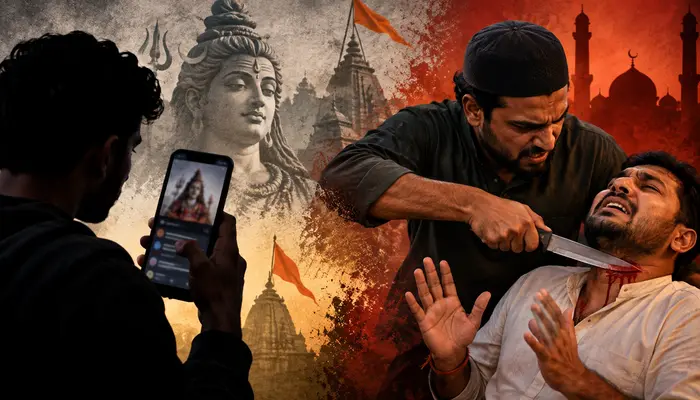
Case Summary
In Madiyaon, Lucknow, Uttar Pradesh, a Hindu man, Gyanendra Kumar, was attacked with a blade on his neck after he objected to derogatory remarks about a Hindu deity made by a Muslim man, Suhail Khan. The incident occurred on 6 October 2026, when Gyanendra Kumar, also known as Bablu, was speaking with Suhail Khan outside their rented accommodation in Naya Purwa, in the Madiyaon area. During the conversation, Suhail made derogatory remarks about a Hindu deity. Gyanendra objected to the remarks, following which Suhail became enraged and slashed him on the neck with a blade, leaving him seriously injured. After the attack, the injured Gyanendra shouted and fled to the Naveen Galla Mandi police outpost, where he sought safety. The police took him to hospital, where he received initial treatment and was discharged, while Suhail fled the scene. Gyanendra was a resident of Kamiyabpur, Manpur, in Sitapur district. He worked at the Naveen Galla Mandi on Sitapur Road for Chand Alam, a vegetable trader. Suhail, who was from Mahmudnagar Chandan in Sitapur district, also worked for Chand Alam. Madiyaon police registered a First Information Report (FIR) against Suhail Khan and began searching for him. Inspector Shivanand Mishra stated that a police team was looking for the accused.
Why it is Hate Crime ?
The primary category selected in this case is: Attack not resulting in death. The subcategory selected is: Attacked for opposing radicals or trying to save victim. In several cases, Hindus are attacked for opposing religiously motivated crimes being committed against a fellow Hindu or simply for voicing an opinion opposing radical elements, who either have in the past or continue to persecute Hindus. In such cases, the initial attack against the victim, against which the Hindu was trying to defend the victim, would also need to be classified as a religiously motivated hate crime. Since the initial crime itself was religiously motivated and the subsequent crime of attempting to save the victim or speaking against the radical elements ends up inviting a violent attack, it would also be classified as a religiously motivated hate crime under this category. The other primary category selected is: Hate speech against Hindus. The subcategory selected is: Anti-Hindu slurs, mocking faith. Anti-Hindu slurs and the deliberate mocking of the Hindu faith owing to religious animosity involve the usage of derogatory terms, stereotypes, or offensive references to religious practices, symbols, or figures. One of the common anti-Hindu slurs used against Hindus is “cow-worshipper” and “cow piss drinker”. The intention of using this term is to demean and mock Hindus as a group and their religious beliefs since Hindus consider the cow holy. Additionally, some symbols and the slurs attached to them have a historical context that exacerbates the insult, hate, stereotyping, dehumanisation and oppression against Hindus. Cow worship has been used for centuries to denigrate Hindus, insult their faith and oppress Hindus specifically as a religious group. There has been overwhelming documentation about how cow slaughter has been used to persecute Hindus with cow meat being thrown in temples and places of worship. There has also been overwhelming documentation where cow meat (beef) has been force-fed to Hindus to either forcefully convert them to Islam or denigrate their faith. Apart from cow worship, the Swastika – which holds deep religious significance for the Hindus – has also been misinterpreted and distorted to use as a slur against Hindus. Similarly, the worship of the Shivling has been used by supremacist ideologies and religions to denigrate Hindus owing to religious animosity. Such slurs and denigration stem out of inherent animosity and hate towards Hindus and their faith, therefore, it is categorised as hate speech targeted at Hindus specifically owing to their religious identity. This case has been added to the tracker because a Hindu deity was subjected to derogatory remarks by a Muslim youth, Suhail Khan and when a Hindu man, Gyanendra Kumar, objected to the denigration of his faith, Suhail attacked his neck with a blade, leaving him seriously injured. The incident reflected hostility towards Hindu religious beliefs, with violence used to intimidate someone who objected to the denigration of his faith. The derogatory remarks about a Hindu deity constituted an affront to Hindu religious beliefs, sacred traditions and the sentiments associated with the worship of the divine. Hinduism attaches profound spiritual significance to its deities, whose worship formed an integral part of religious practice, personal faith and cultural identity. Disrespectful remarks directed at a Hindu deity went beyond an ordinary disagreement and touched upon beliefs that held deep meaning for Hindu devotees. Such conduct undermined the respect that Hindus expected for their religion and created an atmosphere in which their sacred beliefs were treated with contempt. The freedom to worship and express devotion also encompasses the expectation that their faith would not be deliberately denigrated. The remarks consequently represented an affront to Hindu religious sentiments and the dignity associated with practising their faith. Of particular concern was the fact that an objection to disrespectful and derogatory remarks about a Hindu deity escalated into a violent attack on a Hindu man. This reflected hostility towards Hindu religious sentiments and the right to defend one's faith. Resorting to physical violence in response to opposition to the denigration of Hinduism conveyed contempt for the religious beliefs being defended and sought to suppress the expression of Hindu religious identity through intimidation. Such conduct fostered an environment in which defending Hinduism risked personal harm, undermining the dignity of Hindu devotees and their freedom to stand up for their sacred beliefs without fear of violent retaliation. Such conduct undermined the freedom of Hindus to express their religious convictions and reinforced an atmosphere of intimidation surrounding the defence of Hinduism. Accordingly, this case has been documented in the Hinduphobia Tracker's Hate Crime Database as an instance of religiously motivated hostility directed against Hinduism and the religious identity of the Hindu community.
Victim Details
Total Victim
1
Deceased
0
Gender
- Male 1
- Female 0
- Third Gender 0
- Unknown 0
Caste
- SC/ST 0
- OBC 0
- General 0
- Unknown 1
Age Group
- Minor 0
- Adult 0
- Senior Citizen 0
- Unknown 1


Case Status
Complaint registered


Perpetrators Details
Perpetrators
Muslim Extremists
Perpetrators Range
One Person
Perpetrators Gender
male
 Sources




