Goddess Durga and Durga Puja targeted through derogatory social media posts in Sitamarhi, Bihar
 Patna, Bihar, India
  10 October, 2026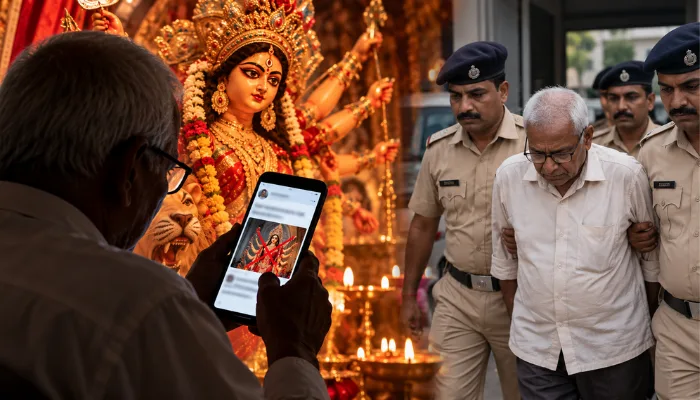
Case Summary
Goddess Durga and Durga Puja were targeted through derogatory social media posts. They were published during Navratri by Ramjivan Rai, a 77-year-old retired Food Corporation of India employee from Ward No. 2 in Runnisaidpur. The posts directly targeted a revered Hindu deity and were circulated at a time when Hindu devotees were observing Navratri and preparing for Durga Puja. On the afternoon of 11 October 2026, Ramjivan posted several offensive comments concerning Maa Durga and Durga Puja on his Facebook account. The content surfaced while the Sitamarhi district social-media cell was monitoring online platforms during the festival period. The posts triggered anger among residents, who demanded action over the derogatory remarks directed at Hindu religious beliefs. Given the sensitivity of the content and the reaction it generated, police registered an FIR at Runnisaidpur Police Station in Sitamarhi, Bihar, late the same evening. Police subsequently began searching for Ramjivan and received information that he was present at his residence in Patna. The Sitamarhi police team then travelled to Patna, raided the residence and arrested him. He was brought back to Sitamarhi for questioning, while further legal proceedings were initiated in connection with the social-media posts. Sitamarhi Superintendent of Police Amit Ranjan stated that strict action would be taken against people attempting to disturb social harmony by posting objectionable material concerning any religion or community. Police also appealed to the public to use social media responsibly and avoid inflammatory or derogatory content during religious festivals. At the time of documentation, the matter remained under police investigation, while further legal action against Ramjivan was underway.
Why it is Hate Crime ?
The primary category selected for this case is: Hate speech against Hindus. The subcategory selected is: Anti-Hindu slurs, mocking faith. Anti-Hindu slurs and the deliberate mocking of the Hindu faith owing to religious animosity involve the use of derogatory terms, stereotypes, or offensive references to religious practices, symbols, or figures. One of the common anti-Hindu slurs used against Hindus is “cow-worshipper” and “cow piss drinker”. The intention of using this term is to demean and mock Hindus as a group and their religious beliefs, since Hindus consider the cow holy. Additionally, some symbols and the slurs attached to them have a historical context that exacerbates the insult, hate, stereotyping, dehumanisation and oppression against Hindus. Cow worship has been used for centuries to denigrate Hindus, insult their faith and oppress Hindus specifically as a religious group. There has been overwhelming documentation about how cow slaughter has been used to persecute Hindus, with cow meat being thrown in temples and places of worship. There has also been overwhelming documentation that cow meat (beef) has been force-fed to Hindus to either forcefully convert them to Islam or denigrate their faith. Apart from cow worship, the Swastika – which holds deep religious significance for the Hindus – has also been misinterpreted and distorted to be used as a slur against Hindus. Similarly, the worship of the Shivling has been used by supremacist ideologies and religions to denigrate Hindus owing to religious animosity. Such slurs and denigration stem from inherent animosity and hate towards Hindus and their faith; therefore, they are categorised as hate speech targeted at Hindus specifically owing to their religious identity. This case qualifies as a religiously motivated hate crime because the derogatory content was directed at Goddess Durga and Durga Puja, both of which hold profound religious significance for Hindus. The attack was therefore not confined to an individual devotee; it targeted sacred elements through which millions of Hindus collectively express their faith, devotion and religious identity. Firstly, Goddess Durga occupies a deeply revered position in Hinduism as a manifestation of Shakti, representing divine power, protection and the triumph of Dharma over evil. Offensive or vulgar treatment of a deity worshipped by Hindus attacks something that devotees regard as sacred. The resulting insult consequently extends to the Hindu community whose religious relationship with the Goddess forms part of its collective spiritual identity. Secondly, the targeting of Durga Puja widened the scope of the hostility beyond a single sacred figure. Durga Puja is a major Hindu religious observance involving worship, rituals, collective prayer and devotional celebration. Mocking or degrading the festival therefore attacks an established Hindu religious practice and communicates contempt towards the traditions through which Hindus publicly and collectively practise their faith. Thirdly, the timing during the Navratri and Durga Puja period amplified the religious nature of the conduct. This is a sacred period when devotees are actively engaged in worship and celebration of the Goddess. Introducing derogatory material about the deity and her worship during that period intrudes directly upon a time of heightened religious devotion and makes the insult particularly hurtful to Hindu devotees. In recent times, social media has increasingly become a platform for anti-Hindu hate, with derogatory memes, videos, and messages targeting Hindu religious symbols, practices, and deities. Such content is recognised as part of a broader pattern of Hinduphobia and religious hate crimes online. This deliberate targeting of revered religious icons firmly establishes thisact as a religiously motivated hate crime; therefore, it is being categorised under the hate crime database Taken together, the direct targeting of Maa Durga, Durga Puja and Hindu religious devotion during Navratri constituted an attack on symbols and practices central to Hindu collective identity. The case is therefore appropriately documented under Hate speech against Hindus, as the derogatory treatment of sacred Hindu beliefs and representations amounted to hostility directed at Hindus through their faith. Disclaimer: Although the accused was arrested in Patna, he was a resident of Runnisaidpur in Sitamarhi district, Bihar, and the case was registered in Sitamarhi. Therefore, the place of the incident has been recorded as Sitamarhi, Bihar.


Case Status
Arrested


Perpetrators Details
Perpetrators
Others
Perpetrators Range
One Person
Perpetrators Gender
male
 Sources




