Hindu festival Dussehra targeted as college schedules exams during celebrations; Hindu students protest in Mangaluru, Karnataka
 Mangalore, Karnataka, India
  11 October, 2026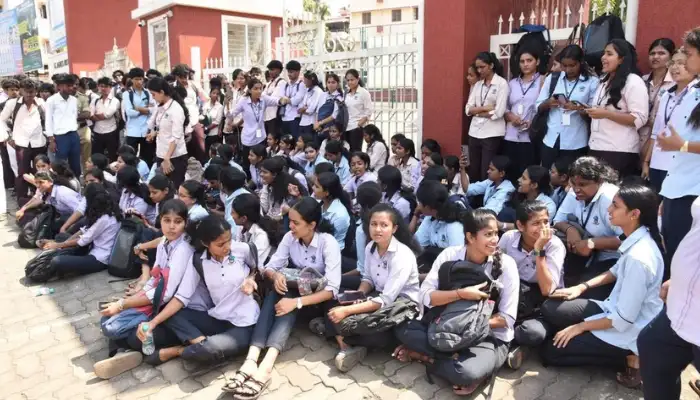
Case Summary
In Mangaluru, Karnataka, the Hindu festival of Dasara/Dussehra was targeted at St. Agnes College. The institution scheduled undergraduate semester examinations during the festival and shifted the Dussehra holiday to the Christmas period, hurting Hindu students' religious and cultural sentiments and limiting their participation in the festival. Hindu students subsequently boycotted their examinations and staged a protest outside the college gates on 12th October 2026, demanding that the examination schedule be changed to accommodate the Hindu festival. The odd-semester undergraduate examinations had been scheduled from 12th October to 28th October 2026. Students objected that the timetable coincided with the Mangaluru Dasara celebrations and prevented them from properly participating in the festivities. They also questioned why the college was conducting examinations during Dasara while providing holidays during the Christmas period. The students said they had approached the college management to postpone the examinations, but the management had not accepted their request before the protest. The protesting students received support from the Akhil Bharatiya Vidyarthi Parishad (ABVP), whose members joined the demonstration. They also submitted a representation to the Dakshina Kannada Deputy Commissioner, seeking intervention in the examination dispute. Despite the boycott and protest outside the campus, the college continued conducting examinations for students who chose to appear. The situation escalated when police personnel attempted to take some ABVP student leaders into custody. Female students blocked the police vehicle and opposed the detention, while some protesters sat or lay down in front of the jeep and demanded the release of the detained student leaders. Senior police officers, including a Deputy Commissioner of Police, arrived as the protest intensified. Accounts circulated in connection with the agitation further stated that female students were pushed and manhandled by police personnel and that an officer slapped a student after the student shouted “Bharat Mata Ki Jai.” The college administration later said it circulated a draft examination timetable on 11th September 2026, giving students 15 days to raise objections, seek clarification, or request changes. Principal M. Venissa said no objections were received during this period, and the college therefore published the final timetable on 26th September 2026. The college also maintained that it had scheduled examinations according to the approved academic calendar and that none fell on gazetted public holidays. As the agitation continued, College Registrar and Controller of Examinations Shubharekha announced that examinations scheduled for 19th and 22nd October would be postponed. She stated that further rescheduling would be difficult because of upcoming internships and a 10-day National Service Scheme camp beginning on 2nd November. Following the announcement, the students withdrew their protest. The college later said it would communicate the revised examination dates through official channels and warned that it would deal with further obstruction of academic activities or disruption of campus functioning under institutional rules.
Why it is Hate Crime ?
The primary category selected for this case is: Restriction/ban on Hindu practices. The subcategory selected is: Administration restricting religious practices. In several cases, it is seen that the administration/state disallows a religious practice owing to prejudicial orders and concerns, targeted specifically against the Hindu community. Such restriction/prohibition would be considered documented as a hate crime because the orders are often a result of pressure by groups that harbour animosity towards Hinduism and Hindus. Often, the restriction by the authorities is driven by bias, hostility, or prejudice against the specific community being stopped from holding a religious practice, by pressure groups that harbour animosity towards Hindus, intrinsic to their faith. Since practices are intrinsic to the faith of the Hindus, such prejudicial restriction is considered a curtailing of the fundamental rights of the Hindu community. In several cases, for example, the authorities ban a Hindu religious practice due to pressure from groups opposed to the religion. In other instances, the prohibition is selectively enforced against one religious group (Hindus) while others are allowed to proceed. There are still other cases where the authorities preemptively restrict a religious practice by Hindus because those who hold animosity towards Hindus may get “provoked”, leading to them being violent, thereby assuaging the sentiments of those who hold animosity towards Hindus by curtailing the religious rights of Hindus. Such acts and orders are prejudiced, indicating discriminatory motives owing to the capitulation to groups that harbour animosity towards Hindus and therefore would be categorised as a religiously motivated hate crime since the original pressure leading to the order itself is a result of hatred/bias/prejudice/religious hate against Hindus. This case is significant because the administrative decision placed Hindu students in a position where participation in Dussehra had to compete directly with compulsory academic obligations. A religious festival is not merely a recreational break; for Hindu students, Dussehra carries devotional, cultural and familial significance. Scheduling examinations through that period effectively curtailed the time and freedom available to observe the festival in the manner traditionally associated with it. The religious character of the restriction becomes stronger because Dussehra was not given the same institutional accommodation that students associated with the Christmas period. Where one religious observance is accommodated through a holiday period while a major Hindu festival is subjected to examinations, the burden does not fall equally. Such differential treatment creates the perception that Hindu religious observance is considered more expendable within the academic calendar. The restriction was also coercive in its practical effect. Students were not merely being asked to attend ordinary classes; they were required to appear for semester examinations carrying direct academic consequences. This forced Hindu students to choose between participating fully in an important religious festival and protecting their academic standing. A restriction does not need to take the form of an explicit written ban when institutional scheduling itself makes religious participation materially difficult. Dussehra holds deep significance in Hindu tradition as a festival associated with Dharma, the victory of good over evil, the triumph of Lord Ram over Ravana, and the worship of divine power in different regional traditions. In Mangaluru and the wider coastal Karnataka region, the festival period also carries strong community and cultural importance. Curtailing students’ ability to participate therefore affected more than leisure time; it interfered with an established Hindu religious and cultural observance. The institutional power imbalance is another important factor. A college controls examination dates, attendance consequences and academic progression. When that authority is exercised in a manner that places a major Hindu festival below academic scheduling priorities while another religious holiday receives accommodation, Hindu students have little practical ability to exercise their religious choice without risking educational consequences. This gives the restriction a distinctly discriminatory impact. The students’ protest also demonstrated that the issue was experienced as one of religious and cultural exclusion, not merely inconvenience. Their objection centred on the denial of meaningful space for Dussehra within the academic calendar and the unequal treatment they perceived between Hindu and Christian festival periods. Their mobilisation therefore arose from an attempt to protect the ability of Hindu students to observe their faith without being academically disadvantaged for doing so. The later decision to postpone only selected examinations also showed that administrative accommodation was possible once pressure was created. This makes the earlier rigidity more significant, because the conflict was not inherently unavoidable. Where institutional flexibility exists but is not initially extended to a Hindu festival despite its religious importance, the resulting burden on Hindu students acquires a prejudicial character. Taken together, the case reflects how administrative scheduling can operate as an effective restriction on Hindu religious practice even without a formal prohibition. By placing examinations across the Dussehra period, while students pointed to accommodation during Christmas, the institution created an unequal religious burden and restricted Hindu students’ practical ability to observe an important festival. Within the Hinduphobia Tracker framework, this makes the case appropriately documentable under Restriction/ban on Hindu practices, with the selected subcategory concerning administrative restriction of religious practice. Disclaimer: The Hinduphobia Tracker records incident dates based on when the victim’s ordeal or the discriminatory action began, not when the media subsequently reported it. In this case, the exact date on which St. Agnes College denied or failed to provide Dussehra holidays could not be conclusively established from the available information. Therefore, 12th October 2026, being the date on which the Hindu students began their protest against the examination schedule during the Dussehra period, has been selected as the indicative incident date for documentation purposes.


Case Status
Unknown


Perpetrators Details
Perpetrators
Unknown
Perpetrators Range
N/A
Perpetrators Gender
unknown
 Sources




