Hindu temple targeted, sacred idols of Lord Ram and Lakshman vandalised in Nashik, Maharashtra
 Nashik, Maharashtra, India
  9 October, 2026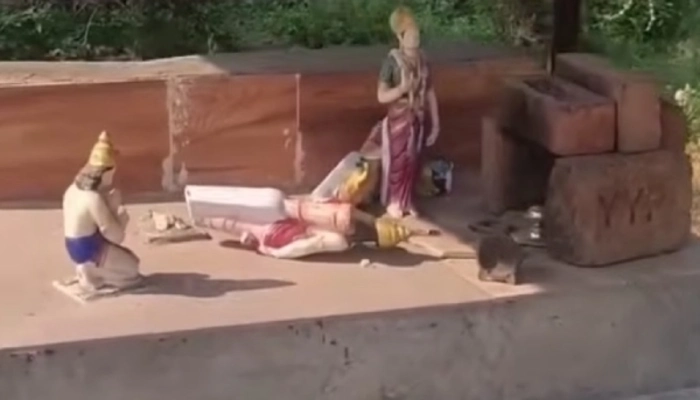
Case Summary
In Dahiwal village, Malegaon tehsil, Nashik district, Maharashtra, a Hindu temple was targeted and the sacred idols of Lord Ram and Lakshman were vandalised by an unidentified man. The incident occurred on 10 October 2026, the day of Sarva Pitru Amavasya, under the pretext of a land dispute. Instead of addressing the dispute through lawful means, the perpetrator vandalised the idols of Hindu deities inside the temple. The incident angered the Hindu villagers, who gathered to protest and demanded immediate and strict legal action against the perpetrator for desecrating the religious site and disturbing social harmony. The protesters raised slogans and staged a road blockade, demanding that the matter be treated seriously and that the perpetrator be punished. They also called for measures to prevent such incidents from recurring and to maintain peace and social harmony in the village. Following the incident and the protest, officers from the Malegaon Taluka police station arrived at the scene, and additional police personnel were deployed from nearby police stations to prevent further unrest and maintain law and order. The police monitored the situation, and the protest was withdrawn after the perpetrator was arrested. At the time of writing, the police stated that further action in the matter would be taken based on the investigation.
Why it is Hate Crime ?
This case is being added to the tracker under the primary category: Attack on Hindu religious representations. The subcategory selected is: Desecration of Hindu religious symbols. Icons and symbols or a religious representation of a spiritual ideal are widely revered in Hinduism. Iconography is of vital significance in the Hindu milieu. It helps connect people’s spiritual beliefs with the real world. Iconography within the Hindu faith takes several shapes and forms. Murtis are of most significance to Hindus, to which daily rituals, prayers and offerings are done. Besides the murtis, there are several other symbols which have deep significance in the Hindu faith – the Om and Swastika for example. Since these Hindu religious symbols hold paramount importance in Hinduism, any desecration of symbols, icons, murtis, religious representations and manifestations, is driven by animosity towards the faith itself which manifests itself through these murtis, icons and symbols. Therefore, any desecration of these Hindu religious symbols and representations is considered religiously motivated hate crimes under this category. The other subcategory selected is: Attack on Temples. In Hinduism, a temple is the abode of the Deity. The Deity in the Temple is consecrated, thereby, making it a real, breathing entity. Hindus believe that not just the Deity but the temple premises itself are sacred to Hindus since Hindus hold the faith that the entire Temple space is an amalgamation of the divine energy of the deity. Given the central significance of Temples in Hindu Dharma, any attack against a Hindu Temple or its peripheral premises is an attack on the faith itself and is born out of animosity towards the faith, of which, the Temple is a central tenet. Any manner of attack against a Temple and/or its premises would therefore be considered a religiously motivated hate crime. In this case, the vandalism of sacred idols of Hindu deities inside a temple constitutes a religiously driven hate crime rooted in anti-Hindu hostility. In Hinduism, idols are sacred representations of deities and serve as focal points of devotion and worship. Lord Ram, revered as an incarnation of Lord Vishnu, embodies dharma (righteousness), virtue, duty and the ideal of a just ruler. Goddess Sita, revered as an incarnation of Goddess Lakshmi and the consort of Lord Ram, represents devotion, purity, strength and moral integrity. Lakshman, the younger brother of Lord Ram, is venerated for his unwavering loyalty, sacrifice and devotion to his elder brother. Together, Lord Ram, Goddess Sita and Lakshman hold immense religious and cultural significance for Hindus, and their representations are integral to devotional practices and the worship of the deities. Their idols are not merely physical objects but sacred representations associated with divine presence, religious observance and the faith of devotees. Therefore, the act of vandalising the idols of Lord Ram and Lakshman amounted to the desecration of sacred Hindu religious symbols. It hurt Hindu religious sentiments and demonstrated complete disregard for the faith and devotional practices associated with these deities, constituting a religiously driven hate crime rooted in anti-Hindu animosity. Furthermore, the desecration occurred inside a Hindu temple, a sacred space where devotees worship deities, offer prayers, perform rituals and observe religious traditions. Temples serve as spiritual centres that facilitate devotees’ connection with the divine and preserve Hindu religious and cultural practices. The consecrated idols and the temple premises are integral to this sacred environment, forming interconnected parts of the larger temple ecosystem. Therefore, vandalising the idols within the temple violated not only the sanctity of the deities’ representations but also that of the place of worship itself. Such an act demonstrated disregard for the religious significance of Hindu temples and the faith and devotional practices they sustain, constituting an affront to Hindu religious sentiments. Some might argue that the incident should not be classified as a hate crime because the vandalism occurred under the pretext of a land dispute. However, a property dispute does not justify the desecration of religious idols. If the perpetrator had a genuine grievance concerning land, he could have pursued legal remedies to resolve the matter. Vandalising the idols of Hindu deities had no legitimate connection to resolving a property dispute and could not serve as a lawful means of addressing such a grievance. Instead, the perpetrator directed his actions at sacred Hindu representations, causing religious offence and violating the sanctity of a place of worship. The existence of a land dispute does not diminish the religious significance of the objects targeted or erase the hostility expressed through their desecration. Nor does it provide justification for directing an act of vandalism at symbols central to Hindu faith. The land dispute, therefore, does not, in itself, negate the religious dimension of the offence or absolve the perpetrator of responsibility for desecrating Hindu sacred symbols. The act remains an attack on Hindu religious sentiments, irrespective of the purported dispute that preceded it. At the time of documentation, the perpetrator's identity and religious affiliation remained unknown. Nevertheless, the act involved the desecration of sacred Hindu symbols within a Hindu temple. The case is therefore being documented in the Hinduphobia Tracker as a religiously driven hate crime targeting Hindu religious representations and a sacred place of worship.


Case Status
Arrested


Perpetrators Details
Perpetrators
Unknown
Perpetrators Range
One Person
Perpetrators Gender
male
 Sources




