Hindu residents targeted for religious conversion by Christian missionaries through organised network of religious institutions and training programmes
 Kosi Zone, Nepal
  8 October, 2026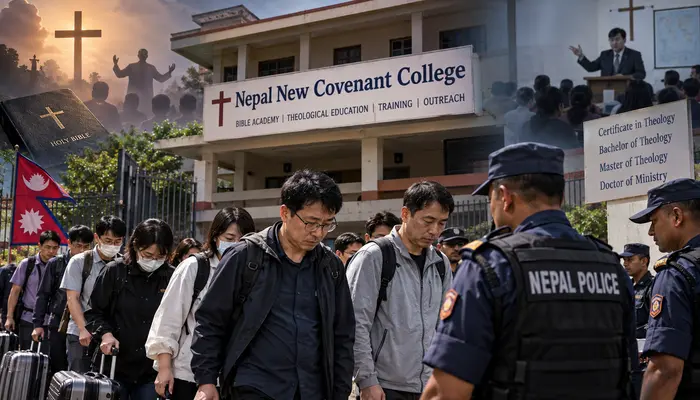
Case Summary
In Morang district, Nepal, Hindu residents were targeted for religious conversion by Christian missionaries operating through a network of religious institutions and training programmes. On 9 October 2026, 24 South Korean nationals were detained by a joint team from the District Administration Office and District Police Office in Sundarharaicha Municipality-7, Morang district, Nepal, for engaging in Christian religious activities and proselytisation while entering the country on tourist visas. It was revealed that the Christian missionary group was detained while participating in religious training and a convocation programme at Nepal New Covenant College, located on Malati Marg in Sundarharaicha. According to Morang district authorities, the perpetrators had engaged in religious classes, training and proselytisation activities in violation of the conditions of their visas. The 24 individuals included 12 men and 12 women, among them Dr Park Gui Hwan, president of Love Nepal Mission, a South Korean organisation that financially supported the college. The group had arrived in Biratnagar in two batches on 6 and 7 October 2026 and had planned to remain in Nepal until 12 October to conduct religious programmes. Six members of the group stayed at Nepalarika Hotel in Sundarharaicha-9, while the remaining 18 stayed in the college hostel. Nepal New Covenant College operated from a two-storey building and a newly constructed 22-room building on a site covering approximately 1 bigha and 1 kattha of land. The institution had initially operated without permission from a government body as an educational institution and was subsequently registered as a social and religious trust named Ratna Baptist Foundation at the Belbari Land Revenue Office. Under the trust, the institution ran a Bible Academy that offered Christian theological courses ranging from certificates and bachelor's and master's degrees in theology to doctoral studies. More than 300 students were enrolled at the college, including approximately 45 students from economically disadvantaged families across Nepal who received Christian religious education at reduced fees or free of charge and accommodation in the hostel. The institution received financial support from Love Nepal Mission, while Nepali individuals, including Mahendra Gang Sachai Rai of Dharan and Dr Sharad KC of Duhabi-5, were involved in its management. Investigative sources further stated that South Korean nationals had repeatedly visited the area on tourist visas to participate in and organise religious programmes aimed at religious conversion. On 20 March 2024, 39 South Korean nationals visited the college to attend a convocation ceremony, with two remaining behind for studies while the others returned to South Korea. Authorities were also investigating a wider network operating in rural and economically disadvantaged settlements across northern Morang, including Sundarharaicha, Letang and Miklajung, through which churches, colleges and foundations had been established with South Korean financial support to train pastors and conduct Christian religious outreach. Following their detention, all 24 South Korean nationals were transferred by air to the Department of Immigration in Kathmandu for further investigation and legal proceedings, including possible deportation, under Nepal's immigration regulations and the Foreign Citizen Monitoring Directive, 2075.
Why it is Hate Crime ?
The primary category selected in this case is: Predatory Proselytisation. Within this, the subcategory selected is: Proselytisation by grooming, brainwashing, manipulation or subtle indoctrination, with the tertiary category being - Pattern of targeting Hindus. Religious brainwashing essentially means the often subtle and forcible indoctrination to induce someone to give up their religious beliefs to accept contrasting regimented ideas. Religious grooming or brainwashing also involves propaganda and manipulation. It involves the systematic effort, driven by religious malice and indoctrination, to persuade “non-believers’ to accept allegiance, command, or doctrine to and of a contrasting faith. Cases of such grooming or brainwashing are far more nuanced than direct threats, coercion, inducement and violence. In such cases, it is often seen that there is repeated, subtle and continual manipulation of the victim to induce disaffection towards their own faith and acceptance of the contrasting faith of the perpetrator. While subtle indoctrination is widely acknowledged as predatory, an element which is often understated in such conversions or the attempts of such conversion is the role of loyalty and trust which might develop between the perpetrator and the victim. Fiduciary relationships are often abused to affect such religious conversion. For example, an educator transmitting religious doctrine of a competing faith to a Hindu student. The Hindu student is likely to accept what the teacher is transmitting owing to existence of the fiduciary relationship. The exploitation of the fiduciary relationship to religiously indoctrinate victims would also be included in this category. Since the underlying animosity towards the victim’s faith forms the basis of predatory proselytization, such cases are considered religiously motivated hate crimes. The other subcategory selected here is - Conversion/ attempts to convert by inducement. Predatory Proselytisation is not just limited to threat, harassment, force and violence, but it also has contours of stealth. In several cases, the Hindu victim is exploited to convert, with non-Hindus taking advantage of their poverty. In such cases, the Hindu victim who is suffering financially is offered monetary benefits, including lucrative offers for jobs, health treatment, education, etc, to induce the victim into changing his/her religion. In such cases, the religious identity of the victim and the aim to disenfranchise him from his faith form the heart of the crime. Also, taking advantage of and exploiting an individual’s economic vulnerabilities is widely acknowledged as exploitation, forms of which are often penalised by law. Such cases therefore are considered religiously motivated hate crimes since the victim’s religious identity forms the very heart of the crime itself. The case constituted an anti-Hindu hate crime because the missionary activities involved an organised effort to promote Christianity and convert Hindus through an established network of religious institutions. The network targeted rural and economically disadvantaged settlements in northern Morang, a Hindu-majority district, through the establishment of churches, religious colleges and foundations. Financial support from South Korean Christian missionary organisations funded these activities, while the training of local pastors enabled the continued expansion of Christian religious outreach aimed at converting the local Hindu population. Through these institutions and training programmes, the missionary network sought to expand Christianity among the local population, including Hindus, making the activities part of an organised effort to bring about religious conversion rather than an isolated instance of religious instruction. The provision of free or subsidised education and accommodation to students from economically disadvantaged families constituted a form of inducement used to expand missionary influence among financially vulnerable communities. By linking educational assistance and accommodation with Christian religious instruction, the network used material benefits to attract students into a Christian teaching environment. Such inducements created avenues for influencing the religious beliefs of vulnerable individuals, including Hindus, and encouraging a shift away from their ancestral faith towards Christianity. The network targeted Hindu religious identity by promoting Christianity and seeking to convert Hindu residents away from their ancestral faith. The establishment of churches, religious colleges and foundations, backed by foreign missionary funding and programmes to train local pastors, enabled the systematic expansion of Christian missionary activities within Hindu-majority communities. These activities were part of an organised effort to spread Christianity and facilitate religious conversion, directly challenging the preservation of Hindu beliefs, traditions and religious identity. The targeting of Hindu residents for conversion through these institutional arrangements constituted hostility towards the preservation of their religious identity and traditions. Furthermore, the group's violation of Nepal's visa regulations demonstrated that its missionary activities were conducted outside the legal conditions governing its stay. The 24 South Korean nationals had entered Nepal on tourist visas but were detained while participating in religious teaching, training and proselytisation, activities that fell outside the permitted purpose of their visas. If the group's activities constituted genuine and lawful religious outreach, why did it not comply with the immigration regulations or the local laws governing such activities? By using tourist visas to engage in proselytisation activities, the group circumvented the legal framework governing its presence in Nepal. This disregard for the law, alongside the use of foreign missionary funding and an established network of religious institutions, demonstrated the organised nature of the operation and its pursuit of missionary activities. This violation reinforced the organised and deliberate nature of the missionary operation, which used foreign visitors and an established institutional network to conduct religious activities beyond the scope of their authorised stay. The nature of the conversion efforts and the wider impact on the Hindu community all indicate a targeted action against Hindus as a collectivity. When individuals or groups focus their efforts on converting members of a particular religion, in this case, Hindus, then it demonstrates a fundamental disregard for the Hindu faith. Conversion, especially when not based on personal conviction but rather on external persuasion or pressure, is not simply about sharing a different belief system. It is an attempt to undermine the values, traditions, and identity of the Hindu community. In this context, the Christian perpetrators specifically targeted Hindus, which demonstrates a lack of respect for Hinduism and its followers. Such actions are carried out to strip Hindu victims of their faith, making it a religiously motivated crime. The Christian faith, by its very theological foundations, places a strong emphasis on proselytisation. In pursuit of conversion objectives, Christian evangelists often employ unethical means, ranging from psychological pressure and misinformation to inducements such as money or jobs. In such cases, Christian missionary groups often target and brainwash socially and economically vulnerable Hindus to further their agenda of religious conversions. This form of coercion strips Hindus of their agency and dignity and enforces forced conversions. These are not random or isolated incidents, but rather premeditated efforts to undermine the Hindu faith, persuade Hindus to discard their own faith, and convert to Christianity. Such acts were deeply rooted in religious animosity towards Hindu victims, and thus, this case was added to the tracker.


Case Status
Arrested


Perpetrators Details
Perpetrators
Christian Extremists
Perpetrators Range
From 10 to 100
Perpetrators Gender
both
 Sources




