Hindu religious event disrupted: Ramleela halted after stones pelted at programme, devotees attacked and threats issued to stop performance
 Haridwar, Uttarakhand, India
  8 October, 2026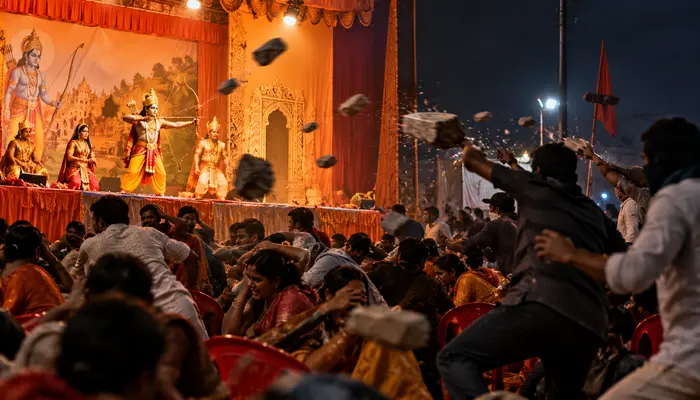
Case Summary
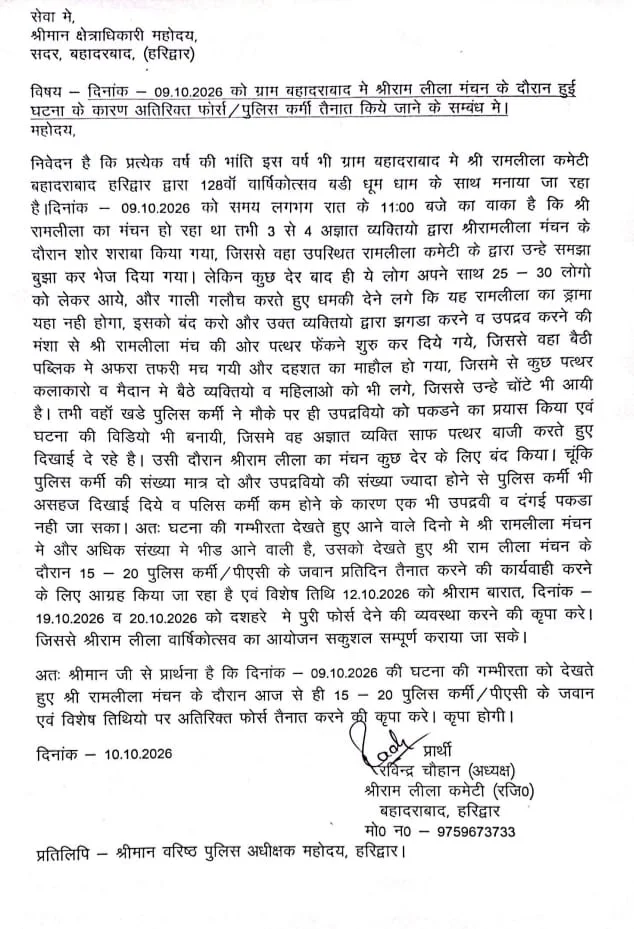
In Bahadrabad town, Haridwar district, Uttarakhand, the 128th Shri Ramleela Annual Festival, a longstanding Hindu religious and cultural event, was disrupted when miscreants pelted stones at the Ramleela stage and the area where Hindu devotees were seated. The incident involved threats to stop the Ramleela performance and verbal abuse at the devotees and organisers. According to the Shri Ramleela Committee president, Ravindra Chauhan, the Ramleela had been organised at the Shiv Temple for many years, and the 128th annual festival continued this longstanding tradition. On Friday, 9 October 2026, at approximately 11.00 pm, while the Ramleela performance was in progress at the Shiv Temple in Bahadrabad, three to four unidentified persons arrived at the venue and began creating a ruckus. Members of the Shri Ramleela Committee intervened, attempted to reason with them and warned them to leave the premises. The miscreants left, only to return with about 25–30 additional people. The group again issued renewed threats to stop the Ramleela and began throwing stones at the stage and the adjoining ground, where artists were performing and many spectators were seated. The stone-pelting created panic and confusion, with the situation escalating into a stampede. Several people, including women, were injured, and the performance was temporarily suspended. Police personnel at the venue tried to apprehend the miscreants; however, their numbers were insufficient for the size of the group, making it difficult to apprehend those responsible. Video footage later emerged showing unidentified persons throwing stones at the Ramleela stage and creating a ruckus. On 10 October 2026, Ravindra Chauhan, president of the Shri Ramleela Committee, Bahadrabad, submitted a written complaint to the Circle Officer, Bahadrabad, Haridwar, seeking action on the incident and additional police deployment for the remaining festival programme. The complaint described the sequence of events, the threats to stop the Ramleela, the stone-pelting, the presence of police personnel and the video recordings made during the incident. Chauhan requested that the authorities identify those involved and take appropriate action. The committee also marked the complaint to the Senior Superintendent of Police, Haridwar. The committee requested about 15–20 additional police personnel for the remaining Ramleela performances and upcoming religious events. The request specifically covered the Shri Ram Baraat scheduled for 12 October 2026 and the Dussehra celebrations scheduled for 19 and 20 October 2026. The committee sought adequate security to protect artists, spectators, devotees and other attendees and to prevent a recurrence of the disturbance. It also requested that the remaining annual festival and associated religious events proceed peacefully. On 11 October 2026, it was reported that police had registered a case against unidentified persons in connection with the stone-pelting incident. The investigation focused on identifying those involved through video footage and establishing their respective roles in the disturbance. Inspector Amarjeet Singh said the police would take further action under the law after the investigation.
Case Images
Why it is Hate Crime ?
The primary category selected in this case is: Attack on Hindu religious representations. The subcategory selected is: Violence against religious structures or centres. In Hinduism, a religious structure is also considered divine. Hindus believe that not just the Deity but the religious structure itself is sacred. In this sub-category, we would document attacks against religious structures which are not consecrated temple spaces. Such religious spaces could be temporary in nature – for example – the religious spaces erected specifically for festivals like Durga Puja etc. This category would also document cases of attacks against religious centres. These spaces in their own right may not be ‘sacred’ per se, however, are often spaces where religious gurus live, religious teaching is imparted, or belong to religious institutions. Any attack against religious structures is a result of animosity towards the religion itself, which manifests itself through the religious spaces and therefore, such attacks are considered religiously motivated hate crimes. Religious centres are also manifestations of the religion, its teachings or gurus and therefore, attacks against such centres would be considered religiously motivated hate crimes. The other primary category selected is: Attack not resulting in death. The subcategory selected is: Attacked for Hindu identity. In several cases, Hindus are attacked merely for their Hindu identity without any perceived provocation. A classic example of this category of religiously motivated hate crime is a murder in 2016. 7 ISIS terrorists were convicted for shooting a school principal in Kanpur because they got ‘triggered’ seeing the Kalava on his wrist and tilak that he had put. In this, the Hindu victim had offered no provocation except for his Hindu religious identity. The motivation for the murder was purely religious, driven by religious supremacy. Such cases where Hindus are targeted merely for their religious identity would be documented as a hate crime under this category. This incident involved the deliberate disruption of a longstanding Hindu religious and cultural event, accompanied by explicit threats to stop the Ramleela performance, verbal abuse directed at devotees and organisers, and stone-pelting at the stage and the area where Hindu spectators had gathered. The fact that the disturbance occurred while the 128th Shri Ramleela Annual Festival was underway at the Shiv Temple is significant. Ramleela is not merely a public performance; it is a religious observance centred on the life and triumph of Bhagwan Shri Ram, bringing Hindu devotees together to participate in and preserve a tradition passed down through generations. Disrupting such an event interferes with the community’s ability to practise and publicly express its faith. The nature and escalation of the incident make it particularly concerning. According to the complaint, the initial group left after committee members confronted them but returned with about 25–30 additional people. The group renewed its threats to stop the performance and pelted stones at the stage where artists were performing and at the adjoining area where devotees were seated. This was not simply a disagreement that caused a temporary disturbance. The reported conduct placed performers and spectators in danger, triggered panic and a stampede, injured several people, including women, and forced the Ramleela to be suspended. The threats to prevent the performance from continuing also raise concerns about an attempt to intimidate the organisers and deny devotees the opportunity to participate in a religious event. The religious context is central to understanding the incident's impact. The Ramleela had been organised at the Shiv Temple for many years, and the 128th annual edition continued an established Hindu tradition. Targeting the event with threats and violence therefore affected more than the immediate individuals present; it disrupted a collective act of religious and cultural expression. The committee’s subsequent request for additional police deployment for the remaining performances, the Ram Baraat and Dussehra celebrations further reflected concerns about the safety of Hindu devotees and the possibility of another disruption. The incident has consequently been included in the Hinduphobia Tracker as a case involving the disruption of Hindu religious practice and intimidation of Hindu devotees. The reported threats to stop the Ramleela, followed by the return of the group in larger numbers and the use of stone-pelting to disrupt the gathering, provide grounds for concern that the event and its participants were being targeted in the exercise of their religious and cultural rights. The reported conduct went beyond disturbing public order: it obstructed a Hindu religious celebration, endangered devotees gathered to participate in it, and sought to prevent a longstanding expression of Hindu faith from continuing. At the same time, the available account does not establish the perpetrators’ identities or explicitly document anti-Hindu remarks beyond the reported threats and verbal abuse. The investigation will help establish whether religious hostility was the underlying motive. Disclaimer: In this case, the total number of perpetrators has not been specified. The available accounts gave differing estimates of the group involved in the stone-pelting incident, with some describing 25–30 additional people accompanying the initial group and others referring to 20–25 people involved in the disturbance. Henceforth, the perpetrator count has been recorded as thirty (30). This is recorded for documentation purposes only, as it represents an estimate based on the available accounts.


Case Status
Complaint filed


Perpetrators Details
Perpetrators
Unknown
Perpetrators Range
From 10 to 100
Perpetrators Gender
unknown
 Sources




