Hindu temple vandalised in Tonk, Rajasthan; idols of Lord Raghunath and Goddess Janaki desecrated, Shaligram idol thrown into drain
 Tonk, Rajasthan, India
  15 September, 2026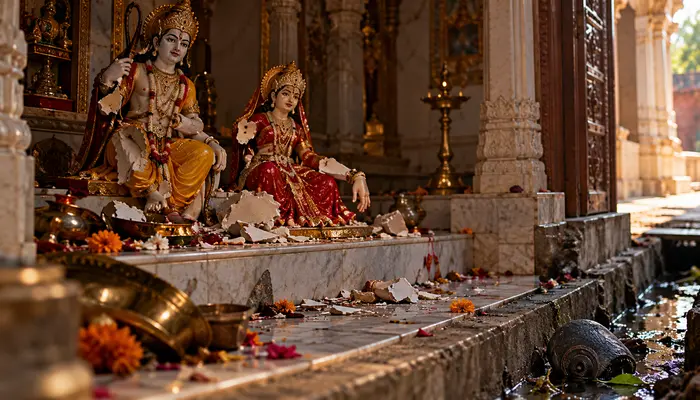
Case Summary
In Panwalia village of Tonk, Rajasthan, a sacred Hindu place of worship, the Shri Raghunathnath Ji Temple was vandalised and the idols of Lord Raghunath and Goddess Janaki were desecrated. The idol of Goddess Janaki’s right hand was broken, and one sacred Shaligram stone was found lying in a drain outside the temple, while the other went missing. On 16 September 2026, temple priest Mahavir Vaishnav left the temple at about 10:30 am to collect bhog (food offerings) for the deities from his home, about 500 metres away. During his absence, an unidentified individual entered the temple and committed the act. The umbrellas, crowns and other ornaments kept inside the temple were found safe. When Mahavir Vaishnav returned, he noticed that the right hand of Goddess Janaki’s idol had been broken. He then discovered that both Shaligram stones were missing from the temple. The priest and local villagers searched the surrounding area and found one stone lying in a drain outside the temple, but they could not locate the second stone. As news of the incident spread, many villagers gathered on the temple premises. The incident angered local residents. Mahavir Vaishnav subsequently lodged a police complaint regarding the incident. Following the complaint, Assistant Sub-Inspector Banna Lal arrived at the site, inspected the temple premises and gathered information about the incident. The police initiated an investigation and began searching for the unidentified individual responsible. According to the inscription plaque installed within the temple premises, the renovation of Shri Raghunath Ji Maharaj Temple and the consecration ceremony of Shri Shiv Panchayat were conducted in November 2025.
Why it is Hate Crime ?
The primary category selected in this case is: Attack on Hindu religious representations. The subcategory selected is: Desecration of Hindu religious symbol. Icons and symbols or a religious representation of a spiritual ideal are widely revered in Hinduism. Iconography is of vital significance in the Hindu milieu. It helps connect people’s spiritual beliefs with the real world. Iconography within the Hindu faith takes several shapes and forms. Murtis are of most significance to Hindus, to which daily rituals, prayers and offerings are done. Besides the murtis, there are several other symbols which have deep significance in the Hindu faith – the Om and Swastika for example. Since these Hindu religious symbols hold paramount importance in Hinduism, any desecration of symbols, icons, murtis, religious representations and manifestations, is driven by animosity towards the faith itself which manifests itself through these murtis, icons and symbols. Therefore, any desecration of these Hindu religious symbols and representations is considered religiously motivated hate crimes under this category. The other subcategory selected is: Attack on Temples. In Hinduism, a temple is the abode of the Deity. The Deity in the Temple is consecrated, thereby, making it a real, breathing entity. Hindus believe that not just the Deity but the temple premises itself are sacred to Hindus since Hindus hold the faith that the entire Temple space is an amalgamation of the divine energy of the deity. Given the central significance of Temples in Hindu Dharma, any attack against a Hindu Temple or its peripheral premises is an attack on the faith itself and is born out of animosity towards the faith, of which, the Temple is a central tenet. Any manner of attack against a Temple and/or its premises would therefore be considered a religiously motivated hate crime. The religious dimension of the incident was demonstrated by the fact that the accused specifically targeted a Hindu place of worship and damaged the idols of Lord Raghunath and Goddess Janaki, revered Hindu deities, while a sacred Shaligram stone was thrown in a drain. The targeting of sacred Hindu figures within a place of worship constituted an act of religious desecration and an affront to Hindu religious beliefs and practices. In Hinduism, murtis, or consecrated idols, are not merely physical representations or decorative objects; they are revered manifestations through which devotees worship and establish a sacred connection with the deity. They occupy a central place in Hindu religious practice and are treated with deep reverence and sanctity. Lord Raghunath and Goddess Janaki also hold profound religious significance in Hinduism, as they represent Lord Rama and Goddess Sita, central figures in the Hindu epic Ramayana and enduring symbols of dharma (righteousness), devotion, moral duty, marital fidelity, and the triumph of good over evil. Their idols serve as sacred focal points for daily worship, prayers, offerings and devotional practices, through which Hindu devotees express their faith and maintain their spiritual connection with the deities. The damage to these idols therefore went beyond physical harm to religious images; it affected figures that embodied the temple’s devotional life and held deep spiritual and emotional value for worshippers. Breaking Goddess Janaki’s right hand and damaging the idols violated the sanctity associated with the worship of Lord Rama and Goddess Sita. For Hindu devotees, the desecration of such sacred representations constitutes an affront to their religious sentiments, beliefs and traditions, as these idols occupy a central place in the expression and practice of their faith. Furthermore, the two Shaligram stones carry distinct significance within Hindu religious tradition because Shaligram Shilas are revered as naturally formed manifestations of Lord Vishnu, the preserver and protector within the Hindu understanding of the divine. Their worship is closely tied to Vaishnava traditions, household and temple rituals, and the offering of prayers and Tulsi leaves. Unlike conventional sculpted idols, Shaligram stones are traditionally regarded as inherently sacred and are worshipped without the same human consecration as many other images. Their religious importance therefore extends beyond their physical appearance, as they represent the divine presence of Lord Vishnu and form part of established Hindu devotional practices. Removing the stones disrupted their place in the temple’s worship, while finding one in a drain outside the premises carried particular significance because a sacred object was found in a place associated with waste and impurity. Such circumstances were deeply disrespectful to a revered object of worship. The disappearance of the second Shaligram stone also deprived the temple of a sacred object whose whereabouts remained unknown. Together, these circumstances affected religious objects central to Hindu worship and raised concerns about the protection and respect accorded to sacred Hindu traditions. Accordingly, this case has been documented in the Hinduphobia Tracker's Hate Crime Database as an instance of religiously motivated hostility directed against Hinduism and the religious identity of the Hindu community. It is important to mention here that, though the last update stated that the miscreants were unknown, regardless, the action stemmed from hatred against Hinduism and resulted in the desecration of the sacred temple and would therefore be considered a religiously motivated hate crime.


Case Status
Complaint filed


Perpetrators Details
Perpetrators
Unknown
Perpetrators Range
Unknown
Perpetrators Gender
unknown
 Sources




