Hindu temple vandalised and religious items set ablaze mere days ahead of Durga Puja in Gopalganj, Bihar
 Gopalganj, Bihar, India
  7 October, 2026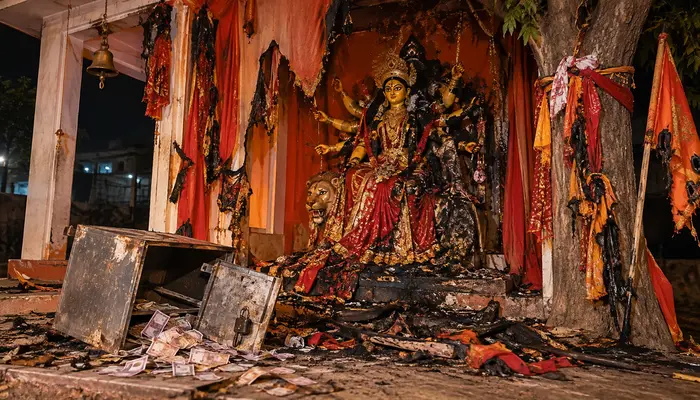
Case Summary
In Chanave village of Gopalganj district, Bihar, a Durga temple was vandalised and religious items were set ablaze on the night of 8 October 2026. The temple curtains, the seat of Goddess Durga, clothes tied to a neem tree and religious flags were burnt. The donation box was also broken, and money was stolen from it before the box was set on fire. The incident came to light after village chowkidar Kamlesh Kumar Manjhi received information about the fire while patrolling the area. He subsequently lodged an FIR at Thawe police station against Bigu Manjhi, a resident of the same village, in connection with the incident. The chowkidar also stated that Bigu Manjhi had been sleeping at the temple for approximately a year and consuming drugs. Following the incident, police personnel, led by station house officer Vibha Kumari, visited the temple and investigated the matter. Police also conducted raids to locate and arrest the accused.
Why it is Hate Crime ?
The primary category selected in this case is: Attack on Hindu religious representations. The first subcategory selected is: Attack on Temples. In Hinduism, a temple is the abode of the Deity. The Deity in the Temple is consecrated, thereby, making it a real, breathing entity. Hindus believe that not just the Deity but the temple premises itself are sacred to Hindus since Hindus hold the faith that the entire Temple space is an amalgamation of the divine energy of the deity. Given the central significance of Temples in Hindu Dharma, any attack against a Hindu Temple or its peripheral premises is an attack on the faith itself and is born out of animosity towards the faith, of which, the Temple is a central tenet. Any manner of attack against a Temple and/or its premises would therefore be considered a religiously motivated hate crime. The other subcategory selected is: Desecration of Hindu religious symbol. Icons and symbols or a religious representation of a spiritual ideal are widely revered in Hinduism. Iconography is of vital significance in the Hindu milieu. It helps connect people’s spiritual beliefs with the real world. Iconography within the Hindu faith takes several shapes and forms. Murtis are of most significance to Hindus, to which daily rituals, prayers and offerings are done. Besides the murtis, there are several other symbols which have deep significance in the Hindu faith – the Om and Swastika for example. Since these Hindu religious symbols hold paramount importance in Hinduism, any desecration of symbols, icons, murtis, religious representations and manifestations, is driven by animosity towards the faith itself which manifests itself through these murtis, icons and symbols. Therefore, any desecration of these Hindu religious symbols and representations is considered religiously motivated hate crimes under this category. The other subcategory selected here is - Breaking rules of places of worship. Sanatan Dharma is not a religion of one book, which is to say that while it has religious scriptures that form the central tenets of the faith, there are several traditions followed through thousands of years, mostly passed from generation to generation orally. One of these oral traditions or written traditions is the rules of specific temples. Certain temples have rules which are traditional rules, dependent on the worship of the presiding deities. These rules and traditions have been followed for thousands of years whether they find scriptural mention or not. Such traditions are based on the nature and rules of worship of the presiding deity of that temple. Any non-compliance of these traditions owing to animosity towards the faith or for the sake of activism stems not only from the lack of faith in the presiding deity but also disregard for the faith of the devotees of that deity/temple and implicit bias against the faith, the tradition and the deity itself. Since these specific traditions are central to the faith of the devotees of that specific temple and presiding deity, any non-compliance with these traditional rules would be considered a religiously motivated hate crime. The incident constituted an anti-Hindu hate crime because it involved the deliberate desecration of a Hindu place of worship and the burning of objects associated with Hindu religious practices. A Durga temple is a sacred space for Hindus, and the seat of Goddess Durga, religious flags, and other objects used in worship hold religious significance for the community. Their deliberate destruction went beyond ordinary property damage, as it affected objects central to Hindu devotion and the sanctity of a religious site. The targeting of these sacred objects represented an attack on Hindu religious practices and the community's ability to worship without interference. The desecration of a Hindu temple undermines the religious security of the community it serves by violating a space dedicated to worship, prayer and devotion to Hindu deities. Such acts cause distress among worshippers by demonstrating disregard for their religious beliefs, sacred objects and places of worship. Temples hold an important place in Hindu religious life, serving as spaces where devotees offer prayers, perform rituals and maintain their connection with their faith. The burning of objects associated with Goddess Durga was particularly significant because these objects formed part of the religious environment dedicated to her worship and held spiritual significance for the Hindu community. Their destruction violated the sanctity of the temple and disrupted the religious setting in which worshippers practised their faith. The incident therefore went beyond damage to physical property, as it involved the desecration of a sacred Hindu space and the destruction of objects integral to religious devotion, undermining the community's ability to worship in an environment where its beliefs and sacred traditions were respected. The timing of the incident, shortly before Durga Puja, further heightened its religious significance. Durga Puja is an important Hindu festival dedicated to Goddess Durga, and the desecration of a Durga temple immediately before the festival struck at a place associated with the worship of the very deity being celebrated. The destruction of sacred objects at this time affected the religious environment in which the local Hindu community prepared to observe the festival. Taken together, the deliberate damage to the Hindu place of worship, the burning of sacred objects and the timing before an important Hindu festival establish the anti-Hindu character of the incident. Furthermore, it was also stated that the perpetrator consumed drugs inside the temple premises, demonstrating disregard for the sanctity of a Hindu place of worship. A temple is a sacred space dedicated to prayer, devotion and the worship of Hindu deities, and engaging in conduct that violates its religious and spiritual purpose undermines its sanctity. The use of drugs within the premises showed disrespect for the religious significance of the space and the beliefs of the Hindu community for whom it served as a place of worship. In the context of the wider incident involving the desecration of sacred objects, this conduct further contributed to the violation of the temple's sanctity and the disregard shown towards Hindu religious practices. Taken together, the desecration of the Durga temple, the destruction of sacred Hindu objects and the disregard for the sanctity of the place of worship constituted an attack on Hindu religious practices and the sentiments of the local Hindu community. The incident reflected a violation of the community's religious space and its right to worship without interference or desecration; therefore, this case has been added to the tracker.


Case Status
Complaint filed


Perpetrators Details
Perpetrators
Others
Perpetrators Range
One Person
Perpetrators Gender
male
 Sources




