Sacred idols of Shani Dev and Bhairav Baba desecrated at Hindu temple in Kangra, Himachal Pradesh
 Kangra, Himachal Pradesh, India
  6 October, 2026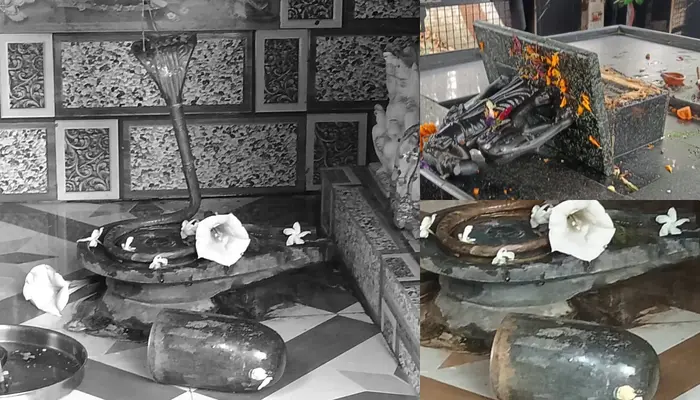
Case Summary
In Ganesh Colony of Ward number 5, Kangra district, Himachal Pradesh, the idols of Hindu deities Shani Dev and Bhairav Baba at the ancient Hindu temple were vandalised in the middle of the night. The sacred idols were found desecrated, causing distress among devotees and anger among local Hindu residents. The incident came to light on the morning of 7 October 2026, when devotees and residents arrived at the temple and discovered the damaged idols. The police were informed and promptly initiated an investigation. Superintendent of Police (SP), Dehra, Sandeep Dhawal, visited the site with police officers and personnel, inspected the premises and issued directions to expedite the investigation. Initial enquiries focused on identifying the person responsible for the vandalism. During the investigation, the police received important information about a suspect and conducted a raid at his residence, but he was not present. Officers subsequently searched various locations, including the Jwalamukhi bus stand and nearby areas. After approximately two hours of searching, the police located the suspect and took him to Jwalamukhi police station for questioning. The police arrested him within approximately 10 hours of the incident coming to light, although the precise timeframe was not consistently reported. The arrested individual was identified as Virender Singh alias Vicky, a resident of Raikha, in Tehsil Jwalamukhi, Kangra district. During preliminary questioning, he admitted to damaging the idols. He claimed that he had been intoxicated on the night of the incident and had quarrelled with family members at home. Following the domestic dispute, he went to the temple in anger and damaged the idols of Shani Dev and Bhairav Baba. The police examined closed-circuit television (CCTV) cameras installed at and near the temple. The footage provided limited assistance in tracing the suspect, and officers relied on information received during the investigation and the search operation to locate him. The police continued investigating the motive behind the vandalism and whether the accused had acted alone or with another person. The circumstances surrounding the incident remained under investigation. Following the incident, Jwalamukhi Nagar Parishad President Somkaran Sharma, Vice President Deepti Sharma and councillor Neeraj Sharma visited the temple, inspected the premises and spoke with residents and temple priest Gopal Sharma. The representatives condemned the vandalism and urged the police administration to conduct a thorough investigation and take appropriate legal action against the person responsible. Devotees also demanded stronger security arrangements at religious places to prevent similar incidents. Temple priest Gopal Sharma described the incident as unfortunate and stated that the damage had hurt the religious sentiments of devotees. The Vishva Hindu Parishad (VHP) also expressed anger over the incident. Kuldeep Rana, the VHP's Himachal Pradesh state temple and priest (archak-purohit) chief, condemned acts involving damage to religious places and idols of deities. The VHP's Dehra organisational district unit called on the police and administration to investigate the incident seriously and ensure appropriate action against the person responsible. Other members who expressed concern included Madan, the Dehra district president; Banish Sharma, the district secretary; Himanshu, the temple archak-purohit chief; Kanti Sharma; and other VHP workers. SP Dehra Sandeep Dhawal confirmed that a first information report (FIR) had been registered in connection with the damage to the idols at the ancient Shani Dev temple and that one accused had been arrested. He stated that further details would emerge after the investigation and questioning were completed. He also appealed to the public to inform the police immediately if they noticed suspicious activity so that timely action could be taken.
Why it is Hate Crime ?
The primary category selected in this case is: Attack on Hindu religious representations. The subcategory selected is: Desecration of Hindu religious symbol. Icons and symbols or a religious representation of a spiritual ideal are widely revered in Hinduism. Iconography is of vital significance in the Hindu milieu. It helps connect people’s spiritual beliefs with the real world. Iconography within the Hindu faith takes several shapes and forms. Murtis are of most significance to Hindus, to which daily rituals, prayers and offerings are done. Besides the murtis, there are several other symbols which have deep significance in the Hindu faith – the Om and Swastika for example. Since these Hindu religious symbols hold paramount importance in Hinduism, any desecration of symbols, icons, murtis, religious representations and manifestations, is driven by animosity towards the faith itself which manifests itself through these murtis, icons and symbols. Therefore, any desecration of these Hindu religious symbols and representations is considered religiously motivated hate crimes under this category. The other subcategory selected is: Breaking rules of places of worship. Sanatan Dharma is not a religion of one book, which is to say that while it has religious scriptures that form the central tenets of the faith, there are several traditions followed through thousands of years, mostly passed from generation to generation orally. One of these oral traditions or written traditions is the rules of specific temples. Certain temples have rules which are traditional rules, dependent on the worship of the presiding deities. These rules and traditions have been followed for thousands of years whether they find scriptural mention or not. Such traditions are based on the nature and rules of worship of the presiding deity of that temple. Any non-compliance of these traditions owing to animosity towards the faith or for the sake of activism stems not only from the lack of faith in the presiding deity but also disregard for the faith of the devotees of that deity/temple and implicit bias against the faith, the tradition and the deity itself. Since these specific traditions are central to the faith of the devotees of that specific temple and presiding deity, any non-compliance with these traditional rules would be considered a religiously motivated hate crime. The other sub-category selected here is - Attack on temples. In Hinduism, a temple is the abode of the Deity. The Deity in the Temple is consecrated, thereby, making it a real, breathing entity. Hindus believe that not just the Deity but the temple premises itself are sacred to Hindus since Hindus hold the faith that the entire Temple space is an amalgamation of the divine energy of the deity. Given the central significance of Temples in Hindu Dharma, any attack against a Hindu Temple or its peripheral premises is an attack on the faith itself and is born out of animosity towards the faith, of which, the Temple is a central tenet. Any manner of attack against a Temple and/or its premises would therefore be considered a religiously motivated hate crime. The religious dimension of this incident arose from the deliberate vandalism of the sacred idols of Hindu deities Shani Dev and Bhairav Baba inside an ancient Hindu temple in Ganesh Colony. In Hinduism, idols are sacred representations through which devotees establish a tangible focus for worship and offer prayers, rituals and devotion to the deity. They are not merely decorative objects but occupy an important place within Hindu religious practice, with them being treated with reverence and incorporated into the ritual life of a temple. The destruction of such idols therefore carries religious significance because it violates objects regarded as sacred by the Hindu community. Shani Dev is revered in Hinduism in connection with karma, justice and the consequences of one's actions, while Bhairav Baba is worshipped as a manifestation associated with Lord Shiva and is venerated for protection. The idols of these deities served as focal points of worship for devotees visiting the ancient Shani Dev temple. Their vandalism consequently extended beyond physical damage to property, as it affected objects central to Hindu religious observance and devotion. The perpetrator's decision to enter the temple while intoxicated further constituted a violation of established standards of temple conduct and religious purity. Hindu temples are traditionally maintained as spaces of physical and ritual purity, and their customs generally require devotees to approach them in a clean, disciplined and respectful state. Consumption of alcohol is considered incompatible with the sanctity and discipline expected within such sacred spaces, and temple customs commonly prohibit or restrict entry after consuming alcohol or while intoxicated. The perpetrator nevertheless entered the temple in an intoxicated state, despite these established religious norms, and desecrated the sacred idols. His conduct therefore demonstrated a disregard for the customs governing conduct within a Hindu place of worship and showed that he did not respect the sanctity, religious discipline or sentiments associated with the temple. His intoxication did not merely involve inappropriate conduct; it was followed by a direct violation of the sacred space and its religious objects. Some may argue that the perpetrator carried out the act under the influence of alcohol. However, intoxication does not justify the deliberate desecration of a Hindu place of worship or negate the religious dimension of the offence. The perpetrator specifically entered a temple and vandalised the idols associated with Hindu religious practice. If the act was solely due to intoxication, the perpetrator could have targeted any non-religious property or non-Hindu religious sites such as a mosque, church or gurudwara. The selective targeting of a Hindu temple demonstrates that the act was directed to hurt the religious sentiments of the Hindu community. By directing his actions towards Hindu sacred symbols within a Hindu temple, he caused direct harm to Hindu religious sentiments and demonstrated hostility towards Hindu religious beliefs and practices. This overall showcases his inherent hostility towards Hinduism and its adherents. Accordingly, this case has been documented in the Hinduphobia Tracker's Hate Crime Database as an instance of religiously motivated hostility directed against Hinduism and the religious identity of the Hindu community.


Case Status
Arrested


Perpetrators Details
Perpetrators
Others
Perpetrators Range
One Person
Perpetrators Gender
male
 Sources




