Hindu woman forced to convert to Islam and enter nikah by Muslim man posing as Hindu; sexually assaulted and physically abused by her in-laws
 Mumbai, Maharashtra, India
  15 August, 2026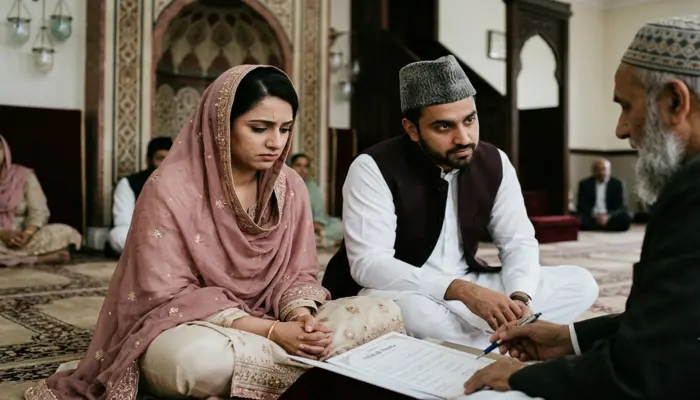
Case Summary
A Hindu woman was deceived and forced into religious conversion and nikah by a Muslim man who initially presented himself as Hindu. After nikah, she was subjected to continued physical and mental harassment from her husband and his family. Furthermore, her father-in-law also raped her under the pretext of religious purification, claiming she was under the influence of "jinnat ka saya" (a supposed supernatural influence). According to reports, the woman stated that her husband had initially drawn her into a romantic relationship by concealing his religious identity and pretending to be Hindu. He subsequently brought her home from Mumbai to Bhimpura in Ballia district, Uttar Pradesh, forced her to convert to Islam and undergo nikah (Islamic marriage) against her will. On the night of 16 August 2026, the woman's husband and other family members locked her in a room and forced her to have sexual intercourse against her will. When she resisted, they brutally assaulted her. She also described a separate incident in which her father-in-law referred to "jinnat ka saya" and used religious purification as a pretext for forcing himself on her. Four people were identified as accused in total. The woman stated that the assault affected her eyesight and left her with multiple injuries, swelling on her head and continued bleeding. She further stated that her in-laws had failed to provide her with proper medical treatment. Fearing further assault and threats to her life, she sought protection from the authorities. Subsequently, the woman stated that she had informed Bhimpura police station about the matter, but no action had been taken. She subsequently sent a written application by registered post to the Superintendent of Police, Ballia, requesting the registration of a criminal case against all the accused and legal action against them. She also requested a medical examination and treatment, documentation of her injuries, and preservation of medical and other evidence relating to the sexual violence. In addition, she sought police protection and measures to prevent the accused from threatening her or exerting pressure on her. Mithilesh Kumar, the officer in charge of Bhimpura police station, stated that the matter was not yet within his knowledge and that it would be investigated if a complaint was received.
Why it is Hate Crime ?
The primary category selected in this case is: Crimes against women in relationships and other sexual crimes. The subcategory selected is: Man pretends to be Hindu. When a non-Hindu man pretends to be a Hindu to deceive a Hindu woman into a relationship, the act is seen as triggered by malafide intentions. In some cases, the woman eventually accepts the man’s original religious identity and converts after the man’s identity is revealed. These cases could be argued as cases of religious brainwashing and a result of the pressure a woman feels after getting into a relationship with a man. The woman, it can be argued, also changed her religious identity because of the stigma she believes she might face if she chooses to walk out of a deceptive relationship. However, for the purpose of documenting hate crimes, the cases in this subcategory are limited to those where there is explicit violence aimed at religious conversion against the wishes of the victim (force-feeding beef, blackmailing with intimate videos, rape on refusal to convert, etc), or if the woman herself complains of the man’s religious deception. In such cases, it is established that the deception of the non-Hindu man had a specific aim of religious conversion or targeting of the victim due to her Hindu religious identity, therefore, making it a religiously motivated hate crime. The other subcategory selected is: Forced conversion before marriage. The tertiary category selected is: Forced to do Nikah. In such cases, a non-Hindu man is in a relationship with a Hindu woman when the pressure to convert her religion begins to manifest. In such cases, typically, two patterns emerge. First, when the relationship is consensual, and the religious identity of the perpetrator is known to the Hindu woman in the relationship, however, at some point during the relationship, the non-Hindu man starts to force the victim to convert her religion and give up her Hindu religious identity. The second is when the woman gets into a marriage with the man pretending to share her faith. Later, when the truth is revealed, the man starts pressuring the woman to convert her religion and give up her religious identity. In both the situations, the methods used to force the victim to convert her religion often revolve around force-feeding beef, forcing her to wear hijab, forcing her to read the Kalma or even pressurizing the victim to do ‘Nikah’, which is marriage under Islamic law, with a prerequisite being conversion to Islam. Cases where a Hindu woman consensually converts to Islam in a relationship will be left out of the hate crime database, even though it could be argued in several cases that the conversion was a result of religious brainwashing. This case is being added to the tracker because a Hindu woman was subjected to religious conversion against her wishes, followed by nikah, after a man who initially presented himself as Hindu. These acts showed coercion affecting her religious identity and freedom of religious choice. She was also subjected to physical and mental harassment, confinement, sexual assault, and sexual coercion by her father-in-law under the pretext of religious purification. Firstly, the Muslim man presented himself as Hindu when he initially developed a romantic relationship with the woman. This proves the use of religious deception in establishing trust and securing a relationship with a Hindu woman. Her understanding of the accused's identity shaped the circumstances leading to the subsequent religious conversion and nikah. The significance lay in the fact that a Hindu woman's trust and personal autonomy had been undermined through the concealment of a fundamental aspect of her prospective partner's identity. Such conduct interfered with her ability to make an informed decision about her relationship, religious beliefs and future marriage. Secondly, the woman stated that her religion was changed against her wishes by the Muslim accused. This formed the clearest religious marker in the case because it concerned an individual's freedom to retain her existing faith. The significance of this aspect lay in the imposition of a religious identity she had not chosen for herself. Her ability to determine her own beliefs and spiritual identity was undermined when she was made to abandon Hinduism and adopt Islam against her will. The forced conversion therefore constituted a central religious dimension of the case, as it concerned her freedom to practise and retain her Hindu faith without coercion. Thirdly, the woman stated that the nikah took place after her forced conversion to Islam. In Islam, marriage to a non-Muslim partner is prohibited, which is why she was forcibly converted to Islam before nikah. The nikah followed a change in religious identity that had been imposed against her wishes, linking the religious coercion to the subsequent marriage. The significance lay in the fact that her marital circumstances were intertwined with the infringement of her religious autonomy and the religious deception. Lastly, the woman's father-in-law used religious beliefs and the pretext of religious purification to sexually exploit her. He referred to “jinnat ka saya”, suggesting that she was under a supposed supernatural influence, and used this as a justification for forcing himself on her. This aspect of the case was significant because religious and supernatural beliefs were invoked as a means of sexual coercion, using the pretence of spiritual purification to facilitate abuse. Rather than being a freely chosen religious practice, the act was something imposed on the woman against her will, violating her bodily autonomy and dignity. The use of religious justification to facilitate sexual abuse further illustrated how religious language was exploited to exert control over her within the marital household. Collectively, these acts demonstrated a pattern of violations involving the religious identity, autonomy and dignity of a Hindu woman, beginning with the concealment of religious identity in a romantic relationship, followed by conversion against her wishes and nikah, and extending to the use of religious purification as a pretext for sexual coercion. Such actions stem from inherent hostility towards the victim's professed faith since Abrahamic faiths believe that any non-adherent to the faith is subject to being dehumanised till they convert. Such acts were not merely personal crimes; they were rooted in a desire to dominate and erase the religious identity of the victim. Accordingly, this case has been documented in the Hinduphobia Tracker's Hate Crime Database as an instance of religiously motivated hostility directed against Hinduism and the religious identity of the Hindu community. Disclaimer: The Hinduphobia Tracker records incidents based on when an event occurred or when the victim's ordeal began. It is important to clarify that none of the media sources covering this case has specified the exact date when the Hindu woman first met the Muslim perpetrator. Therefore, for documentation purposes, the earliest date, 16 August 2026, has been recorded as 16 August 2026, based on the reported incident of sexual assault and confinement. Disclaimer: As per the Hinduphobia Tracker’s methodology, the location of an incident is recorded as the place where the victim first met the accused. Accordingly, Mumbai has been recorded as the incident location, as the victim reportedly first met the accused there before he brought her to Bhimpura.
Victim Details
Total Victim
1
Deceased
0
Gender
- Male 0
- Female 1
- Third Gender 0
- Unknown 0
Caste
- SC/ST 0
- OBC 0
- General 0
- Unknown 1
Age Group
- Minor 0
- Adult 1
- Senior Citizen 0
- Unknown 0


Case Status
Unknown


Perpetrators Details
Perpetrators
Muslim Extremists
Perpetrators Range
One Person
Perpetrators Gender
male
 Sources




