Hindu man and his family brutally assaulted by Muslim men for installing a religious banner for Navratri in Indore, Madhya Pradesh
 Indore, Madhya Pradesh, India
  6 October, 2026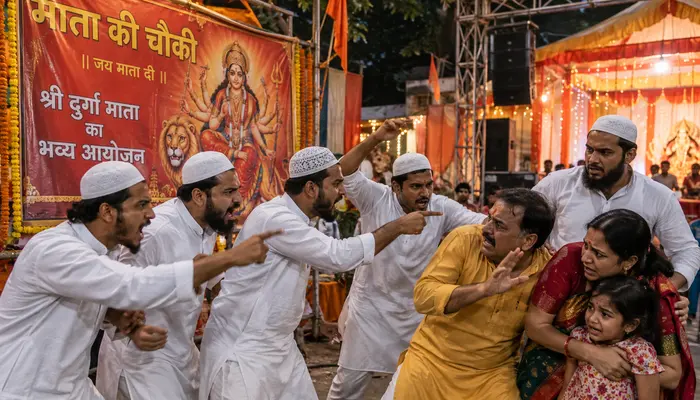
Case Summary
In Rajendra Nagar, Indore, Madhya Pradesh, a Hindu man and his family were brutally assaulted by a group of Muslim men. The attack occurred over the installation of a Mata Ki Chowki banner near a Durga pandal erected for the Navratri celebrations. The assailants beat the victims with a wooden pole, fists and kicks. They also barged into the family’s home, dragged the man’s two sons outside and assaulted them. The accused threatened to kill the family if they installed the banner again. According to media reports, the incident occurred on Wednesday, 7 October 2026, at around 10.30 pm. Suresh Sahu, a 44-year-old Hindu auto-rickshaw driver, was putting up the Mata Ki Chowki banner outside his home near the Durga pandal. He lived in Scheme No. 103, Kali Multi, Tejpur Gadbadi, and the banner was intended for a religious programme. The pandal had been set up on the road outside his house for Mata Ki Chowki, ahead of the upcoming Navratri celebrations. According to Suresh’s police complaint, two Muslim men, Shakil and Arbaaz, called him over while he was installing the banner. Both men lived in Kali Multi. Several other Muslim men were already present and objected to the banner’s installation. Suresh explained that the religious programme was intended for everyone and insisted on putting up the banner. The disagreement escalated, and the Muslim men began abusing him. When Suresh objected to the verbal abuse, one of the men attacked him. The accused, identified as Sikandar, picked up a nearby wooden pole and struck Suresh on his left arm. Subsequently, Gullu, Shakil, Arbaaz, Jabbar and Yunus joined the assault. They assaulted Suresh with kicks and punches. Hearing the commotion, Suresh’s wife, Sapna, rushed to intervene. His mother-in-law, Dwarikabai, and his cousin, Rohit, also arrived at the scene. However, the Muslim assailants assaulted them as well. The violence subsequently escalated, with several Muslim men entering Suresh’s house. According to Suresh’s complaint, six Muslim men entered his home. They were identified as Zafar Khan, Mehboob, Farhan, Gaffar, Rahim and Ramzan. The accused then targeted Suresh’s sons, Vikas and Akash. They assaulted both brothers, dragged them out of the house and continued beating them. Before leaving, the accused threatened to kill the family if they installed the Mata Ki Chowki banner again. A video concerning the incident subsequently went viral on social media. A prominent social media handle shared the video, which featured a statement by the Deputy Commissioner of Police (DCP). According to the statement in the viral video, eight to ten Muslim men had attacked the Hindu family over the pandal and the religious banner. The video stated that the incident began with a quarrel between Hindu and Muslim children over the pandal and poster, which subsequently escalated into violence between Hindu and Muslim adults. It also stated that a case had been registered, five accused had been arrested, and the police were searching for the remaining suspects. Following Suresh’s complaint, the Rajendra Nagar police registered a case against 11 named accused and others. The case was registered under Sections 115(2), 191(2), 331(6) and 351(3) of the Bharatiya Nyaya Sanhita (BNS). The named accused were Zafar, son of Afzal Khan; Mehboob, son of Karim Shah; and Gaffar, son of Abdul Shah. The list also included Rahim, son of Mehboob Shah; Ramzan, son of Gulzar; and Sikandar, son of Mehbub Shah. The remaining accused were Gullu, son of Zafar; Shakil, son of Mehbub Shah; and Arbaaz, son of Yunus Khan. The final two named accused were Jabbar, son of Gaffar Shah, and Yunus, son of Ismail Khan. At the time of writing this report, Assistant Commissioner of Police Nidhi Saxena had confirmed that five accused had been arrested. Police teams were deployed to locate and apprehend the remaining accused. The police continued investigating the incident to establish the sequence of events and determine each accused person’s role in the assault.
Why it is Hate Crime ?
This case is being added to the tracker under the primary category: Attack not resulting in death. The subcategory selected is: Attacked for Hindu identity. In several cases, Hindus are attacked merely for their Hindu identity without any perceived provocation. A classic example of this category of religiously motivated hate crime is a murder in 2016. 7 ISIS terrorists were convicted for shooting a school principal in Kanpur because they got ‘triggered’ seeing the Kalava on his wrist and tilak that he had put. In this, the Hindu victim had offered no provocation except for his Hindu religious identity. The motivation for the murder was purely religious, driven by religious supremacy. Such cases where Hindus are targeted merely for their religious identity would be documented as a hate crime under this category. The other subcategory selected is: Attacked for opposing radicals or trying to save the victim. In several cases, Hindus are attacked for opposing religiously motivated crimes being committed against a fellow Hindu or simply for voicing an opinion opposing radical elements, who either have in the past or continue to persecute Hindus. In such cases, the initial attack against the victim, against which the Hindu was trying to defend the victim, would also need to be classified as a religiously motivated hate crime. Since the initial crime itself was religiously motivated and the subsequent crime of attempting to save the victim or speaking against the radical elements ends up inviting a violent attack, it would also be classified as a religiously motivated hate crime under this category. The other subcategory selected is: Communal Clash/Attack. Communal clash is a form of collective violence that involves clashes between groups belonging to different religious identities. For a communal clash between Hindus and non-Hindus to qualify as a religiously motivated hate crime, the trigger of the violence itself would have to be anti-Hindu in essence. For example, if there is a Hindu religious procession that comes under attack from a non-Hindu mob and after the initial attack, Hindus retaliate in self-defence, leading to a communal clash between the two religious communities. While at a later stage, both communities are involved in the clash/violence, the initial trigger of the violence was by the non-Hindu mob against the Hindus and therefore, it could safely be termed as an anti-Hindu violence. Further, the trigger would also have to be religiously motivated. In the cited example, the attack by the non-Hindu mob was against religious processions and therefore, can be concluded to be religiously motivated. In some cases, the trigger may be non-religious, however, it develops into religious violence against Hindus at a later stage. In such cases too, the foundational animosity towards Hindus becomes the motivating factor of the crime and therefore, it would be classified as a religiously motivated hate crime against Hindus under this category. This case was a clear example of a religiously driven hate crime rooted in anti-Hindu hostility. A Hindu man and his family were brutally assaulted over the installation of a Hindu religious banner for the Navratri celebrations. Navratri is a major Hindu festival dedicated to the worship of Goddess Durga and her various manifestations, celebrating the triumph of divine feminine power over evil. During the festival, devotees organise prayers, devotional rituals and religious gatherings, while Durga pandals serve as community spaces where worshippers come together to offer prayers and seek the Goddess’s blessings. Religious banners bearing the name and imagery of Goddess Durga, along with announcements of Mata Ki Chowki programmes, are displayed as expressions of devotion and to mark these celebrations. The installation of a Mata Ki Chowki banner near a Durga pandal was therefore a legitimate expression of the victim’s Hindu religious identity and devotion. The objection to this display, followed by violence against the victim, consequently targeted not merely a physical banner but his right to practise and publicly express his Hindu faith. The attack was rooted in hostility towards the victim’s Hindu identity, as he was targeted for installing a religious banner associated with the worship of Goddess Durga during Navratri. The perpetrators objected to the installation, verbally abused the Hindu man and physically assaulted him when he insisted on proceeding with it. This sequence of events established a direct connection between the victim’s expression of Hindu faith and the violence inflicted upon him. The banner represented his participation in a Hindu religious celebration, and the perpetrators’ response demonstrated intolerance towards his religious observance. The victim was not simply assaulted in an unrelated neighbourhood dispute; he was subjected to violence after asserting his right to display a banner associated with Hindu worship. The attack therefore constituted an assault on his freedom to practise and express his Hindu identity, with physical violence used to intimidate him over a religious observance. The religious dimension of the attack must also be understood in the context of Islamic theological doctrines that regard the worship of deities other than Allah as 'shirk' and prohibit idol worship, practices central to Hindu religious traditions. Such doctrines foster religiously exclusionary and supremacist attitudes when used to regard non-Islamic faiths, particularly polytheistic traditions such as Hinduism, as inferior or illegitimate. While Muslims are entitled to follow the theological principles of their own faith, those beliefs do not grant them the right to impose religious restrictions on Hindus or interfere with their freedom to practise and publicly express their faith. The perpetrators’ objection to a banner associated with the worship of Goddess Durga, followed by the brutal assault on the Hindu man who insisted on installing it, demonstrated hostility towards the public expression of Hindu religious beliefs. Rather than respecting the victim’s right to observe his religion, they resorted to violence over an expression of Hindu devotion to which they objected. This conduct reflected religious intolerance and an attempt to suppress the public expression of Hinduism through intimidation, supporting the classification of the incident as a religiously driven hate crime. The assault on the victim’s family further demonstrated the extent of the religious hostility underlying the incident. Family members who intervened to protect the Hindu man were also subjected to violence, showing that the aggression extended to those who resisted the intimidation. Their victimisation reinforced the religious nature of the attack, as even those attempting to defend a family member targeted over his religious expression were not spared. This demonstrated how anti-Hindu hostility extended beyond the individual directly targeted to those who stood up for him. The violence against the family therefore further underscored the communal character of the incident, in which resistance to the suppression of Hindu religious expression was met with further aggression. The attack on the victim’s sons and the threat to kill the family if they installed the banner again provided further evidence of hostility towards their Hindu identity and religious beliefs. The explicit threat linked the family’s continued expression of Hindu faith to the prospect of further violence. This went beyond an attempt to intimidate the victim during the initial confrontation; it demonstrated an effort to deter the family from publicly expressing their religious beliefs in the future. Targeting the victim’s sons and extending the threat to the entire household also showed that the hostility was not confined to the individual who had installed the banner, but encompassed his family in an attempt to suppress their religious expression. Such coercion reflects religious animosity because it seeks to make the public practice of Hinduism subject to the perpetrators’ approval, using threats of violence to deny Hindus the freedom to observe and express their faith. The attempt to prevent the family from displaying a Hindu religious banner through intimidation and threats of lethal violence therefore reinforced the classification of the incident as a hate crime. Since this case meets the parameters of a religiously driven offence, it is being added to the hate crime database of the Hinduphobia Tracker. Disclaimer: The total victim count has been recorded as six, comprising Suresh Sahu, his wife Sapna, his mother-in-law Dwarikabai, his cousin Rohit, and his two sons, Vikas and Akash, all of whom were assaulted during the incident.
Victim Details
Total Victim
6
Deceased
0
Gender
- Male 4
- Female 2
- Third Gender 0
- Unknown 0
Caste
- SC/ST 0
- OBC 0
- General 0
- Unknown 6
Age Group
- Minor 0
- Adult 4
- Senior Citizen 0
- Unknown 2


Case Status
Case sub-judice


Perpetrators Details
Perpetrators
Muslim Extremists
Perpetrators Range
From 10 to 100
Perpetrators Gender
male
 Sources




