Ancient Hindu temple targeted, sacred Shivalinga desecrated in Ghaziabad, Uttar Pradesh
 Ghaziabad, Uttar Pradesh, India
  7 October, 2026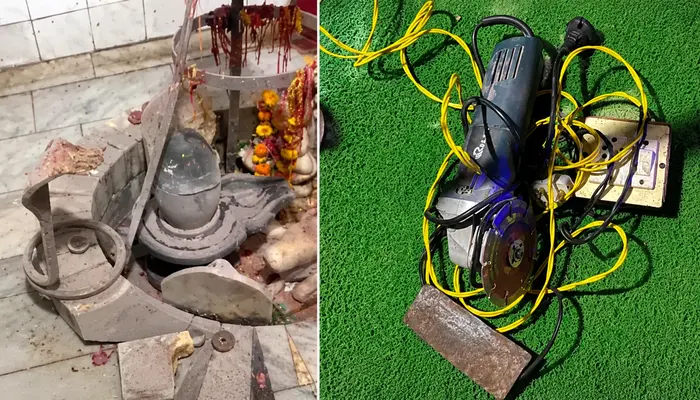
Case Summary
In Biharipura, Ghaziabad, Uttar Pradesh, an ancient Shiva temple was targeted by an unidentified girl who damaged the sacred Shivalinga by attempting to cut it using a grinder. The incident took place at around 1:30 am on 8 October 2026 and triggered anger among local Hindu devotees and residents. The incident came to light when people in the surrounding area heard the sound of a grinder operating inside the temple and rushed to the spot. The girl left the grinder and other items at the scene before fleeing. Around the same time, a woman saw the girl jumping over the temple’s boundary wall and questioned her. The girl said that she had entered the temple to offer prayers but had been locked inside, following which she climbed over the wall to leave. Information gathered by the police from eyewitnesses and people present at the scene also indicated the girl’s involvement in the incident. The temple was located approximately 200 metres from the Bypass Police Outpost, prompting local residents to question police patrolling and surveillance in the area. Following the incident, a large number of people gathered near the temple, leading to a commotion and tension in the area. The police received information through Dial-112, following which personnel from Crossing Republic Police Station reached the spot, inspected the temple and appealed to the gathering to maintain peace. The police also seized the grinder and other items left at the scene. Assistant Commissioner of Police, Wave City, Priyashri Pal, stated that the police questioned eyewitnesses and other people present at the scene. They examined the circumstances surrounding the incident and investigated the activities of individuals who had been present in and around the temple at the relevant time. Following the damage to the Shivalinga, the police arranged for the damaged Shivalinga to be removed and a new Shivalinga to be installed in the temple. Police officials stated that peace and order had been restored at the site and that necessary legal action was being taken. As part of the investigation, the police examined CCTV footage from cameras installed in and around the temple, including those at nearby houses, along with other evidence, to establish the complete sequence of events and identify those involved.
Why it is Hate Crime ?
The primary category selected in this case is: Attack on Hindu religious representations. The subcategory selected is: Desecration of Hindu religious symbol. Icons and symbols or a religious representation of a spiritual ideal are widely revered in Hinduism. Iconography is of vital significance in the Hindu milieu. It helps connect people’s spiritual beliefs with the real world. Iconography within the Hindu faith takes several shapes and forms. Murtis are of most significance to Hindus, to which daily rituals, prayers and offerings are done. Besides the murtis, there are several other symbols which have deep significance in the Hindu faith – the Om and Swastika for example. Since these Hindu religious symbols hold paramount importance in Hinduism, any desecration of symbols, icons, murtis, religious representations and manifestations, is driven by animosity towards the faith itself which manifests itself through these murtis, icons and symbols. Therefore, any desecration of these Hindu religious symbols and representations is considered religiously motivated hate crimes under this category. The other subcategory selected is: Attack on Temples. In Hinduism, a temple is the abode of the Deity. The Deity in the Temple is consecrated, thereby, making it a real, breathing entity. Hindus believe that not just the Deity but the temple premises itself are sacred to Hindus since Hindus hold the faith that the entire Temple space is an amalgamation of the divine energy of the deity. Given the central significance of Temples in Hindu Dharma, any attack against a Hindu Temple or its peripheral premises is an attack on the faith itself and is born out of animosity towards the faith, of which, the Temple is a central tenet. Any manner of attack against a Temple and/or its premises would therefore be considered a religiously motivated hate crime. This case constitutes a religiously motivated hate crime because the sacred Shivalinga at an ancient Hindu temple in Ghaziabad was damaged, and an attempt was made to cut it using a grinder. The act targeted a central symbol of Hindu worship and caused anger and distress among local Hindu devotees and residents. In Hinduism, the Shivalinga is a sacred representation of Lord Shiva, revered as a manifestation of the divine and worshipped through prayers, abhishekam, offerings and other religious rituals. Damaging this revered symbol and attempting to cut it with a grinder constituted the desecration of an object central to Hindu faith and worship. Such an act went beyond ordinary vandalism, demonstrating contempt for the religious beliefs and sacred traditions associated with Lord Shiva and reflecting deep-seated hostility towards Hinduism and the community that venerates the Shivalinga. The religious significance of the act was further compounded by the fact that it occurred inside an ancient Hindu temple. A temple is a sacred place where devotees worship the deity, perform rituals and maintain their spiritual connection with the divine. The Shivalinga and the temple form interconnected parts of a larger religious ecosystem, with the sanctity of the sacred symbol intrinsically linked to that of the place where it is worshipped. Damaging the Shivalinga within this setting therefore amounted to an attack on a sacred Hindu religious site, violating the sanctity of the temple and disrupting the religious space in which devotees practise their faith. The act consequently constituted an affront to Hindu religious sentiments, as it targeted both a revered representation of Lord Shiva and the sacred place dedicated to his worship. The anger and distress among local Hindu devotees and residents reflected the impact of this violation on the religious sentiments of the Hindu community. Although the perpetrator's religious identity remains unknown, the act targeted a sacred Hindu religious symbol within a Hindu temple and reflected hostility towards Hinduism and its devotees. Therefore, this case is being added to the Hinduphobia Tracker's Hate Crime Database.


Case Status
Complaint filed


Perpetrators Details
Perpetrators
Unknown
Perpetrators Range
One Person
Perpetrators Gender
female
 Sources




