Ganesh idol immersion procession targeted, devotees subjected to heckling, objectionable remarks and death threats in Bahraich, Uttar Pradesh
 Bahraich, Uttar Pradesh, India
  24 September, 2025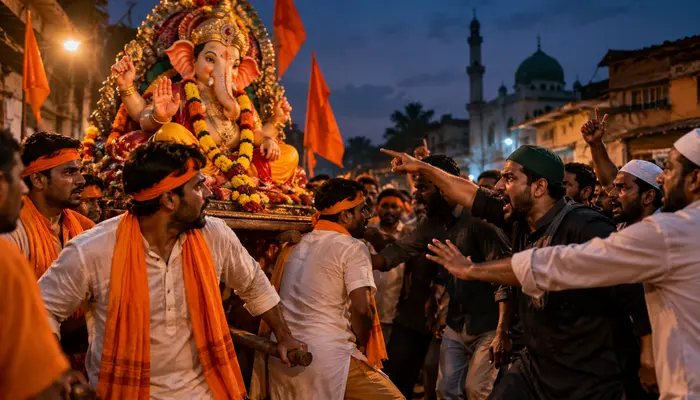
Case Summary
In Fakharpur, Bahraich, a Ganesh idol immersion procession was targeted, and Hindu devotees participating in the procession were heckled and subjected to abuse and objectionable remarks. They were prevented from proceeding with the immersion and threatened with death. At Ram Janaki Temple, Prabhu Shah Sthan, in Madhopur Gram Panchayat, the Ganesh Puja Mahotsav had been taking place since 14 August 2026. On 25 September 2026, after the worship concluded, villagers took out a procession carrying the Ganesh idol for immersion. In Khalidpur, district panchayat member Sarwar Maulana, gram administrator Hasir Khan, Kalamuddin Ansari, Khalidpur administrator's representative Anil Mulla Qureshi, and others stopped and heckled the procession. The devotees were subjected to objectionable remarks and death threats, and were barred from proceeding with the immersion. The police were informed after the situation became tense. Fakharpur Station House Officer Ram Kumar Rajbhar, accompanied by police personnel, reached the location and took the procession to the designated place, where police supervised the immersion of the Ganesh idol. On 5 October 2026, Fakharpur Police Station registered a First Information Report on the complaint of Omkar Nath, the priest of the Shri Ram Janaki Temple in Madhopur village. The First Information Report named nine persons and about 100 unidentified persons, for a total of 109. The named persons included Maulana Sarwar, Hasir Khan alias Namoon, Kalamuddin Ansari, Anil Mulla Qureshi and Sabit Ali. The case was registered under Sections 196(1), 351(3) and 352 of the Bharatiya Nyaya Sanhita, concerning promotion of enmity and disturbance of social harmony, criminal intimidation and intentional insult, respectively. Residents identified Khan and Ansari as village heads, and Qureshi as a representative of a village head. On 6 October 2026, police arrested two of the named accused, Sabit Ali and Amin Sai, and produced both before a court. Police continued efforts to apprehend the remaining accused, while Ayush Vikram Singh, Additional Superintendent of Police (City), said the investigation was ongoing.
Why it is Hate Crime ?
The primary category selected in this case is: Attack not resulting in death. The subcategory selected is: Attack on religious procession. The outward celebration and display of religious symbols in an intrinsic part of Hinduism. Religious processions on various festivals are age-old traditions and a way to manifest faith and form a part of the religious practices of Hindus. On several occasions, such religious processions come under attack by non-Hindu mobs, in a manifestation of their animosity towards Hinduism and their practices. The reasons cited for such violent attacks are many and range from crossing a non-Hindu resident-dominated area to playing loud music, crossing from an area where there is a religious structure of another faith etc. The violent attacks are triggered by the outward display of religiosity by Hindus. The attacks are mainly a manifestation of religious supremacist doctrine which believes that idolatry, essentially the Hindu faith, is one that deserves to be annihilated since the very tenets of Hinduism, its practices and traditions are considered a sin in those doctrines. Since these attacks emanate from intrinsic and doctrinal animosity towards Hindus and Hinduism, it is considered a religiously motivated hate crime under this category. The other subcategory selected is: Attack on Hindu devotees. Hindu devotees are a few of the easiest targets of religiously motivated hate crimes because during the festival/procession/puja etc, for non-Hindus it is easy to profile their victims on the basis of religion. Hindu devotees come under attack on several occasions by individual non-Hindus or mobs of non-Hindus owing to their animosity against Hinduism, its symbols and tradition/practices. There are several instances of Hindu devotees being attacked while they worship in temples or temporary religious structures, during religious processions, doing bhajan/kirtan/puja in their own homes, in the residential society etc. These attacks are perpetrated by non-Hindus primarily because of their animosity towards Hindus and their faith. In some cases, the trigger for the violence may be non-religious, however, there are two elements that make these hate crimes. First, the Hindus who come under attack are attacked violently while indulging in religious activity. Whether they are in a place of worship or not is immaterial to the crime. When individuals are attacked while indulging in religious practices, the attack in itself is a hindrance to their freedom to practice religion and therefore constitutes a hate crime. Secondly, religious supremacist doctrines and ideologies deem religious practices of Hindus to be offensive ab initio since they are considered “sinful” by these ideologies, worthy to be annihilated by force or coercion. Driven by these religious supremacist ideologies and doctrines, the attacks against Hindu devotees stem from intrinsic animosity towards Hinduism. In some cases, the trigger for the violence may be non-religious, however, it develops into a religiously motivated crime during the course of the violence. Since these attacks stem from animosity towards Hindus and Hinduism, they are considered religiously motivated hate crimes under this category. This case is a clear example of religiously driven hostility because the Ganesh idol immersion procession was stopped and heckled, constituting an attack on Hindu religious sentiments. Also, Hindu devotees were subjected to abuse, objectionable remarks and death threats, further heightening the hostility towards Hindus. The incident therefore went beyond ordinary procession restriction and management. Ganesh Chaturthi is a major Hindu festival dedicated to Lord Ganesha. The immersion procession is an integral part of the celebration, marking the customary conclusion of the period of worship following the installation of the idol. Preventing devotees from completing this procession therefore interfered directly with an established act of Hindu religious observance. Preventing the devotees from proceeding with the Ganesh idol immersion and subjecting the participants to abuse, objectionable remarks, and death threats therefore disrupted the customary completion of their Hindu religious observance. Firstly, the Ganesh idol immersion procession being stopped and heckled while devotees were carrying the idol for immersion constituted a direct attack on Hindu religious representation because the Ganesh idol is not merely an ordinary figure being transported; it represents Lord Ganesha and the devotees’ religious worship and observance. The procession forms a visible and collective expression of Hindu faith, with the idol being taken from the place of worship towards immersion as part of the religious ceremony. Stopping and heckling that procession therefore interfered directly with a public manifestation of Hindu religious practice. The conduct affected the religious representation carried by the devotees and disrupted the manner in which they were expressing and completing their worship of Lord Ganesha. Secondly, the abuse and objectionable remarks directed at Hindu participants during the religious procession targeted devotees while they were engaged in a Hindu religious observance. Such conduct demeaned the people who were participating in the worship and procession and subjected them to hostility because they were taking part in a distinctly Hindu religious activity. The objectionable remarks therefore did not merely affect the ordinary movement of a group of people; they were made in the context of a Hindu religious procession and affected the dignity of the devotees participating in it. Thirdly, barring the devotees from proceeding with the Ganesh idol immersion interfered with the completion of their religious observance. Immersion forms the concluding stage of the Ganesh worship, and preventing the procession from reaching the designated place interrupted the devotees' ability to carry out that religious act as intended. The restriction consequently affected not only the physical movement of the procession but also the devotees' exercise of their Hindu religious practice. The obstruction of the Ganesh idol immersion procession, the heckling and mistreatment of Hindu devotees, the objectionable remarks and death threats directed at participants, and the interference with the completion of the immersion reflected hostility towards a Hindu religious observance and the religious identity of the devotees. Accordingly, this case has been documented in the Hinduphobia Tracker's Hate Crime Database as an instance of religiously motivated hostility directed against Hinduism and the religious identity of the Hindu community.


Case Status
Case sub-judice


Perpetrators Details
Perpetrators
Muslim Extremists
Perpetrators Range
From 10 to 100
Perpetrators Gender
unknown
 Sources




