Durga Puja pandal desecrated in Kolkata; azaan played before idol of Goddess Durga, Islamic and Christian symbols displayed
 Kolkata, West Bengal, India
  2 October, 2019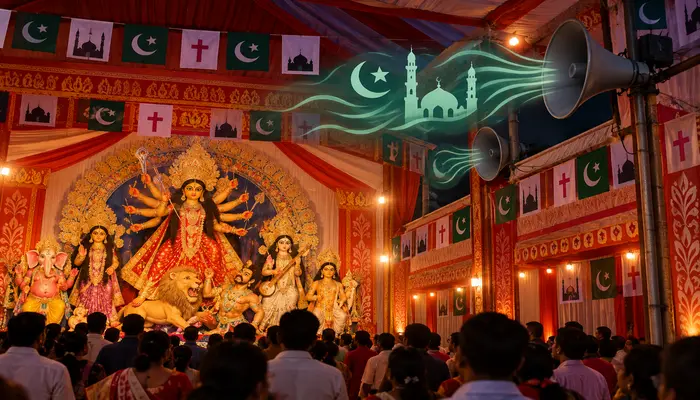
Case Summary
In Beliaghata’s 33 Pally area of Kolkata, West Bengal, a Durga Puja pandal was desecrated when a recording of the Islamic azaan was played before the idol of Goddess Durga. Islamic and Christian religious symbols were also displayed inside the pandal. The community Durga Puja at Beliaghata 33 Pally had been playing a recording of the azaan from the pandal since the festivities commenced on Maha Panchami. On 3 October 2019, a video showing the azaan being played at the venue was subsequently shared on social media, drawing backlash over the use of an Islamic prayer recording inside a pandal dedicated to the worship of Goddess Durga. The pandal had been decorated around the theme “Amra Ek, Eka Noye” (We are together, not alone), with representations and religious symbols associated with Hinduism, Christianity and Islam. The decorations included the Aum symbol, a Christian crucifix, and the Islamic star and crescent. Large banners at the entrance also displayed the three religious symbols alongside the message conveying that people were together and not alone. Alongside these displays, a video containing audio messages associated with the three religions was played at the pandal, including the azaan. The playing of the Islamic call to prayer before the idol of Goddess Durga led to outrage on social media, with users stating that the organisers were attempting to demonstrate pseudo-secularism and questioning the decision to incorporate the azaan into a Durga Puja celebration. The organisers defended the arrangement, claiming that the decorations and audio were intended to convey a message of religious unity. Parimal Dey, the club secretary of Beliaghata 33 Pally, said that Durga Puja pandals in Kolkata were often designed around social messages and that the theme was intended to convey that humanity was above religion. He said that models representing a church, temple and mosque had been used to highlight the theme. The playing of the azaan also led to a police complaint. On the evening of 4 October 2019, Calcutta High Court lawyer Santanu Singha filed a complaint at the Phoolbagan police station, stating that the act had hurt religious sentiments. The complaint named ten people, including the club secretary and local Trinamool Congress leader Paresh Paul, who was the primary organiser of the community Puja and the local Member of the Legislative Assembly. Singha stated that the organisers had deliberately played the azaan from the Puja venue and accused them of attempting to disturb peace and hurt the religious sentiments of Hindus. Meanwhile, police stated that their cyber cell was monitoring social media posts related to the Beliaghata pandal.
Why it is Hate Crime ?
This case is being added to the tracker under the primary category: Attack on Hindu religious representations. The subcategory selected is: Defiling religious customs. Sanatan Dharma is not a religion of one book, which is to say that while it has religious scriptures that form the central tenets of the faith, there are several traditions followed through thousands of years, mostly passed from generation to generation orally. There are several such customs and traditions that are followed by various Hindus and Hindu sects. Defiling of these traditions and customs is a breach of an individual or group’s religious practices. Such practices can range from dietary restrictions like not eating non-vegetarian food for a certain period of the year, not eating non-vegetarian food at all, not eating beef since the cow is considered holy in Hinduism, the sanctity of religious customs followed in the house (like many ISCKON devotees), etc. Any malicious action leading to the breach of such traditions or defilement of these traditions owing to animosity towards the faith or for the sake of activism stems not only from the lack of faith in the religion itself but also from disregard for the faith of the devotees who follow the customs/traditions and implicit bias against the faith, the tradition itself. Since these specific traditions are central to the faith of the devotees of that specific sect of Hindus, any non-compliance with these traditional rules would be considered a religiously motivated hate crime. The other subcategory selected is: Breaking rules of place of worship. Sanatan Dharma is not a religion of one book, which is to say that while it has religious scriptures that form the central tenets of the faith, there are several traditions followed through thousands of years, mostly passed from generation to generation orally. One of these oral traditions or written traditions is the rules of specific temples. Certain temples have rules which are traditional rules, dependent on the worship of the presiding deities. These rules and traditions have been followed for thousands of years whether they find scriptural mention or not. Such traditions are based on the nature and rules of worship of the presiding deity of that temple. Any non-compliance of these traditions owing to animosity towards the faith or for the sake of activism stems not only from the lack of faith in the presiding deity but also disregard for the faith of the devotees of that deity/temple and implicit bias against the faith, the tradition and the deity itself. Since these specific traditions are central to the faith of the devotees of that specific temple and presiding deity, any non-compliance with these traditional rules would be considered a religiously motivated hate crime. This incident was a clear example of a religiously driven hate crime, as the sanctity of a Durga Puja pandal was violated by the deliberate introduction of the azaan and Christian and Islamic religious symbols during the celebrations. Durga Puja is a major Hindu festival dedicated to the worship of Goddess Durga, and the pandal where the deity is installed becomes a sacred Hindu space during the celebrations. As a place dedicated to Hindu worship, it is governed by sacred customs and practices that preserve its religious character and sanctity. Introducing the religious practices and symbols of Islam and Christianity into this space violated those customs and altered the character of the Hindu religious celebration. This deliberate disregard for established Hindu practices demonstrated anti-Hindu animosity and constituted a clear instance of religiously motivated hostility. The incident also violated the rules governing a Hindu place of worship. A Durga Puja pandal is not merely a temporary structure or public exhibition; during the festival, it serves as a sacred space where devotees worship Goddess Durga and perform Hindu religious rituals. Its sanctity therefore requires adherence to the religious customs governing Hindu worship. By introducing practices and symbols belonging to other faiths, the organisers treated the religious character of a Hindu place of worship as something that could be altered for an external message. This disregard for the sanctity of a Hindu religious space constituted a further manifestation of anti-Hindu hostility. The playing of the azaan was particularly significant because the Islamic call to prayer contains the declaration of the oneness of Allah and rejects the existence of any other deity. It was played directly before the idol of Goddess Durga inside a pandal established for her worship. Hinduism recognises the Divine through multiple deities and manifestations, including Goddess Durga. Introducing an Islamic declaration of faith asserting the supremacy and oneness of Allah directly before the idol of a Hindu deity therefore amounted to an act of religious provocation. It placed an explicitly Islamic religious proclamation in direct opposition to the Hindu religious character of the space and diminished the sanctity of the deity being worshipped there. This was not an accidental occurrence or an incidental religious sound from outside the premises, but a deliberate act that provoked Hindu religious sentiments and demonstrated hostility towards the beliefs and sacred traditions associated with the worship of Goddess Durga. The organisers presented the arrangement as a message of secularism and religious unity. However, secularism did not require a Hindu place of worship to dilute and desecrate its sacred customs to accommodate the religious practices of other faiths. Every place of worship possesses its own religious character and customs. It would be equally inappropriate to introduce Durga Puja rituals or Hindu prayers into a mosque during Eid in the name of religious unity. Applying this principle selectively to a Hindu religious space created a clear religious double standard, in which a Hindu festival was expected to accommodate practices belonging to other faiths while its own sacred character was altered and desecrated. This further demonstrated hostility towards the distinct religious identity of Hinduism. The involvement of Trinamool Congress leader Paresh Paul, who was the primary organiser of the community Durga Puja, gave the incident a clear institutional dimension. At the time of documentation, the Trinamool Congress was the ruling political party in West Bengal, making the involvement of one of its leaders in an arrangement that violated the religious character of a Durga Puja pandal particularly significant. His participation provided political and institutional backing to an act that interfered with the sacred customs of a Hindu religious space, rather than being an isolated act by an unaffiliated individual. The involvement of a member of the ruling establishment therefore demonstrated how Hindu religious practices are subjected to institutional pressure to accommodate non-Hindu religious elements, amounting to the institutional targeting of Hindu religious identity. This institutional dimension further established the incident as a hate crime directed against Hinduism and its sacred practices. Taken together, the violation of sacred Hindu customs, the breach of the rules governing a Hindu place of worship, the introduction of non-Hindu religious practices and symbols, and the religious provocation directed at the worship of Goddess Durga demonstrated the anti-Hindu character of the incident. By interfering with the sanctity and religious identity of a Durga Puja pandal, the act constituted a clear religiously driven hate crime. Since the case met the parameters of a hate crime rooted in anti-Hindu animosity, it was added to the Hinduphobia Tracker’s hate crime database.


Case Status
Complaint filed


Perpetrators Details
Perpetrators
State and Establishment
Perpetrators Range
From 10 to 100
Perpetrators Gender
both
 Sources




