Hindu journalist arrested by Kolkata police for reporting on desecration of Kali Puja pandal in West Bengal
 Kolkata, West Bengal, India
  4 October, 2026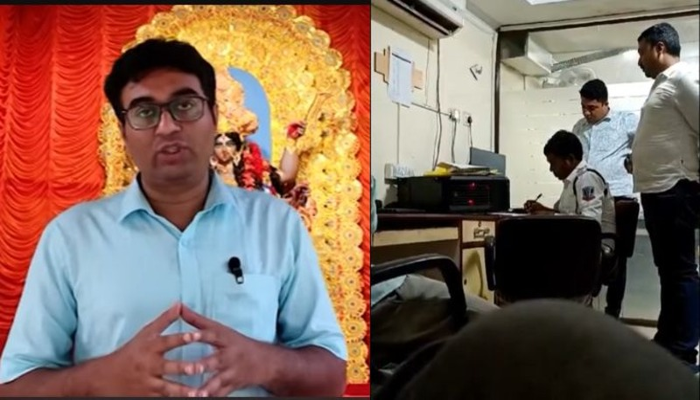
Case Summary
Journalist Ananyo Gupta was arrested by Kolkata Police after he reported on attacks on Kali Puja pandals in Razabazar and Dakshindari areas of Kolkata, West Bengal. On 2 November 2024, Ananyo Gupta ran the West Bengal-based Madhyom news portal and uploaded a video on his YouTube channel covering the vandalism at a Kali Puja pandal in Dakshindari, near Ultadanga. In the caption of the video, he wrote, “Attacks on Hindus and communal violence during Kali Puja in West Bengal are still ongoing. There have been 2 incidents of violence during Kali Puja in Kolkata, one at Dakshindari and the other at Razabazar.” He hit out at the state’s Mamata Banerjee government, writing, “As usual, the government is trying to cover up cases and impose a media blackout.” The video subsequently received significant attention on social media. The incident concerned an attack on a Kali Puja pandal and the desecration of Maa Kali’s idol. Gupta’s reporting highlighted the incident and brought attention to the attack on a Hindu religious site and deity. Following the publication of the video, Kolkata Police arrested Gupta on 5 November 2024. BJP leader Suvendu Adhikari criticised the arrest, stating that the journalist had been detained for reporting on the vandalism and questioning the failure of the police to protect the Kali Puja pandal. The arrest drew concerns over press freedom and the reporting of attacks targeting Hindu religious sites in West Bengal. Adhikari described the action against Gupta as an attempt to suppress voices reporting attacks against Sanatan Dharma.
Why it is Hate Crime ?
This case has been added to the tracker under the primary category of - Attack not resulting in death. Within it, the sub-category selected here is - Attacked for opposing radicals or trying to save victim. In several cases, Hindus are attacked for opposing religiously motivated crimes being committed against a fellow Hindu or simply for voicing an opinion opposing radical elements, who either have in the past or continue to persecute Hindus. In such cases, the initial attack against the victim, against which the Hindu was trying to defend the victim, would also need to be classified as a religiously motivated hate crime. Since the initial crime itself was religiously motivated and the subsequent crime of attempting to save the victim or speaking against the radical elements ends up inviting a violent attack, it would also be classified as a religiously motivated hate crime under this category. This case qualified as a religiously motivated hate crime because journalist Ananyo Gupta was arrested after reporting on an attack against a Hindu religious site. His arrest was directly connected to his coverage of the vandalism and desecration at a Kali Puja pandal, making the suppression of his reporting directly connected to the Hindu religious context of the incident he had brought to public attention. Gupta had specifically documented and publicised an attack on a Kali Puja pandal and the desecration of Maa Kali’s idol. His reporting brought an incident affecting Hindu religious expression into the public domain. Arresting him after he publicised the incident therefore suppressed reporting on conduct directed against a Hindu religious site and restricted public scrutiny of an attack affecting the Hindu community. The religious nexus arose from the subject of Gupta’s reporting. He was documenting an attack on a Hindu religious observance and the desecration of a Hindu deity. By taking action against him after he reported the incident, the authorities suppressed a voice drawing attention to hostility towards Hindu religious expression. This was significant because reporting on attacks against temples, religious festivals and Hindu deities enables such incidents to be exposed and brought before the wider public. The arrest consequently had a chilling effect on the reporting of anti-Hindu incidents. When a journalist documenting an attack on a Hindu religious site was arrested following that reporting, it discouraged further reporting on similar incidents and restricted the ability of Hindu victims and communities to bring such conduct to public attention. Such suppression can contribute to the concealment and normalisation of religiously targeted hostility by limiting scrutiny of incidents affecting the Hindu community. The arrest also assumed greater significance in the context of the wider pattern of restrictions and administrative action affecting Hindu religious expression in West Bengal. This is not an isolated incident. Over the past several years, a disturbing pattern has emerged in West Bengal where incidents targeting Hindus, their temples, and festivals have occurred and received support from the state and administration. This targeting has become institutionalised under the leadership of Chief Minister Mamata Banerjee, whose government stands accused of deliberately shielding anti-Hindu elements while clamping down on Hindu rights. There are increasing instances where the state actively suppresses Hindu religious expression. Hindus have been arrested simply for chanting “Jai Shri Ram”, a phrase vilified by the administration and the ruling party. Permission for Hindu processions, especially during festivals like Ram Navami or Hanuman Jayanti, is routinely denied on grounds of "law and order concerns", while Muslim religious gatherings face no such hurdles. Moreover, over the years, the Mamata-led government issued numerous prejudicial directives, like orders restricting Durga Puja immersions citing Muharram processions. Inaction on anti-Hindu mob violence in areas like Dhulian, Islampur, and Kaliachak. Public endorsements and appeasement of radical clerics and Islamist leaders, while dismissing concerns raised by Hindu groups as “communal provocation”. The systematic suppression of Hindu voices, denial of communal violence, and criminalisation of Hindu identity expressions such as “Jai Shri Ram” reflect not just administrative failure but deeper ideological hostility towards the Hindu community. Even communal attacks against Hindus have been downplayed by the state and police authorities. A glaring example of this systemic whitewashing appears in the handling of the Murshidabad violence, as well as multiple other incidents in Basirhat, Malda, Midnapore, and Uttar Dinajpur. In the Basirhat case (March 2025), for instance, when a Kali temple was vandalised and the idol desecrated, the police quickly dismissed the communal nature of the attack and labelled the perpetrator as “mentally unstable” without serious investigation or due process. In the aftermath of widespread anti-Hindu violence in Murshidabad and Malda (April 2025), which included arson, looting, and idol desecration, the West Bengal Police attempted to present the violence as “minor clashes” or “local disputes” unrelated to religion. Reports indicated that despite credible accounts of Hindu homes and temples being attacked, the police either failed to act in time or took a biased stance that allowed the violence to escalate. In many cases, police statements contradicted eyewitness reports and video evidence shared on social media, showcasing institutionalised bias against Hindus who are victims of hate crimes. The case therefore qualified as a hate crime not because Gupta himself was the victim of the original attack on the Kali Puja pandal, but because he was targeted through state action for documenting and publicising an incident directed against Hindu religious expression. His arrest, viewed alongside the broader pattern of suppression surrounding Hindu religious expression in West Bengal, demonstrated how action against those who expose anti-Hindu incidents can itself become part of the broader targeting and suppression of Hindu voices.
Victim Details
Total Victim
1
Deceased
0
Gender
- Male 1
- Female 0
- Third Gender 0
- Unknown 0
Caste
- SC/ST 0
- OBC 0
- General 0
- Unknown 1
Age Group
- Minor 0
- Adult 1
- Senior Citizen 0
- Unknown 0


Case Status
Unknown


Perpetrators Details
Perpetrators
State and Establishment
Perpetrators Range
N/A
Perpetrators Gender
unknown
 Sources




