Goddess Durga idol desecrated and damaged ahead of Durga Puja; Hindu devotees intimidated and abused
 Nadia district, West Bengal, India
  4 October, 2026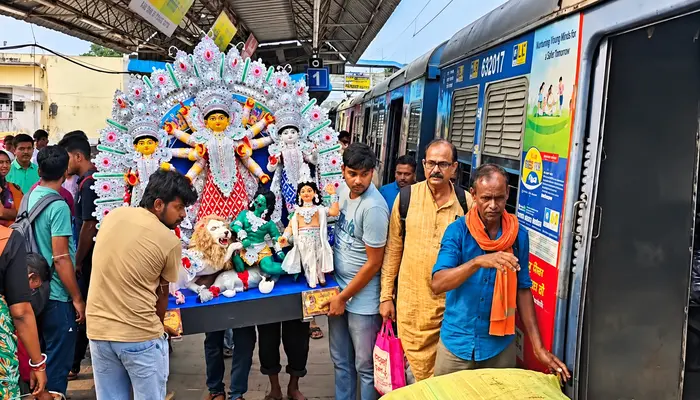
Case Summary
An incident involving the vandalism and desecration of a Durga idol occurred aboard a local train travelling from Santipur to Sealdah in West Bengal. The Durga idol was damaged, and parts of the Goddess’s hands and fingers, along with her delicate ornaments, were found broken. The accompanying idols of Lord Kartik and Lord Ganesha also sustained damage. The Durga idol was subjected to further disrespect, including people placing their feet on it and smoking in front of it, while the Hindu devotees accompanying the idols were intimidated and verbally abused. The incident involved a 5.5-foot Durga idol made by Soumyadeep Mondal, a young clay artist from Santipur. The idol had been commissioned for the annual Durga Puja held at the home of Shri Shatrughna Shobhon Kar, a resident of Namkhana Block in South 24 Parganas. The Puja was organised by his son, Abhyudayeshwar Kar, who lived away from home. On 5 October 2026, the idol was taken to Santipur railway station and was loaded onto the train at Santipur station at around 2.22 pm, with the organisers purchasing a designated ticket for transporting it in the first vendor compartment. The idol was being taken towards Namkhana in the Sundarbans area for the family Puja. The confrontation began when the train reached Phulia station. A group of channa traders entered the vendor compartment and began behaving aggressively towards those accompanying the idol. The traders engaged in high-handed intimidation, severe misconduct and verbal abuse. Shatrughna Shobhon Kar, the Puja organiser, was attacked, pushed by the neck and forced off the train. The group then dragged the Durga idol towards the train door and took it out of the compartment. Other passengers and railway officials intervened, allowing the idol to be returned to the compartment. The traders also had stored their chickpea containers carelessly, allowing dirty water to spill beneath the idols of Kartik and Ganesh, softening their clay, thus damaging the idols. Further instances of disrespect included stepping on the idols, smoking in their presence and pressuring the organisers to move the idol to a common area. After the journey, the Durga idol reached the Kar family home in Namkhana, where its condition was examined. Several parts of the Goddess’s hands and fingers, along with delicate ornaments attached to the idol, had broken. Soumyadeep Mondal, the artist who created the idol, expressed strong anger over the incident. Mondal subsequently submitted a written complaint to the Government Railway Police at Ranaghat and demanded that those responsible be identified and punished. As of the date of writing this report, the Railway Police had begun an investigation, while railway authorities had assured appropriate action. The incident also drew a strong response from the Nadia District Kumbhakar Samiti. Its general secretary, Munna Pal, referred to an earlier incident at Bathna station involving a Ganesha idol, saying that a similar episode had occurred there. He said that people travelled from outside to collect idols made by Santipur’s artisans and that such obstruction and misconduct on trains harmed both the reputation of Santipur and the livelihoods of its clay artists. The association said that the All India Kumbhakar Samiti and state-level representatives would approach senior railway authorities, seeking better security and strict measures.
Why it is Hate Crime ?
The primary category selected in this case is: Attack on Hindu religious representations. The subcategory selected is: Desecration of Hindu religious symbol. Icons and symbols or a religious representation of a spiritual ideal are widely revered in Hinduism. Iconography is of vital significance in the Hindu milieu. It helps connect people’s spiritual beliefs with the real world. Iconography within the Hindu faith takes several shapes and forms. Murtis are of most significance to Hindus, to which daily rituals, prayers and offerings are done. Besides the murtis, there are several other symbols which have deep significance in the Hindu faith – the Om and Swastika for example. Since these Hindu religious symbols hold paramount importance in Hinduism, any desecration of symbols, icons, murtis, religious representations and manifestations, is driven by animosity towards the faith itself which manifests itself through these murtis, icons and symbols. Therefore, any desecration of these Hindu religious symbols and representations is considered religiously motivated hate crimes under this category. The other primary category selected is: Attack not resulting in death. The subcategory selected is: Attack against Hindu devotees. Hindu devotees are a few of the easiest targets of religiously motivated hate crimes because during the festival/procession/puja etc, for non-Hindus it is easy to profile their victims on the basis of religion. Hindu devotees come under attack on several occasions by individual non-Hindus or mobs of non-Hindus owing to their animosity against Hinduism, its symbols and tradition/practices. There are several instances of Hindu devotees being attacked while they worship in temples or temporary religious structures, during religious processions, doing bhajan/kirtan/puja in their own homes, in the residential society etc. These attacks are perpetrated by non-Hindus primarily because of their animosity towards Hindus and their faith. In some cases, the trigger for the violence may be non-religious, however, there are two elements that make these hate crimes. First, the Hindus who come under attack are attacked violently while indulging in religious activity. Whether they are in a place of worship or not is immaterial to the crime. When individuals are attacked while indulging in religious practices, the attack in itself is a hindrance to their freedom to practice religion and therefore constitutes a hate crime. Secondly, religious supremacist doctrines and ideologies deem religious practices of Hindus to be offensive ab initio since they are considered “sinful” by these ideologies, worthy to be annihilated by force or coercion. Driven by these religious supremacist ideologies and doctrines, the attacks against Hindu devotees stem from intrinsic animosity towards Hinduism. In some cases, the trigger for the violence may be non-religious, however, it develops into a religiously motivated crime during the course of the violence. Since these attacks stem from animosity towards Hindus and Hinduism, they are considered religiously motivated hate crimes under this category. This incident constituted a religiously motivated hate crime because the perpetrators specifically targeted sacred Hindu deities and the religious practices surrounding their worship, just before the Durga Puja festival. The Goddess Durga idol was dragged, desecrated and damaged, while the Kartik and Ganesha idols were also damaged. Hindu devotees accompanying the idols were also intimidated and abused. These acts went beyond ordinary misconduct or property damage and constituted an assault on the religious identity, dignity and spiritual practices of the Hindu community. Durga Puja is one of the most significant Hindu festivals, honouring Goddess Durga and her victory over the demon Mahishasura, and symbolising the triumph of good over evil. It is a major religious and cultural observance for Hindus, particularly in West Bengal, where elaborately decorated pandals and sacred idols are central to the celebrations. The festival holds deep spiritual and cultural significance for Hindu communities, with the consecrated idols serving as a focal point of worship and devotion. In Hinduism, idols serve as sacred representations of deities and provide devotees with a tangible focus for worship, through which they offer prayers, perform rituals and express their devotion. They are consecrated, worshipped and incorporated into the ritual life of temples and religious ceremonies. Deliberate damage to or desecration of an idol therefore constitutes an attack on a religious symbol that holds profound significance for Hindu devotees. The Goddess Durga, Kartik and Ganesha idols represent sacred Hindu deities and serve as central religious images in Hindu worship. Their desecration and physical damage, therefore go beyond ordinary damage to personal property. The later discovery of broken portions of the Goddess Durga idol and its ornaments further affected sacred representations that hold direct religious significance for worshippers and the artisan who created them. In Hindu religious practice, the physical form of a deity’s idol is treated with reverence rather than as an ordinary possession, so its deliberate damage and mistreatment constitute an affront to a tangible representation of Hindu faith. Equally significant was the treatment of the Durga idol during its journey for Durga Puja, which interfered directly with the religious observance for which the idol had been created and transported. Placing feet on the idol, smoking in front of it and forcing devotees accompanying it out of the compartment disregarded and defiled the reverence ordinarily accorded to a deity being taken for worship. These actions affected not merely the movement of a sacred idol on a train but the manner in which Hindus carried a deity to a Puja. The timing also gave the conduct particular religious significance, as the idol was being transported for the Durga Puja festival, when devotees were preparing for the worship of Goddess Durga. The conduct therefore disrupted the religious setting surrounding the idol and interfered with the devotees’ ability to accompany it with the dignity and reverence associated with the festival. Beyond the desecration of the sacred images, the Hindu devotees accompanying them were also subjected to intimidation, physical force, abusive language and removal from the compartment. Shatrughna Shobhon Kar, the Puja organiser, was pushed and forced off the train, while the people accompanying the idol were subjected to abusive treatment. This affected Hindu devotees while they were carrying out a religious duty connected with transporting their deity for worship. Their removal from the compartment also separated them from the sacred idols they were accompanying and disrupted their participation in the religious activity. The conduct consequently affected both the dignity of the devotees and their ability to observe the religious occasion in the manner they intended. Furthermore, even if the traders had an issue with the transportation of the idol or the use of the vendor compartment, the matter could have been resolved amicably or brought to the attention of railway officials and the police. The Puja organisers had purchased a designated ticket for transporting the idol, and any disagreement could have been addressed through lawful means rather than intimidation, physical force or disrespectful treatment of sacred Hindu religious images. Resorting to aggression and conduct that resulted in damage to the idols was entirely unnecessary. Disagreements over the use of public transport did not justify mistreating Hindu devotees or compromising the dignity accorded to their deities, particularly when the idols were being transported for a major religious festival. Taken together, these acts disrupted the Hindu community’s observance of a major religious festival, compromised the sanctity accorded to its deities, and subjected devotees to humiliation and coercive treatment while they were carrying out a religious practice. The incident therefore affected both the physical integrity of sacred Hindu figures and the ability of Hindu devotees to observe their faith with dignity and reverence. Accordingly, this case has been documented in the Hinduphobia Tracker's Hate Crime Database as an instance of religiously motivated hostility directed against Hinduism and the religious identity of the Hindu community. Disclaimer: Media reports stated that multiple Hindu victims were subjected to intimidation, physical force and abusive language; however, the total number of victims was not specified. Only one victim, Shatrughna Shobhon Kar, was specifically identified. Therefore, the victim count was kept at one (1). This is a conservative estimate, as the total number of victims could be higher.
Victim Details
Total Victim
1
Deceased
0
Gender
- Male 1
- Female 0
- Third Gender 0
- Unknown 0
Caste
- SC/ST 0
- OBC 0
- General 0
- Unknown 1
Age Group
- Minor 0
- Adult 0
- Senior Citizen 1
- Unknown 0


Case Status
Complaint filed


Perpetrators Details
Perpetrators
Unknown
Perpetrators Range
Unknown
Perpetrators Gender
unknown
 Sources




