Goddess Durga idol vandalised just days before Navratri in Hooghly, West Bengal; Goddess Lakshmi and Lord Ganesha idols also desecrated
 Hooghly district, West Bengal, India
  4 October, 2026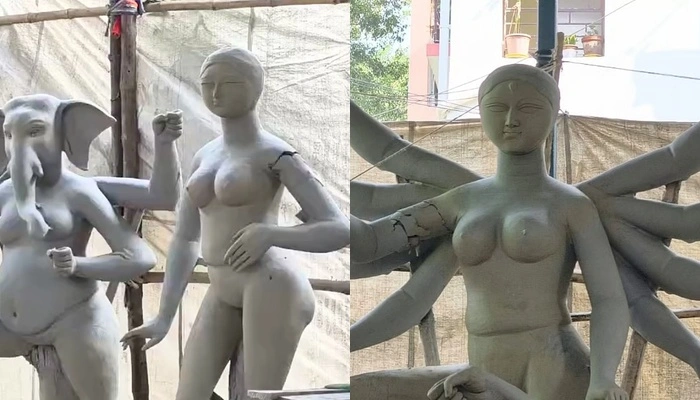
Case Summary
In Dankuni, Hooghly, West Bengal, just days before Navratri, vandals vandalised a Durga idol at the Dankuni Abasan Sarbojanin Puja Committee’s pandal, breaking the Goddess Durga's hand. Attempts were also made to break the hands of Goddess Lakshmi and Lord Ganesha. Puja organisers and idol maker Sanjay Adhikari said the damage was deliberate. The incident took place at the pandal in Ward No.10 of Dankuni Municipality. Unidentified people entered the pandal on the night of 5th October 2026 and damaged the idols. The vandalism was discovered on 6th October 2026, angering puja organisers and residents. A written complaint was subsequently lodged at Dankuni Police Station. Adhikari said he had been making the idols for two and a half months and that only the painting work remained. He said he rushed to the pandal after receiving the news on 6th October 2026 and that he had never faced such a situation before. He maintained that the damage had been intentional. Police arrived after being informed and began an investigation. Officers photographed the damaged idols and began searching for those responsible, while also trying to establish the reason for the incident. Police assured the organisers they would investigate the matter properly. Debashish Mukhopadhyay, a local Bharatiya Janata Party leader, said the housing complex had hosted the Durga Puja for many years and that nothing similar had happened before. He said the incident appeared to have been motivated by resentment and referred to a longstanding water problem on the housing complex’s roads. According to him, the issue had been resolved after the change of government, which he suggested might have caused resentment among some people. He said he had brought the matter to the police’s attention and that closed-circuit television footage from the housing complex gate was also being examined.
Why it is Hate Crime ?
The primary category selected in this case is: Attack on Hindu religious representations. The subcategory selected is: Desecration of Hindu religious symbol. Icons and symbols or a religious representation of a spiritual ideal are widely revered in Hinduism. Iconography is of vital significance in the Hindu milieu. It helps connect people’s spiritual beliefs with the real world. Iconography within the Hindu faith takes several shapes and forms. Murtis are of most significance to Hindus, to which daily rituals, prayers and offerings are done. Besides the murtis, there are several other symbols which have deep significance in the Hindu faith – the Om and Swastika for example. Since these Hindu religious symbols hold paramount importance in Hinduism, any desecration of symbols, icons, murtis, religious representations and manifestations, is driven by animosity towards the faith itself which manifests itself through these murtis, icons and symbols. Therefore, any desecration of these Hindu religious symbols and representations is considered religiously motivated hate crimes under this category. This case is an example of a religiously driven hate crime because a sacred idol of Goddess Durga, installed for the upcoming Durga Puja festival in Hooghly, West Bengal, was vandalised shortly before the festival. The idol was being prepared for worship as part of an important Hindu religious observance when it was targeted. At the same time, the idols of Goddess Lakshmi and Lord Ganesha were also damaged. Durga Puja is one of the most significant Hindu festivals, celebrating Goddess Durga and her victory over the demon Mahishasura, symbolising the triumph of good over evil. It is a major religious and cultural observance for Hindus, particularly in West Bengal, where elaborately decorated pandals and idols form a central part of the celebrations. In Hinduism, idols serve as sacred representations of deities and provide devotees with a tangible focus for worship, through which they offer prayers, perform rituals and express their devotion. They are consecrated, worshipped and incorporated into the ritual life of temples and religious ceremonies. Deliberate damage to or desecration of an idol therefore constitutes an attack on a religious symbol that holds profound significance for Hindu devotees. The damage to the idol of Goddess Durga had specifically interfered with the central focus of the forthcoming Durga Puja observance. Goddess Durga holds a particularly prominent place in the festival’s rituals, and the idol had been undergoing preparations for worship by the devotees. Breaking the deity’s hand had therefore disrupted the religious preparations and compromised an object around which prayers, offerings and ceremonial activities were due to take place. The physical integrity of the idol had been important to the completion of the religious preparations, as devotees had expected to approach the representation of the deity in a prepared and appropriate form during the ceremonies. The timing, just days before Navratri, had further affected the Hindu community’s preparations for the festival and its anticipated religious observances, leaving the central religious idol damaged immediately before worship was due to begin. The attempted damage to the idols of Goddess Lakshmi and Lord Ganesha had carried additional religious significance because both deities have distinct associations within Hindu devotional practice. Goddess Lakshmi is revered in connection with prosperity, wellbeing and auspiciousness, while Lord Ganesha is invoked for the removal of obstacles and the successful commencement of important undertakings. Their presence within the Durga Puja setting had therefore represented more than their physical inclusion alongside Durga. It had connected the festival’s worship with broader Hindu devotional traditions. Attempts to break their hands had consequently interfered with representations of deities associated with blessings and auspicious religious practice. The location of the vandalism inside the Durga Puja pandal had also affected the collective religious activities of the Hindu community. The space had been prepared for devotees to gather, participate in ceremonies and observe the festival together, making the damage an interference with the community’s planned worship rather than an isolated incident involving an object outside a religious setting. Because the vandalism had occurred shortly before the festival, it had disrupted preparations at a particularly important stage, when the religious arrangements and idols had been readied for the arrival of devotees and the commencement of the ceremonies. The damage had affected the religious observance at multiple levels by interfering with the preparation of sacred idols, disrupting the intended worship of several Hindu deities and compromising the setting in which the Hindu community had been preparing to gather for the festival. The timing before Navratri had further heightened the religious impact by interrupting preparations immediately before an important period of Hindu worship. Taken together, these elements had affected the community’s ability to carry out its planned religious observance and had interfered with the expression of Hindu religious identity in a dedicated worship setting. Accordingly, this case has been documented in the Hinduphobia Tracker's Hate Crime Database as an instance of religiously motivated hostility directed against Hinduism and the religious identity of the Hindu community.


Case Status
Complaint filed


Perpetrators Details
Perpetrators
Unknown
Perpetrators Range
Unknown
Perpetrators Gender
unknown
 Sources




