Hindu goddess Maa Durga’s idol deliberately vandalised in Khulna, Bangladesh; police officer mocks desecration
 Khulna District, Bangladesh
  25 September, 2026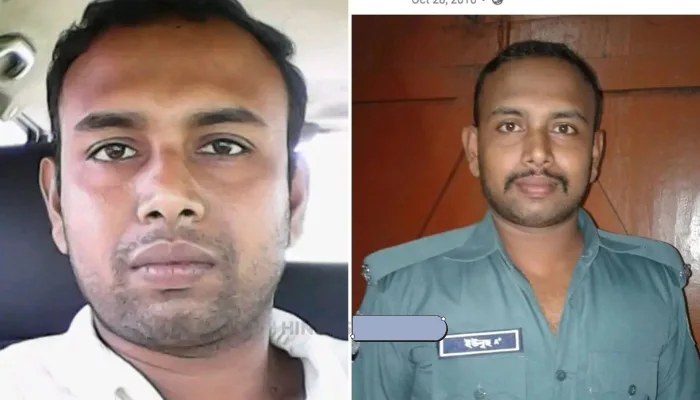
Case Summary
In Debiganj, Panchagarh, Bangladesh, an idol of the Hindu goddess Maa Durga under construction for Durga Puja at the Galandhi Chowrangi Sri Sri Durga Temple was deliberately vandalised by unidentified miscreants. Following this, Khulna Metropolitan Police officer Yunus Sardar made a derogatory and dismissive remark about the desecration on Facebook. Commenting beneath a news report about the vandalism, he wrote, “The one made of sand may have fallen,” effectively trivialising the deliberate damage caused to the Hindu religious representation. The vandalism took place on the night of 26th September 2026 at the temple in Debiduba Union of Debiganj Upazila. After the priests and artisans had completed their work and left the Puja mandap, miscreants entered the premises after midnight and damaged the buffalo and peacock portions of the Durga idol that was being prepared for the upcoming festival. The then Officer-in-Charge of Debiganj Police Station, Md. Musa Mia, confirmed that the idol had been damaged after the temple premises were left unattended. Police subsequently visited the site and began examining the incident, including CCTV footage from the mandap area. Radhanath Barman, general secretary of the Galandhi Chowrangi Sri Sri Durga Temple, also filed a case regarding the vandalism. After news of the attack on the Durga idol was published on a verified Facebook page, Yunus Sardar, whose Facebook profile displayed his name, photograph in police uniform and association with the Khulna Metropolitan Police, posted the comment dismissing the possibility of deliberate vandalism. His response generated anger because it came from a serving police officer in relation to an incident involving the desecration of a Hindu religious representation. Jayashree Dev subsequently submitted a written complaint to the Khulna Metropolitan Police Commissioner, attaching screenshots of the Facebook news post, Yunus Sardar’s comment and his profile. She sought an impartial departmental inquiry and action under applicable police rules, raising concerns regarding the officer’s professional conduct, impartiality and sensitivity towards attacks on Hindu religious institutions and representations. The complaint emphasised that a police officer was expected to respond responsibly and impartially to attacks involving religious places and symbols. The remark became particularly significant because it was made in the context of the deliberate vandalism of an idol of Maa Durga, rather than an accidental incident, and was therefore viewed as disrespectful towards the desecrated Hindu religious representation. This incident occurred against the broader backdrop of the historical persecution faced by Hindus in Bangladesh. While the Hindu minority has endured discrimination, targeted violence, and religious hostility over decades, such persecution has intensified in distinct spurts during periods of political and social instability. The latest major escalation began and continued after the ouster of Sheikh Hasina’s government in August 2024, followed by another surge after the death of Sharif Osman Bin Hadi in December 2025, and subsequently in the immediate aftermath of the 13th National Parliamentary Election in 2026. Following the ouster of Sheikh Hasina, multiple incidents involving attacks on Hindu homes, temples and religious institutions were documented, alongside intimidation, arson and mob violence targeting Hindu localities. The Hinduphobia Tracker recorded 336 incidents involving the Hindu minority during this period, reflecting the scale of the escalation and the continuing vulnerability of Hindus in Bangladesh. A further spurt of violence followed the death of Sharif Osman Bin Hadi, a Muslim political activist and student leader known for his anti-Hindu and anti-India rhetoric, in December 2025. In the aftermath, Hindu communities were subjected to retaliatory violence, with Hindu homes and properties selectively attacked and several families forced to flee. Among the victims was Dipu Chandra Das, who was lynched and whose body was subsequently set ablaze by a Muslim mob over false blasphemy allegations. The Hinduphobia Tracker documented 51 incidents of anti-Hindu violence in the period following Hadi’s death alone, further illustrating how existing hostility towards the Hindu minority intensified during moments of communal mobilisation. During the same period, posters and written material calling for the extermination of Hindus were also displayed in public spaces. Such rhetoric, when viewed alongside incidents of arson, vandalism, assault and targeted intimidation, reflected an environment in which hostility towards Hindus was not merely episodic but repeatedly resurfaced in more intense forms during periods of unrest. The most recent escalation followed the 13th National Parliamentary Election in 2026. In the immediate aftermath of the election results, Hindu families in districts including Noakhali, Rangpur, Nilphamari, Sylhet, Thakurgaon and Dinajpur faced attacks involving arson, looting, assault and vandalism of Hindu homes and temples. In several instances, Hindu properties were selectively targeted, and families were threatened with displacement. The present incident therefore occurred within a much longer history of persecution of Hindus in Bangladesh, where hostility towards the community has persisted over time and intensified in repeated spurts. The latest cycle began after the ouster of Sheikh Hasina and continued through subsequent periods of political and communal upheaval, leaving the Hindu minority increasingly vulnerable to targeted violence, intimidation and religious hostility.
Why it is Hate Crime ?
The primary category selected for this case is: Attack on Hindu religious representations, and within this, the subcategory selected is: Desecration of Hindu religious symbol. Icons and symbols or a religious representation of a spiritual ideal are widely revered in Hinduism. Iconography is of vital significance in the Hindu milieu. It helps connect people’s spiritual beliefs with the real world. Iconography within the Hindu faith takes several shapes and forms. Murtis are of most significance to Hindus, to which daily rituals, prayers and offerings are done. Besides the murtis, there are several other symbols which have deep significance in the Hindu faith – the Om and Swastika for example. Since these Hindu religious symbols hold paramount importance in Hinduism, any desecration of symbols, icons, murtis, religious representations and manifestations, is driven by animosity towards the faith itself which manifests itself through these murtis, icons and symbols. Therefore, any desecration of these Hindu religious symbols and representations is considered religiously motivated hate crimes under this category. The other category selected is: Hate speech against Hindus. The subcategory selected for this case is: Anti-Hindu slurs, mocking faith. Anti-Hindu slurs and the deliberate mocking of the Hindu faith owing to religious animosity involve the usage of derogatory terms, stereotypes, or offensive references to religious practices, symbols, or figures. One of the common anti-Hindu slurs used against Hindus is “cow-worshipper” and “cow piss drinker”. The intention of using this term is to demean and mock Hindus as a group and their religious beliefs since Hindus consider the cow holy. Additionally, some symbols and the slurs attached to them have a historical context that exacerbates the insult, hate, stereotyping, dehumanisation and oppression against Hindus. Cow worship has been used for centuries to denigrate Hindus, insult their faith and oppress Hindus specifically as a religious group. There has been overwhelming documentation about how cow slaughter has been used to persecute Hindus with cow meat being thrown in temples and places of worship. There has also been overwhelming documentation where cow meat (beef) has been force-fed to Hindus to either forcefully convert them to Islam or denigrate their faith. Apart from cow worship, the Swastika – which holds deep religious significance for the Hindus – has also been misinterpreted and distorted to use as a slur against Hindus. Similarly, the worship of the Shivling has been used by supremacist ideologies and religions to denigrate Hindus owing to religious animosity. Such slurs and denigration stem out of inherent animosity and hate towards Hindus and their faith, therefore, it is categorised as hate speech targeted at Hindus specifically owing to their religious identity. This case has been categorised as a hate crime because it involved the deliberate targeting of a sacred Hindu religious representation, followed by the dismissive treatment of that desecration by a serving police officer. The religious dimension is established first by the nature of the target itself: the damaged object was an idol of Maa Durga being prepared for Durga Puja at a Hindu temple. Maa Durga holds profound religious significance in Hinduism as a manifestation of Shakti, representing divine power, protection, courage and the destruction of evil. Moreover, the deity's idol is not merely a physical structure; it is a sacred object of worship and an integral part of Hindu religious observance. During Durga Puja, her Pratima becomes the central focus of collective devotion, ritual worship and religious celebration. Consequently, targeting a Durga idol at a temple, even if done immediately before the festival, interfered directly with an important act of Hindu worship and with preparations for the community's religious observance. Thereafter, the way in which the incident was handled also adds to its religious dimension. Rather than recognising the damage as a potentially deliberate attack on a Hindu religious representation, the police officer's public remark dismissed the possibility of intentional desecration. Mocking or dismissing the destruction of such an idol directly denigrates an object through which Hindus express reverence towards the Goddess and naturally causes deep offence to devotees whose faith is embodied in that representation. The remark was particularly significant because it came after the idol had been deliberately vandalised. Instead of treating the desecration of a Hindu religious representation with the seriousness expected in such circumstances, the comment reduced the incident to the possibility that a structure made from sand had simply fallen. This effectively erased the deliberate nature of the attack and trivialised the religious significance of what had been damaged. Within the context of an attack on Hindu worship, such dismissiveness reflected disregard, hostility and contempt towards Hindu religious sentiments and the sanctity Hindus attach to their deities. The fact that the remark came from a serving police officer further aggravated its significance. Police personnel hold public authority and are entrusted with protecting citizens and responding impartially to attacks on places of worship and religious communities. A dismissive comment from such an official regarding the deliberate desecration of a Hindu deity’s representation could reasonably deepen the sense among Hindu devotees that their religious injury was being mocked rather than treated with dignity and seriousness. Taken together, the vandalism of the idol, thereafter, the mockery of a vandalised representation of Maa Durga, the minimisation of deliberate desecration and the disregard shown towards the religious sentiments attached to the Goddess amounted to mocking Hindu faith and its sacred representations. The conduct communicated that an attack on an object of Hindu reverence was unworthy of serious concern, thereby expressing prejudice and animosity towards Hindu religious belief and forming the basis for documenting the case as anti-Hindu hate speech.


Case Status
Complaint filed


Perpetrators Details
Perpetrators
Muslim Extremists
Perpetrators Range
One Person
Perpetrators Gender
male
 Sources




