Durga Puja under attack in Bangladesh: Muslims demand ban on Hindu Festival and restrictions on worship, calls it ‘sinful’
 Bangladesh
  2 October, 2026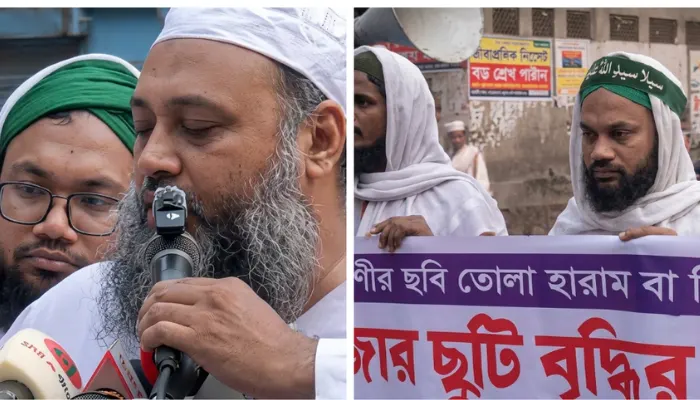
Case Summary
In Bangladesh, on 3rd October 2026, the radical Muslim organisation, Insaf Kayemkari Chhatra Sramik Janata, presented an eight-point charter seeking extensive restrictions on the Hindu festival of Durga Puja. The group denounced the worship of Maa Durga as "shirk" and sought restrictions on the construction of Puja mandaps, Durga idols, idol immersion, government assistance to Hindu devotees, public holidays, and Puja committees' activities. It called the festival a “sinful and depraved” practice and demanded a blanket ban on it. The charter demanded that Durga Puja mandaps be confined to temple premises rather than being erected visibly in public spaces. It also sought limits on the number, size, and height of Durga idols and Puja mandaps, along with punitive action for violating the proposed restrictions. The group further demanded a ban on the traditional immersion of Durga idols, using 'environmental concerns' as an excuse. Another demand called for withdrawing public holidays associated with Durga Puja. Bangladesh’s official 2026 holiday schedule had provided government holidays for Durga Puja, while the charter sought their removal. The group also opposed state assistance used for distributing food or rice to economically disadvantaged Hindu devotees through Puja mandaps. Government authorities had separately announced grants for Puja mandaps ahead of the festival. The charter additionally sought to make political protest compulsory for Hindu Puja committees, demanding that they publicly protest what the group described as persecution of Muslims in India. This sought to condition the organisation of a Hindu religious festival in Bangladesh upon Hindu organisers taking a prescribed political position regarding events in another country. The group also demanded that Bangladesh should stop exporting Hilsa to India during Durga Puja. Taken together, the eight-point charter sought restrictions on Hindu worship, public religious expression, ritual immersion, state assistance, holidays, and the political conduct expected of Hindu festival organisers. Insaf Kayemkari Chhatra Sramik Janata, often translated as the Justice-Establishing Student, Worker and Mass Public movement, is a radical Islamist organisation in Bangladesh that became active following the ousting of Sheikh Hasina’s government in August 2024. The political upheaval was followed by a renewed wave of hostility and violence against Bangladesh’s Hindu minority, a community that has faced persecution and discrimination for decades. The persecution continued following the death of Sharif Osman Bin Hadi in December 2025 and resurfaced in the immediate aftermath of Bangladesh’s 13th National Parliamentary Election in 2026. Following the ouster of Sheikh Hasina, multiple incidents involving attacks on Hindu homes, temples and religious institutions were documented, alongside intimidation, arson and mob violence targeting Hindu localities. The Hinduphobia Tracker recorded 336 incidents involving the Hindu minority during this period, reflecting the scale of the escalation and the continuing vulnerability of Hindus in Bangladesh. A further spurt of violence followed the death of Sharif Osman Bin Hadi, a Muslim political activist and student leader known for his anti-Hindu and anti-India rhetoric, in December 2025. In the aftermath, Hindu communities were subjected to retaliatory violence, with Hindu homes and properties selectively attacked and several families forced to flee. Among the victims was Dipu Chandra Das, who was lynched and whose body was subsequently set ablaze by a Muslim mob over false blasphemy allegations. The Hinduphobia Tracker documented 51 incidents of anti-Hindu violence in the period following Hadi’s death alone, further illustrating how existing hostility towards the Hindu minority intensified during moments of communal mobilisation. During the same period, posters and written material calling for the extermination of Hindus were also displayed in public spaces. Such rhetoric, when viewed alongside incidents of arson, vandalism, assault and targeted intimidation, reflected an environment in which hostility towards Hindus was not merely episodic but repeatedly resurfaced in more intense forms during periods of unrest. The most recent escalation followed the 13th National Parliamentary Election in 2026. In the immediate aftermath of the election results, Hindu families in districts including Noakhali, Rangpur, Nilphamari, Sylhet, Thakurgaon and Dinajpur faced attacks involving arson, looting, assault and vandalism of Hindu homes and temples. In several instances, Hindu properties were selectively targeted, and families were threatened with displacement. The present incident therefore occurred within a much longer history of persecution of Hindus in Bangladesh, where hostility towards the community has persisted over time and intensified in repeated spurts. The latest cycle began after the ouster of Sheikh Hasina and continued through subsequent periods of political and communal upheaval, leaving the Hindu minority increasingly vulnerable to targeted violence, intimidation and religious hostility.
Why it is Hate Crime ?
The primary category selected for this case is: Restriction/ ban on Hindu practices. The subcategory selected for this case is: Restriction on expression of Hindu identity. An example of the state-affected prejudicial and targeted orders against the Hindu community would be a government denying the right of a Hindu or a group of Hindus to hold a religious procession owing to the animosity of non-Hindu groups. Denial of the religious right of Hindus to assuage the non-Hindu group, which harbours animosity to a point where it could lead to violence against Hindus, is not only a failure of law and order but is a prejudicial order against Hindus, denying them their fundamental rights to express their religious identity. An example of a hate crime against Hindus by a non-Hindu would be a non-Hindu institution forcing its Hindu employees to abandon religious symbols that a Hindu would wear as an expression of faith owing to inherent prejudice against the faith professed by the victim, or a non-Hindu group of people restricting a Hindu group from constructing a place of worship simply because the demography of the area in which the temple is being built is dominated by non-Hindus. Such actions are driven by religious animosity and/or prejudice against Hindus and their faith and would therefore be categorised as a hate crime. The next primary category selected for this case is: Attack on Hindu religious representation. The subcategory selected for this case is: Defiling religious customs. Sanatan Dharma is not a religion of one book, which is to say that while it has religious scriptures that form the central tenets of the faith, there are several traditions followed through thousands of years, mostly passed from generation to generation orally. There are several such customs and traditions that are followed by various Hindus and Hindu sects. Defiling these traditions and customs is a breach of an individual or group’s religious practices. Such practices can range from dietary restrictions like not eating non-vegetarian food for a certain period of the year, not eating non-vegetarian food at all, not eating beef since the cow is considered holy in Hinduism, the sanctity of religious customs followed in the house (like many ISKCON devotees), etc. Any malicious action leading to the breach of such traditions or defilement of these traditions owing to animosity towards the faith or for the sake of activism stems not only from the lack of faith in the religion itself but also from disregard for the faith of the devotees who follow the customs/traditions and implicit bias against the faith and the tradition itself. Since these specific traditions are central to the faith of the devotees of that specific sect of Hindus, any non-compliance with these traditional rules would be considered a religiously motivated hate crime. The other category selected is: Hate speech against Hindus, and within this, the subcategory selected is: Anti-Hindu slurs, mocking faith. Anti-Hindu slurs and the deliberate mocking of the Hindu faith owing to religious animosity involve the usage of derogatory terms, stereotypes, or offensive references to religious practices, symbols, or figures. One of the common anti-Hindu slurs used against Hindus is “cow-worshipper” and “cow piss drinker”. The intention of using this term is to demean and mock Hindus as a group and their religious beliefs since Hindus consider the cow holy. Additionally, some symbols and the slurs attached to them have a historical context that exacerbates the insult, hate, stereotyping, dehumanisation and oppression against Hindus. Cow worship has been used for centuries to denigrate Hindus, insult their faith and oppress Hindus specifically as a religious group. There has been overwhelming documentation about how cow slaughter has been used to persecute Hindus with cow meat being thrown in temples and places of worship. There has also been overwhelming documentation where cow meat (beef) has been force-fed to Hindus to either forcefully convert them to Islam or denigrate their faith. Apart from cow worship, the Swastika – which holds deep religious significance for the Hindus – has also been misinterpreted and distorted to use as a slur against Hindus. Similarly, the worship of the Shivling has been used by supremacist ideologies and religions to denigrate Hindus owing to religious animosity. Such slurs and denigration stem out of inherent animosity and hate towards Hindus and their faith, therefore, it is categorised as hate speech targeted at Hindus specifically owing to their religious identity. This case was documented as a religiously motivated hate crime because the demands were directed at restricting the public expression and practice of Hindu faith during Durga Puja. The pressure did not concern an ordinary public activity; it targeted religious worship, sacred images, mandaps, and established festival rituals integral to Hindu religious observance. Durga Puja holds immense religious and cultural significance for Hindus, particularly Bengali Hindus. It celebrates Maa Durga’s victory over the demon Mahishasura, symbolising the triumph of good over evil and dharma over adharma. Maa Durga is worshipped as a manifestation of Shakti, the divine feminine power representing strength, protection and righteousness. The festival involves prayers, offerings, installation of Durga Pratimas and collective worship at Puja mandaps. These are not merely cultural displays; they are visible manifestations of Hindu religious identity and collective devotion. For Bangladesh’s Hindu minority, Durga Puja also represents religious continuity, community solidarity and the preservation of spiritual and cultural heritage. The religious hostility was also reflected in the objectionable remarks made by the Muslim accused about Hindu gods and goddesses. Hindu deities are integral and sacred to Hindu religious belief, and mocking them constitutes a direct insult to Hindu religious sentiments. The remarks therefore added an explicit element of religious denigration to the broader attempts to restrict Hindu observance. In Islamic theology, idol worship, referred to as Shirk, is regarded as a grave sin, and Islamic teachings reject practices associated with idol worship. When Hindu deities are publicly mocked on this basis, such conduct can reflect theological contempt towards Hindu practices and target the beliefs, identity and dignity of Hindus. The attempts to push Durga Puja observances away from public spaces further demonstrated the religious dimension of the targeting. A community’s religious identity is expressed not only through private belief but also through sacred symbols, rituals, imagery and public worship. Efforts to confine mandaps, regulate their visibility or remove Hindu worship from shared public spaces effectively interfere with the community’s ability to practise and express its faith openly. Such restrictions carry a discriminatory character because they seek to reduce the visibility of Hindu religious practice in public life. The demand to prohibit Pratima Visarjan further interfered with an established Hindu religious custom. Durga Puja culminates in the ceremonial immersion of the Goddess, marking the festival's conclusion. For devotees, Visarjan is not an optional or decorative activity but a meaningful religious tradition embedded in the observance itself. It symbolises the Goddess’s departure and reflects Hindu beliefs concerning creation, dissolution and renewal. Attempting to prohibit the practice therefore interfered directly with the festival's religious integrity and showed disregard for a custom followed by generations of Hindu worshippers. Taken together, these were not isolated objections to one aspect of Durga Puja. The demands sought to regulate how Hindus worshipped, where they could conduct that worship, how they could display sacred images in public, and whether an established religious ritual could be performed at all. The simultaneous denigration of Hindu deities and restrictions on public religious observance therefore reflected hostility towards both Hindu religious belief and its visible practice. The case consequently involved two interconnected forms of religious targeting: the denigration of Hindu beliefs and the suppression of Hindu religious expression and practice. By seeking to make Hindu worship less visible while interfering with established rituals intrinsic to Durga Puja, the conduct demonstrated prejudice against the public expression and observance of Hindu faith, forming the basis for documenting the incident as a religiously motivated hate crime. Disclaimer: The available material did not specify the exact number of members of Insaf Kayemkari Chhatra Sramik Janata who were involved in presenting or supporting the eight-point charter. Therefore, for documentation purposes, the exact number of perpetrators is recorded as unknown.


Case Status
Unknown


Perpetrators Details
Perpetrators
Muslim Extremists
Perpetrators Range
Unknown
Perpetrators Gender
male
 Sources




