Multiple women trapped, blackmailed and raped by Muslim men posing as Hindus; contacts of over 200 women found on accused’s phone
 Jodhpur, Rajasthan, India
  10 December, 2025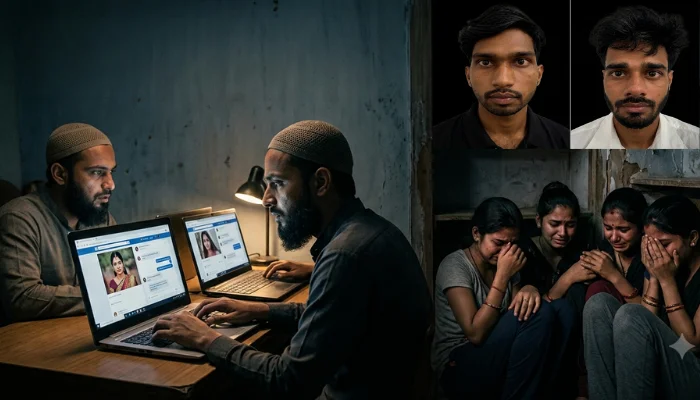
Case Summary
Multiple women were trapped, blackmailed and raped by two Muslim men who posed as Hindu women online to establish contact with their targets. Police identified the two accused as Faizan Ahmed and Aamir Hussain. The accused created fake social media accounts using Hindu names such as 'Vaishnavi' and 'Tanishka' and lured women with promises of earning lakhs of rupees through work-from-home jobs. The case came to light after a woman from Jodhpur, Rajasthan, approached the police with details of her ordeal. Police recovered data relating to more than 200 women from the accused’s mobile phones, including nude videos and chats involving around 30 women. Faizan Ahmed, a Mumbai resident and graduate, and Aamir Hussain, a literate native of Jharkhand who was living in Mumbai, met while working at a cake shop in Mankhurd along Mumbai’s Harbour Line. During their spare time at the bakery, they operated fake social media profiles created using women’s names. The accused admitted before the police that they had created accounts using Hindu names such as Vaishnavi and Tanishka and posed as Hindu women while chatting with women on Snapchat, Instagram and WhatsApp. They lured their targets with promises of lucrative work-from-home opportunities. The accused initially claimed to be vendors for a company called 'Red State' and asked the women to fill out agreement forms containing personal details, including their mobile numbers and email addresses, as well as their signatures. They then assigned simple online tasks, initially asking the women to rate restaurants and hotels and like and share social media content. To build trust, the accused transferred payments to their bank accounts after the women completed the initial tasks. After the women completed the rating assignments, they were given promotional tasks involving creating video reels for products. After the women completed the tasks, the accused withheld their payments and told them the money would be released only if they made video calls. The accused used the agreements as a means of intimidation, threatening the women with legal action for breaching the terms. They used these threats to pressure them into making video calls and, after establishing contact, lured them with promises of higher payments while threatening them with legal consequences. The accused then forced the women to record obscene and nude videos. After obtaining the intimate material, they contacted the women on their personal numbers, blackmailed them and demanded money in exchange for keeping the videos private. They also summoned some women to hotels and raped them. Police recovered nude videos and chat records involving around 30 women, while the phones contained mobile numbers, email addresses and other personal information relating to more than 200 women. The woman who lodged a complaint in Jodhpur on 31 August 2026 said she saw a work-from-home advertisement on Snapchat and, after responding, was contacted by an unidentified person who offered her online work and obtained her identity details and signature. She was initially assigned tasks such as liking and sharing social media reels. During these interactions, the Muslim perpetrators obtained her private photographs and videos, which were later used to pressure her into making nude video calls and threaten her with public exposure. According to the police, Faizan travelled from Mumbai to Jodhpur in December 2025 and asked the woman to meet him at a hotel. He raped her at the hotel on 11 December 2025, after which the blackmail and demands for money continued. Following the complaint, Jodhpur Rural Police traced the accused’s mobile locations to Mumbai and sent a team to Mankhurd based on technical evidence. Since the police did not have photographs of the accused, officers searched for them by posing as delivery workers. Within two to three days, they traced Faizan’s residence and went there disguised as LPG cylinder delivery personnel. After confirming his presence, they arrested him and subsequently apprehended Aamir as well, bringing both men to Jodhpur. The investigation also found that the accused had targeted several women in Mumbai’s Marine Drive area, where a separate case of blackmail and fraud was registered against them. Police suspected that the racket operated across several states and targeted women in Rajasthan as well as other parts of the country. The investigation also indicated possible links to a suspected sex-racket syndicate, while police were examining whether other people were involved. Investigators were analysing the digital evidence recovered from the accused’s phones to establish the extent of the network, identify other potential victims and determine how the personal information of more than 200 women was obtained and used.
Why it is Hate Crime ?
This case is being added to the tracker under the primary category: Attack not resulting in death. The subcategory selected is: Attacked for Hindu identity. In several cases, Hindus are attacked merely for their Hindu identity without any perceived provocation. A classic example of this category of religiously motivated hate crime is a murder in 2016. 7 ISIS terrorists were convicted for shooting a school principal in Kanpur because they got ‘triggered’ seeing the Kalava on his wrist and tilak that he had put. In this, the Hindu victim had offered no provocation except for his Hindu religious identity. The motivation for the murder was purely religious, driven by religious supremacy. Such cases where Hindus are targeted merely for their religious identity would be documented as a hate crime under this category. This case was a clear example of a religiously driven hate crime, as the Muslim perpetrators deliberately pretended to be Hindu women to lure, trap, blackmail and sexually exploit multiple women. The use of fabricated Hindu identities was central to their method of operation, as they used Hindu names and personas to establish contact and gain the victims’ trust. By deliberately adopting Hindu identities to facilitate the exploitation of women, the perpetrators made religious identity an integral part of the crime rather than an incidental element. The most significant religious marker was that the perpetrators admitted to creating such accounts. If their objective had simply been sexual exploitation and blackmail without a religious dimension, they would have adopted fabricated Muslim identities. Instead, they posed as Hindu women to establish contact and gain the trust of their targets, indicating that Hindu women were the primary targets of this method of exploitation. By exploiting the appearance of a shared Hindu identity to gain access to Hindu women and subsequently subject them to sexual exploitation, blackmail and coercion, the perpetrators demonstrated religious profiling and hostility towards Hindu women and their faith, making the crime religiously driven. The fabricated Hindu identities enabled the perpetrators to exploit the victims’ trust and socioeconomic vulnerabilities by creating a false sense of familiarity and religious affinity before offering work-from-home opportunities. By deliberately presenting themselves as Hindu women, the perpetrators made the victims more likely to trust them and lower their guard. This manipulation also affected the victims’ ability to make a fully informed and voluntary decision, as the women were approached on the basis of a false identity and were not aware of the true circumstances or intentions of those engaging with them. The deliberate choice to assume Hindu identities indicated that the victims’ Hindu identity was central to how they were approached and targeted. Their shared, albeit fabricated, religious identity helped the perpetrators establish credibility and gain access. The perpetrators then exploited that trust for sexual and financial gain, treating the Hindu women not as individuals entitled to make decisions on the basis of accurate information, but as targets whose religious identity and vulnerabilities could be manipulated for criminal purposes. The use of a false Hindu identity therefore went beyond ordinary deception. It was a deliberate method of influencing the victims’ choices by withholding the true identity and intentions of the perpetrators. By creating a false sense of religious familiarity, the perpetrators interfered with the women’s ability to assess the situation independently and make an informed decision about whom they were dealing with. This reflected a dehumanising approach in which Hindu identity was reduced to a tool for gaining access to vulnerable women, while their personal dignity and autonomy were disregarded. The subsequent sexual exploitation and blackmail demonstrated how the deception was used against the victims. After establishing contact through fabricated Hindu identities, the perpetrators obtained private photographs and videos, pressured the women into nude video calls and used the material to threaten and blackmail them. The sequence showed that the fabricated Hindu identity was not merely a false persona but the means through which trust was established before the women were subjected to such predatory exploitation. The deliberate targeting of women through identities presented as Hindu therefore demonstrated hostility towards both the victims and the religious identity that had been appropriated to gain access to them. The scale of the targeting demonstrated that this was not an isolated act against one or two women, but a broader pattern in which multiple women, primarily Hindu women, were targeted for exploitation. Around 30 women were identified through obscene material and chat records recovered from the accused, while their phones contained personal details and contact information relating to more than 200 other women. The sheer number of women targeted demonstrated that the perpetrators were systematically seeking out women for exploitation rather than acting against a small number of incidental victims. The fact that Hindu women constituted the documented victims and were approached through fabricated Hindu identities further strengthened the religious dimension of this pattern. It indicated a sustained method of targeting in which Hindu women were repeatedly selected, deceived and exploited, reflecting hostility towards Hindu women and the Hindu community rather than an isolated instance of sexual exploitation. The existence of a separate case against the perpetrators in Mumbai for similar blackmail and fraud further established that this pattern was repeated rather than a one-off incident. Their targeting of multiple women in another location demonstrated continuity in their conduct, while the repeated use of fabricated Hindu identities indicated a consistent method of approaching and exploiting primarily Hindu women. The recurrence of this targeting showed that Hindu women were not victims of a single criminal episode but were repeatedly subjected to the same form of deception and exploitation. Taken together, the scale and repeated nature of the targeting demonstrated a sustained pattern directed primarily at Hindu women, reinforcing the religious dimension of the crime. Overall, since this case meets the parameters of a religiously driven offence, it is being added to the hate crime database of the Hinduphobia Tracker. Disclaimer: Hinduphobia Tracker records the incident date based on when the victim’s ordeal begins, rather than when the media reports the incident. In this case, the exact date on which the ordeal of all the victims began was not clear. The earliest date mentioned was 11 December 2025, when one of the victims from Jodhpur was raped by the perpetrators. Henceforth, 11 December 2025 has been selected as the indicative incident date for documentation purposes only. Hinduphobia Tracker records an incident's location based on where the victim’s ordeal begins, rather than where the media reports it. However, in this case, the personal details and locations of all the victims were not stated. The only location mentioned was that of the victim from Jodhpur. For documentation purposes, the incident location has been recorded as Jodhpur, Rajasthan, India. The investigation revealed obscene photographs and nude chats involving around 30 women, indicating that 30 women had been targeted by the perpetrators. Henceforth, the victim count has been recorded as 30.
Victim Details
Total Victim
30
Deceased
0
Gender
- Male 0
- Female 30
- Third Gender 0
- Unknown 0
Caste
- SC/ST 0
- OBC 0
- General 0
- Unknown 30
Age Group
- Minor 0
- Adult 0
- Senior Citizen 0
- Unknown 30


Case Status
Arrested


Perpetrators Details
Perpetrators
Muslim Extremists
Perpetrators Range
From 2 To 5
Perpetrators Gender
male
 Sources




