Hindu place of worship targeted; sacred idol of Goddess Durga desecrated in Hyderabad ahead of Durga Puja
 Hyderabad, Telangana, India
  3 October, 2026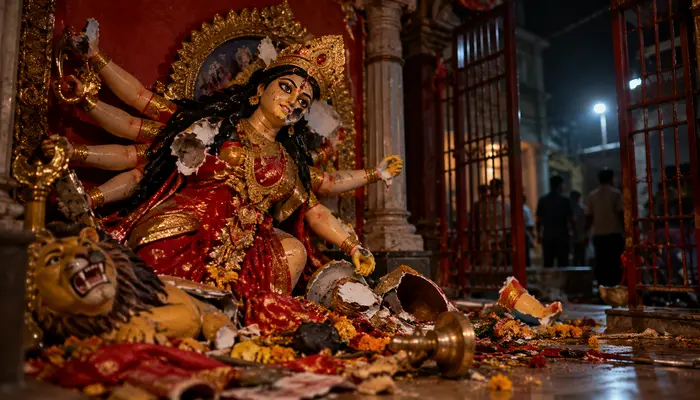
Case Summary
In Hyderabad, at Bapu Ghat in Langer Houz, a sacred idol of Goddess Durga at a temple was desecrated, constituting an act against a Hindu place of worship ahead of Durga Puja. The incident occurred just days before Durga Puja. On 4th October 2026, at 5 pm, some devotees visited the temple and found the idol desecrated. At 7 pm, Bharatiya Janata Party leaders Indira Reddy and Praveen filed a complaint with the Langer Houz police. Following the incident, tension prevailed in Langer Houz, and residents staged a protest against the desecration of the Goddess Durga idol ahead of Navratri. A large crowd gathered at the Langer Houz police station and demanded action against those responsible, heightening tensions in the area. Police officials held talks with the protesters and assured them that they would take appropriate action after verifying the circumstances surrounding the incident. The crowd subsequently remained at the police station seeking action. Langer Houz Station House Officer B Venkat Ramulu said the exact time of the desecration was unclear. Police visited the temple and restored the idol. Ramulu added that police had to register a case regarding the incident.
Why it is Hate Crime ?
The primary category selected in this case is: Attack on Hindu religious representations. The subcategory selected is: Desecration of Hindu religious symbol. Icons and symbols or a religious representation of a spiritual ideal are widely revered in Hinduism. Iconography is of vital significance in the Hindu milieu. It helps connect people’s spiritual beliefs with the real world. Iconography within the Hindu faith takes several shapes and forms. Murtis are of most significance to Hindus, to which daily rituals, prayers and offerings are done. Besides the murtis, there are several other symbols which have deep significance in the Hindu faith – the Om and Swastika for example. Since these Hindu religious symbols hold paramount importance in Hinduism, any desecration of symbols, icons, murtis, religious representations and manifestations, is driven by animosity towards the faith itself which manifests itself through these murtis, icons and symbols. Therefore, any desecration of these Hindu religious symbols and representations is considered religiously motivated hate crimes under this category. This incident has been categorised as a hate crime because the target of the act was a sacred Hindu religious symbol located within a Hindu place of worship, and the desecration occurred immediately before Durga Puja, one of the most important periods in the Hindu religious calendar. Choosing a Goddess Durga idol as the target gives the incident a clear religious dimension rather than making it an ordinary act of vandalism. The timing is also significant. The desecration took place only days before Navratri and Durga Puja, when devotees would be preparing to worship Goddess Durga. An attack on the idol at this particular time had the potential to cause heightened religious distress and disrupt the community's observance of the festival. The nature of the target is another important indicator. A temple idol is not merely a physical object for Hindu devotees; it is an object of worship and occupies a central place in religious practice. Desecrating it, therefore, constitutes an attack on a sacred Hindu symbol and, by extension, on the religious space in which it is worshipped. It is important to mention here that, though the last update was that the miscreants were unknown, the action stemmed from hatred against Hinduism and resulted in the desecration of the sacred idol and would therefore be considered a religiously motivated hate crime.


Case Status
Complaint filed


Perpetrators Details
Perpetrators
Unknown
Perpetrators Range
Unknown
Perpetrators Gender
unknown
 Sources




