Hindu temple desecrated in Bagalkot, Karnataka, as Muslim women consume non-vegetarian food inside its premises
 Bagalkot, Karnataka, India
  4 October, 2026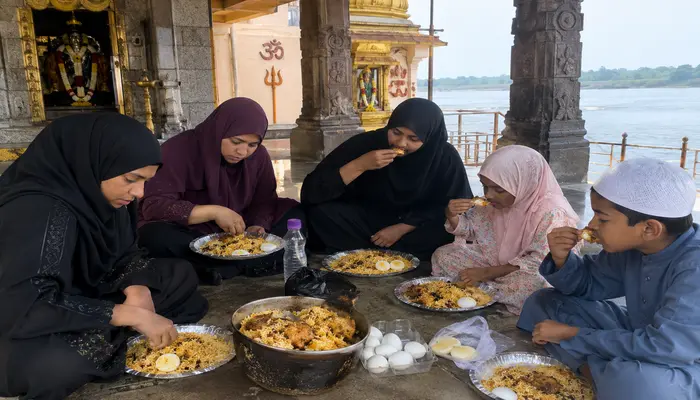
Case Summary
In Bagalkot, Karnataka, a Hindu temple was desecrated when three Muslim women and two children consumed non-vegetarian food inside its sacred premises. The incident took place at the Basavanna Aiky Mantapa in Kudalasangama, a prominent Hindu pilgrimage centre in Bagalkot district, situated near the confluence of the Krishna and Malaprabha rivers. The Basavanna Aiky Mantapa is the sacred samadhi site associated with Jnanyogi Basavanna, the 12th-century Hindu saint and philosopher, and holds immense religious significance for devotees. It was here that three Muslim women, accompanied by two children, entered the temple premises, sat near the Aiky Mantapa and were seen consuming non-vegetarian food. The incident came to light on 5 October 2026 after a video recorded by a Hindu devotee at the site went viral on social media. The video showed the three Muslim women consuming non-vegetarian food as Hindu devotees confronted them over their conduct. The man recording the video could be heard questioning how meat could be consumed at such a sacred site, while other devotees pointed out that the premises were part of a Shiva temple and told the women that consuming meat there was inappropriate. When confronted, the Muslim women began arguing with the Hindu devotees, who subsequently informed the temple office staff about the incident. When security personnel arrived, the perpetrators denied consuming meat and claimed that they had only eaten eggs. However, the Hindu devotees disputed this account, stating that they had seen the Muslim group consuming chicken. Following the confrontation, the perpetrators left the premises. Temple office staff later stated that when they attempted to obtain information about them near the information centre, the Muslim accused did not provide any details and left by bus. The temple office staff confirmed that the group comprised three Muslim women and two children. At the time of documentation, no case had been registered in connection with the incident. The incident angered Hindu devotees, who stated that consuming non-vegetarian food within the temple premises and near the sacred Aiky Mantapa had hurt the religious sentiments of Basava devotees. They demanded that the temple authorities take measures to prevent such incidents and maintain the sanctity, cleanliness and religious character of the sacred site. Following the incident, Bharatiya Janata Party Member of Legislative Assembly from Vijayapura Basanagouda R Patil Yatnal condemned the consumption of non-vegetarian food at the sacred site in a post on X. He stated that Hindu temples have their own sanctity and said that such conduct was unacceptable at a place of religious significance. He urged the police and district administration to take legal action and called for clear regulations, notice boards, fines and penalties to ensure the sanctity, cleanliness and devotional character of Basavanna’s sacred place were maintained. The Karnataka Bharatiya Janata Party also condemned the incident on its official X handle. The party described the consumption of non-vegetarian food at Kudalasangama as highly condemnable. It questioned Chief Minister D.K. Shivakumar, ministers and local Member of Legislative Assembly Vijayananda Kashappanavar over the incident, describing it as a further insult to Basavanna and his devotees. The viral video subsequently triggered a wider debate on social media. Hindu users questioned why the Muslim family had deliberately chosen to consume non-veg food within the temple premises despite having other places available to eat and called for legal action against the perpetrators.
Why it is Hate Crime ?
The primary category selected in this case is: Attack on Hindu religious representations. The subcategory selected is: Breaking rules of place of worship. Sanatan Dharma is not a religion of one book, which is to say that while it has religious scriptures that form the central tenets of the faith, there are several traditions followed through thousands of years, mostly passed from generation to generation orally. One of these oral traditions or written traditions is the rules of specific temples. Certain temples have rules which are traditional rules, dependent on the worship of the presiding deities. These rules and traditions have been followed for thousands of years whether they find scriptural mention or not. Such traditions are based on the nature and rules of worship of the presiding deity of that temple. Any non-compliance of these traditions owing to animosity towards the faith or for the sake of activism stems not only from the lack of faith in the presiding deity but also disregard for the faith of the devotees of that deity/temple and implicit bias against the faith, the tradition and the deity itself. Since these specific traditions are central to the faith of the devotees of that specific temple and presiding deity, any non-compliance with these traditional rules would be considered a religiously motivated hate crime. The other subcategory selected is: Defiling religious customs. Sanatan Dharma is not a religion of one book, which is to say that while it has religious scriptures that form the central tenets of the faith, there are several traditions followed through thousands of years, mostly passed from generation to generation orally. There are several such customs and traditions that are followed by various Hindus and Hindu sects. Defiling of these traditions and customs is a breach of an individual or group’s religious practices. Such practices can range from dietary restrictions like not eating non-vegetarian food for a certain period of the year, not eating non-vegetarian food at all, not eating beef since the cow is considered holy in Hinduism, the sanctity of religious customs followed in the house (like many ISCKON devotees), etc. Any malicious action leading to the breach of such traditions or defilement of these traditions owing to animosity towards the faith or for the sake of activism stems not only from the lack of faith in the religion itself but also from disregard for the faith of the devotees who follow the customs/traditions and implicit bias against the faith, the tradition itself. Since these specific traditions are central to the faith of the devotees of that specific sect of Hindus, any non-compliance with these traditional rules would be considered a religiously motivated hate crime. This case is a clear example of a religiously driven hate crime, as three Muslim women, accompanied by two children, entered a sacred Hindu temple and consumed non-vegetarian food within its premises. Hindu temples are sacred places of worship where ritual purity and sanctity are preserved through established religious customs, practices and rules of conduct. These customs govern not only worship and ritual observances but also the behaviour and activities permitted within the temple premises. In temples where dietary restrictions are observed, the consumption of non-vegetarian food, including meat and eggs, is prohibited within the sacred premises. Such restrictions are followed to preserve the ritual purity of the temple, maintain its sacred atmosphere and distinguish the temple space from ordinary places of public activity. Everyone entering the premises is expected to respect these established religious practices and conduct themselves accordingly. The Basavanna Aikya Mantapa at Kudalasangama is the sacred samadhi associated with Jnanyogi Basavanna, the 12th-century Hindu saint and philosopher. Kudalasangama is an important Hindu pilgrimage centre situated at the confluence of the Krishna and Malaprabha rivers, and the Aikya Mantapa forms part of the larger sacred temple kshetra revered by Hindu devotees. The site is therefore not merely a public location but a religiously significant pilgrimage destination where devotees visit to offer prayers and pay their respects to Basavanna. The established prohibition on non-vegetarian food within the temple premises is observed as part of the practices intended to preserve the sanctity and ritual purity of this sacred environment. Against this religious backdrop, consuming non-vegetarian food inside the temple premises violated the sacred rules governing conduct at the site and defiled the sanctity of both the temple and the Basavanna Aiky Mantapa. The act disregarded established Hindu customs concerning food and ritual purity at a revered pilgrimage centre, particularly in the vicinity of Basavanna’s sacred samadhi. Such conduct demonstrated religious animosity and a clear disregard for Hindu religious practices and sentiments, amounting to religious desecration and constituting a religiously driven hate crime. The subsequent explanation from the perpetrators that they had consumed eggs rather than meat did not alter the nature of the violation. Eggs are also non-vegetarian food, and their consumption remained contrary to the dietary restrictions observed within the temple premises to preserve ritual purity. The distinction between chicken and eggs therefore did not change the fact that food prohibited within the sacred space had been consumed there. The explanation consequently did not address the underlying religious violation, as the restriction applied to non-vegetarian food more broadly rather than only to meat. Moreover, when Hindu devotees confronted the Muslim women over their conduct, they began arguing with them rather than acknowledging the religious objection and apologising for having offended Hindu sentiments. Their response further reflected a disregard for the religious customs governing the premises and for the objections raised by Hindu devotees. Rather than recognising that their conduct had violated the norms of a sacred place of worship, they disputed the objections raised by those present. This response, when viewed alongside the consumption of prohibited food within the temple, reinforced the disregard shown towards Hindu religious practices and the sentiments of the Hindu community. Since this case meets the parameters of a hate crime, it is being added to the hate crime database of the Hinduphobia Tracker. Disclaimer: Hinduphobia Tracker records incident dates based on when the crime or ordeal occurred rather than when the incident was reported by the media. In this case, the earliest available date was 5 October 2026, when a video of the incident went viral on social media. Henceforth, 5 October 2026 is being selected as the indicative incident date for documentation purposes only.


Case Status
Complaint not filed


Perpetrators Details
Perpetrators
Muslim Extremists
Perpetrators Range
From 2 To 5
Perpetrators Gender
female
 Sources




