Hindu women lured with inducements and religious books to convert to Christianity in Kushinagar, Uttar Pradesh
 Kushinagar, Uttar Pradesh, India
  2 October, 2026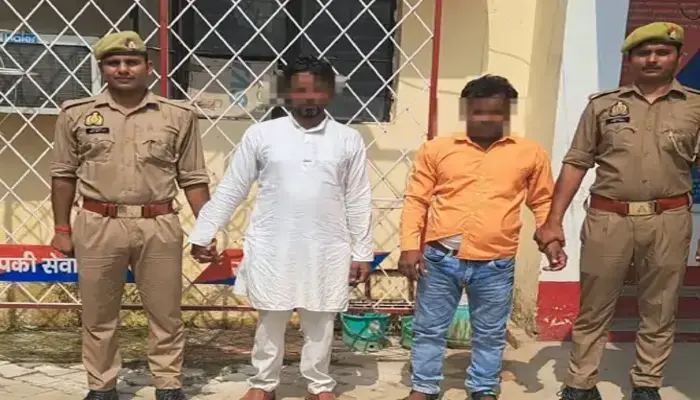
Case Summary
In Semri Parsoni village under Hata Kotwali in Kushinagar, Hindu women were lured with inducements and religious books in an attempt to convert them to Christianity. On 3rd October 2026, Dhruv Nishad, a resident of Khirkia village under Padrauna Kotwali in Kushinagar, and Durgesh Nishad, a resident of Kataura village under Gauribazar police station in Deoria district, visited a village in the Hata Kotwali area. The two had shown religious books to some women and had used inducements while attempting to convert them to Christianity. After receiving information about the activity, Bharatiya Janata Party Nagar Mandal president Avadhesh Singh had reached the spot and informed the police. The police reached the spot and arrested both men. Based on a complaint submitted by Avadhesh Singh, police registered a First Information Report against Dhruv Nishad and Durgesh Nishad under Sections 3 and 5(1) of the Uttar Pradesh Prohibition of Unlawful Conversion of Religion Act, 2021. Police also recovered an Apache motorcycle bearing registration number UP57BZ4677 from the two arrested men. On 6th October 2026, MLA Mohan Verma visited the spot and spoke to residents. He had directed officials to investigate the matter and take appropriate action. Mohan Verma had said that changing religion through inducement or pressure was wrong and that maintaining social harmony was essential. The arrest team comprised Hata Kotwali in-charge Deepak Kumar Singh, Sub-Inspector Rizwan Ahmad and Constable Sujeet Yadav. The police had continued investigating other aspects of the case. The court had produced the two accused and sent them to jail. Hata Kotwali Station House Officer Deepak Kumar Singh had confirmed that both men had been sent to jail following their court appearance.
Why it is Hate Crime ?
The primary category selected in this case is: Predatory Proselytisation. Within this, the first subcategory selected is: Conversion/ attempts to convert by inducement. Predatory Proselytisation is not just limited to threat, harassment, force and violence, but it also has contours of stealth. In several cases, the Hindu victim is exploited to convert, with non-Hindus taking advantage of their poverty. In such cases, the Hindu victim who is suffering financially is offered monetary benefits, including lucrative offers for jobs, health treatment, education, etc, to induce the victim into changing his/her religion. In such cases, the religious identity of the victim and the aim to disenfranchise him from his faith form the heart of the crime. Also, taking advantage of and exploiting an individual’s economic vulnerabilities is widely acknowledged as exploitation, forms of which are often penalised by law. Such cases therefore are considered religiously motivated hate crimes since the victim’s religious identity forms the very heart of the crime itself. This case was included in the Hinduphobia Tracker because Hindu women were specifically targeted for conversion to Christianity through inducements and religious literature. The religious trigger was evident from the deliberate attempt to persuade Hindu women to abandon their faith, while the involvement of multiple individuals and the subsequent police action established that the activity went beyond ordinary religious interaction and involved an organised attempt at religious conversion. At the outset, the specific targeting of Hindu women for conversion to Christianity had constituted a direct challenge to their existing Hindu religious identity. The approach was not presented as a general exchange between people of different faiths. It had been directed towards Hindu women to change their religious affiliation. The significance had rested in the deliberate effort to persuade members of the Hindu community to leave their established faith and embrace Christianity. The targeting had therefore represented the central religious marker in the matter, as the conduct had been directed towards altering the women's religious identity rather than merely discussing religious beliefs. Of particular significance was the use of inducements to encourage Hindu women to change their religion. The inducements introduced a material or persuasive element into the proposed change of faith, making them part of the effort to move the women away from Hinduism. The religious concern arose from the connection between the inducement and the proposed conversion: the material incentive was being used in support of an effort to replace the women's existing Hindu faith with Christianity. This made the inducement a distinct religious marker rather than ordinary assistance or persuasion. More importantly, using the vulnerabilities or material needs of Hindu women as leverage for the explicit purpose of converting them amounts to exploitation of their circumstances for religious targeting. The issue is not the provision of assistance itself, but using that assistance to induce members of a particular religious community to abandon their faith. Where material vulnerability is deliberately exploited to facilitate conversion, the conduct takes on a coercive and discriminatory character and becomes a significant indicator of religiously motivated hostility. Equally significant had been the use of religious books in the conversion effort. The books had provided explicitly religious material through which Christianity had been presented to Hindu women while they were being approached for conversion. Their use had therefore formed part of the broader effort to persuade the women to move away from their existing Hindu beliefs and religious identity. The religious literature consequently served as another identifiable marker of conversion activity, linking the presentation of Christian religious material directly to attempts to change the women's faith. The incident also highlights a growing pattern in organised conversion networks, where individuals who have embraced Christianity continue to retain their Hindu names while practising Christianity. This allows these crypto Christians to seamlessly integrate into Hindu communities, gain the confidence of unsuspecting families, and carry out conversion activities without immediately revealing their religious identity. In this case too, the pastors operated under the Hindu names Dhruv Nishad and Durgesh Nishad, illustrating how the continued use of a Hindu identity can facilitate access to communities that might otherwise be wary of conversion efforts. Collectively, the targeting of Hindu women for conversion to Christianity, the use of inducements to encourage a change of faith, and the presentation of religious books as part of the conversion effort demonstrated a sustained attempt to undermine their existing Hindu religious identity. Taken together, these elements place the conduct in a distinctly religious context involving efforts to move members of the Hindu community away from their faith. Accordingly, this case has been documented in the Hinduphobia Tracker's Hate Crime Database as an instance of religiously motivated hostility directed against Hinduism and the religious identity of the Hindu community.


Case Status
Arrested


Perpetrators Details
Perpetrators
Christian Extremists
Perpetrators Range
From 2 To 5
Perpetrators Gender
male
 Sources




