Anti-Hindu hostility at film institute in Kolkata: Hindu religious symbols desecrated, “Pakistan Zindabad” and "saffron is terrorism" slogans raised
 Kolkata, West Bengal, India
  26 September, 2026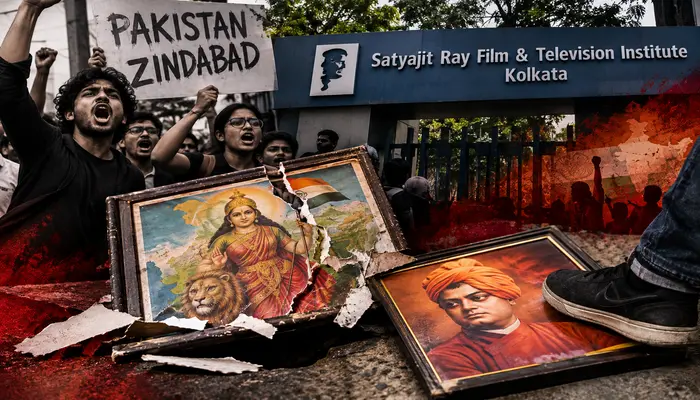
Case Summary
On 27 September 2026, students at the Satyajit Ray Film and Television Institute (SRFTI) in Mukundapur, Kolkata, desecrated images of Bharat Mata and Swami Vivekananda during a confrontation with members of the Akhil Bharatiya Grahak Panchayat (ABGP), an RSS-linked Hindu organisation. According to members of the organisation, the students tore a photograph of Bharat Mata, spat on and kicked a photograph of Swami Vivekananda, while also raising slogans such as “Pakistan Zindabad” and “saffron is terrorism.” The confrontation began after SRFTI students objected to an event organised by ABGP at the institute. Members of the Hindu organisation stated that the students resorted to the desecration of the images during the ensuing altercation. They further said a similar confrontation took place on 4 October 202h, when members of the organisation reached the institute to protest the desecration, and students responded by throwing stones and glass bottles at them. On 4 October 2026, members of the Bangiyo Hindu Jagaran Manch (BHJM) marched towards the Satyajit Ray Film and Television Institute (SRFTI) campus in Mukundapur to protest the desecration of images of Bharat Mata and Swami Vivekananda and the raising of “Pakistan Zindabad” and “saffron is terrorism” slogans during the 27 September confrontation. The organisation had announced the protest following the incident, with a BHJM member stating that the mobilisation would continue because of the insult to Swami Vivekananda and the chanting of pro-Pakistan slogans. During the protest, the demonstrators recited the Hanuman Chalisa and raised their objections to the disrespect shown to Bharat Mata and Swami Vivekananda. Babita Prasad, one of the members of the Hindu organisation who participated in the protest, stated, “Today Bharat Mata's photo was kicked, spit was thrown, and Swami Vivekananda, who raised the stature of this country abroad and held his country in high esteem, his photo was kicked, and spit was thrown”. She said the protest was intended to make society think about “which country we live in and with whom we live”. Hindu Jagran Manch member Sudhanshu Singh also questioned the use of the phrase “saffron is terrorism” in connection with Swami Vivekananda, pointing out that Vivekananda wore saffron robes and questioning how saffron could be associated with terrorism. The protesters also said they threw stones and bottles during the confrontation. A person identifying himself as a Kolkata Police Special Branch personnel claimed that he was beaten during the incident despite telling those involved that he was a police officer, despite protesters saying that they had remained restrained. The personnel claimed that he suffered bleeding from his nose and mouth and said his mobile phone and watch were also missing. A protester, however, denied that the Hindu Jagran Manch members had assaulted police personnel. “No one has beaten the police,” the protester said, adding that the demonstration was a spontaneous, unarmed protest by people. The protester said the organisation had been conducting its demonstrations in accordance with the Constitution and denied responsibility for any assault on police personnel. Following the 27 September confrontation, three FIRs were registered in connection with the violence. Two FIRs were registered against unknown students and one against unknown persons, with charges including wrongful restraint, assault on public servants, voluntarily causing hurt and criminal intimidation. The ABGP also filed a complaint against unknown students, while SRFTI Dean (Film) Sukanta Majumder filed a complaint against unknown persons in connection with the incident.
Why it is Hate Crime ?
This case has been added to the tracker under the primary category of - Attack on Hindu religious representations. Within it, the sub-category selected is - Desecration of Hindu religious symbol. Icons and symbols or a religious representation of a spiritual ideal are widely revered in Hinduism. Iconography is of vital significance in the Hindu milieu. It helps connect people’s spiritual beliefs with the real world. Iconography within the Hindu faith takes several shapes and forms. Murtis are of most significance to Hindus, to which daily rituals, prayers and offerings are done. Besides the murtis, there are several other symbols which have deep significance in the Hindu faith – the Om and Swastika for example. Since these Hindu religious symbols hold paramount importance in Hinduism, any desecration of symbols, icons, murtis, religious representations and manifestations, is driven by animosity towards the faith itself which manifests itself through these murtis, icons and symbols. Therefore, any desecration of these Hindu religious symbols and representations is considered religiously motivated hate crimes under this category. The other primary category selected here is - Hate speech against Hindus. Within it, the sub-category selected is - Anti-Hindu slurs, mocking faith. Anti-Hindu slurs and the deliberate mocking of the Hindu faith owing to religious animosity involve the usage of derogatory terms, stereotypes, or offensive references to religious practices, symbols, or figures. One of the common anti-Hindu slurs used against Hindus is “cow-worshipper” and “cow piss drinker”. The intention of using this term is to demean and mock Hindus as a group and their religious beliefs since Hindus consider the cow holy. Additionally, some symbols and the slurs attached to them have a historical context that exacerbates the insult, hate, stereotyping, dehumanisation and oppression against Hindus. Cow worship has been used for centuries to denigrate Hindus, insult their faith and oppress Hindus specifically as a religious group. There has been overwhelming documentation about how cow slaughter has been used to persecute Hindus with cow meat being thrown in temples and places of worship. There has also been overwhelming documentation where cow meat (beef) has been force-fed to Hindus to either forcefully convert them to Islam or denigrate their faith. Apart from cow worship, the Swastika – which holds deep religious significance for the Hindus – has also been misinterpreted and distorted to use as a slur against Hindus. Similarly, the worship of the Shivling has been used by supremacist ideologies and religions to denigrate Hindus owing to religious animosity. Such slurs and denigration stem out of inherent animosity and hate towards Hindus and their faith, therefore, it is categorised as hate speech targeted at Hindus specifically owing to their religious identity. The other primary category selected here is - Attack not resulting in death. Within it, the sub-category selected here is - Attacked for opposing radicals or trying to save victim. In several cases, Hindus are attacked for opposing religiously motivated crimes being committed against a fellow Hindu or simply for voicing an opinion opposing radical elements, who either have in the past or continue to persecute Hindus. In such cases, the initial attack against the victim, against which the Hindu was trying to defend the victim, would also need to be classified as a religiously motivated hate crime. Since the initial crime itself was religiously motivated and the subsequent crime of attempting to save the victim or speaking against the radical elements ends up inviting a violent attack, it would also be classified as a religiously motivated hate crime under this category. This case qualified as a religiously motivated hate crime because the conduct by the students was directed at symbols and figures that hold religious and civilisational significance for Hindus. The tearing of a photograph of Bharat Mata and the kicking and spitting on a photograph of Swami Vivekananda went beyond an ordinary disagreement with the Akhil Bharatiya Grahak Panchayat (ABGP) or its programme. The conduct was directed towards representations closely associated with Hindu religious and cultural identity, making the religious character of the hostility central to the incident. Swami Vivekananda holds a prominent place in modern Hindu thought and is widely recognised for presenting Hindu philosophy to audiences in India and abroad. His saffron robes, teachings and public advocacy of Hindu spiritual traditions have made him an important figure in the representation of Hindu religious identity. Similarly, Bharat Mata is a personification of India as a mother figure and has particular significance within Hindu cultural and devotional imagination, where the nation is represented through a sacred feminine form. The targeting of images of both therefore carried a significance beyond ordinary damage to photographs or disagreement with an organisation. By tearing the image of Bharat Mata and kicking and disrespecting the image of Swami Vivekananda, the perpetrators directed contempt towards representations closely associated with Hindu religious, cultural and civilisational identity. The fact that the two images represented both a prominent Hindu spiritual figure and a sacredly conceived personification of the nation further reinforced the identity-based character of the reported conduct. If the students had objections to the presence of the Akhil Bharatiya Grahak Panchayat (ABGP) or disagreed with the organisation's programme at the institute, they could have expressed that disagreement through criticism, protest or other forms of opposition directed towards the organisation and its activities. However, their conduct went beyond such a disagreement as they insulted symbols and figures associated with Hindu religious and cultural identity. The tearing of Bharat Mata's image and disrespect towards Swami Vivekananda therefore did not merely challenge the ABGP or its programme but demeaned representations that hold significance for the wider Hindu community. This distinction was central to the hate-crime character of the incident, as the hostility was directed not only at a particular organisation or viewpoint but at symbols through which Hindu religious and cultural identity was expressed. The raising of “Pakistan Zindabad” slogans further strengthened the communal and ideological character of the incident. Such slogans form part of a broader ideological pattern that carries deep communal implications for Hindus as a collective. While such slogans are often interpreted primarily through the lens of national security or public order, their historical, ideological, and civilisational context reveals that they frequently function as expressions of hostility toward the Hindu identity that India, as a civilisation, represents. The slogan “Pakistan Zindabad” is intrinsically tied to the legacy of the Partition of India, which was justified through the two-nation theory; the belief that Muslims and Hindus constitute separate and incompatible nations. Pakistan was created as a state founded explicitly on Islamic identity in opposition to what was portrayed as a Hindu-majority civilisation. When such slogans are raised alongside the targeting of Bharat Mata and Swami Vivekananda, it reinforced the impression that the hostility extended beyond the ABGP to symbols representing Hindu and Indian identity. The significance of the slogan was further heightened because “Pakistan Zindabad” has also been used in instances involving Islamist elements or separatist mobilisation against India, where Pakistan has been invoked as a symbol of opposition to the Indian state and its predominantly Hindu civilisational character. The use of the same slogan in a confrontation involving a Hindu organisation therefore echoed a form of rhetoric that has previously been associated with hostility towards India. Therefore, its combination with the disrespect towards Bharat Mata and Swami Vivekananda demonstrated that the conduct was directed at identities and symbols associated with Hindu-majority India rather than being confined to opposition against the ABGP. Additionally, the reference to the phrase “saffron is terrorism” carried a specific religious significance because it associated saffron, a colour deeply embedded in Hindu religious identity, with terrorism and criminality. Saffron has traditionally been associated within Hinduism with renunciation, asceticism, spiritual discipline and the life of the sannyasi, and it is prominently worn by Hindu monks, spiritual teachers and religious figures. Swami Vivekananda himself was widely recognised in saffron robes, making the reported reference particularly relevant in the context of the confrontation over his image. Associating saffron with terrorism therefore did not merely constitute criticism of a colour or a political symbol; in this context, it carried the potential to stigmatise a visible marker of Hindu religious identity by placing a religiously significant symbol in the same conceptual category as terrorism. The expression therefore contributed to an environment in which a central marker of Hindu religious life was portrayed in an inherently negative and criminalising manner. It was the combination of the religious meaning of saffron, its direct association with Swami Vivekananda in this incident, and the use of the term “terrorism” that gave the expression its anti-Hindu significance. Its invocation during the protest was directly connected to the dispute over Swami Vivekananda and the treatment of his saffron-clad image. The phrase was therefore relevant to the religious-hate dimension of the case because it highlighted how saffron itself had become a contested marker of Hindu identity within the confrontation. The violence during the 4 October mobilisation further reinforced the hate-crime character of the incident because the Hindu organisation members had gathered specifically to oppose conduct they regarded as an insult to Bharat Mata and Swami Vivekananda, as well as the anti-Hindu, anti-India slogans. The subsequent use of stones and glass bottles against those members of the Hindu organisation represented a physical escalation of a confrontation that had already centred on Hindu religious and cultural identity. The presence of police personnel at the site also made the escalation particularly significant, as the protesters had assembled in the presence of law enforcement and the dispute could have been addressed through lawful protest and police intervention rather than physical violence. Violence in this context had the effect of intimidating and physically confronting those who were publicly asserting their objection to conduct they that was hostile to the Hindu faith. It demonstrated that the hostility surrounding the incident was not confined to the desecration of Hindu symbols but also escalated against those who came forward to oppose and condemn that conduct. This progression strengthened the basis for treating the incident as more than an ordinary political or institutional disagreement, as the religious significance of the underlying dispute remained central to the confrontation and its subsequent escalation. It demonstrated that hostility was not confined to the Hindu symbols themselves but also affected people who mobilised to defend or express solidarity with those symbols and the religious identity they represented. Taken together, the conduct reflected hostility that extended beyond opposition to the ABGP and encompassed Hindu religious and cultural identity. The disrespect towards Swami Vivekananda and Bharat Mata, the “Pakistan Zindabad” and "saffron is terrorism" slogans, and the subsequent stone-pelting and throwing of bottles at members of the Hindu organisation who had gathered to oppose the conduct gave the incident a clear religious and communal dimension. The hostility therefore extended from Hindu symbols to individuals who had mobilised to defend their faith and its symbols, which was central to its classification as a hate crime against Hindus.


Case Status
Complaint registered


Perpetrators Details
Perpetrators
Unknown
Perpetrators Range
Unknown
Perpetrators Gender
unknown
 Sources




