Sacred Hindu temple of Goddess Kali vandalised in Rangpur, Bangladesh
 Rangpur, Rangpur District, Bangladesh
  30 September, 2026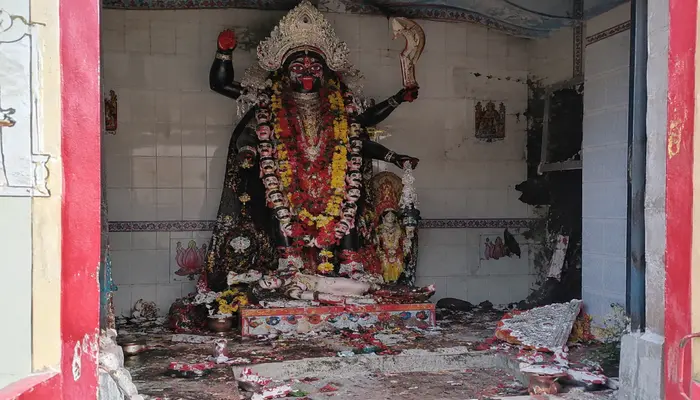
Case Summary
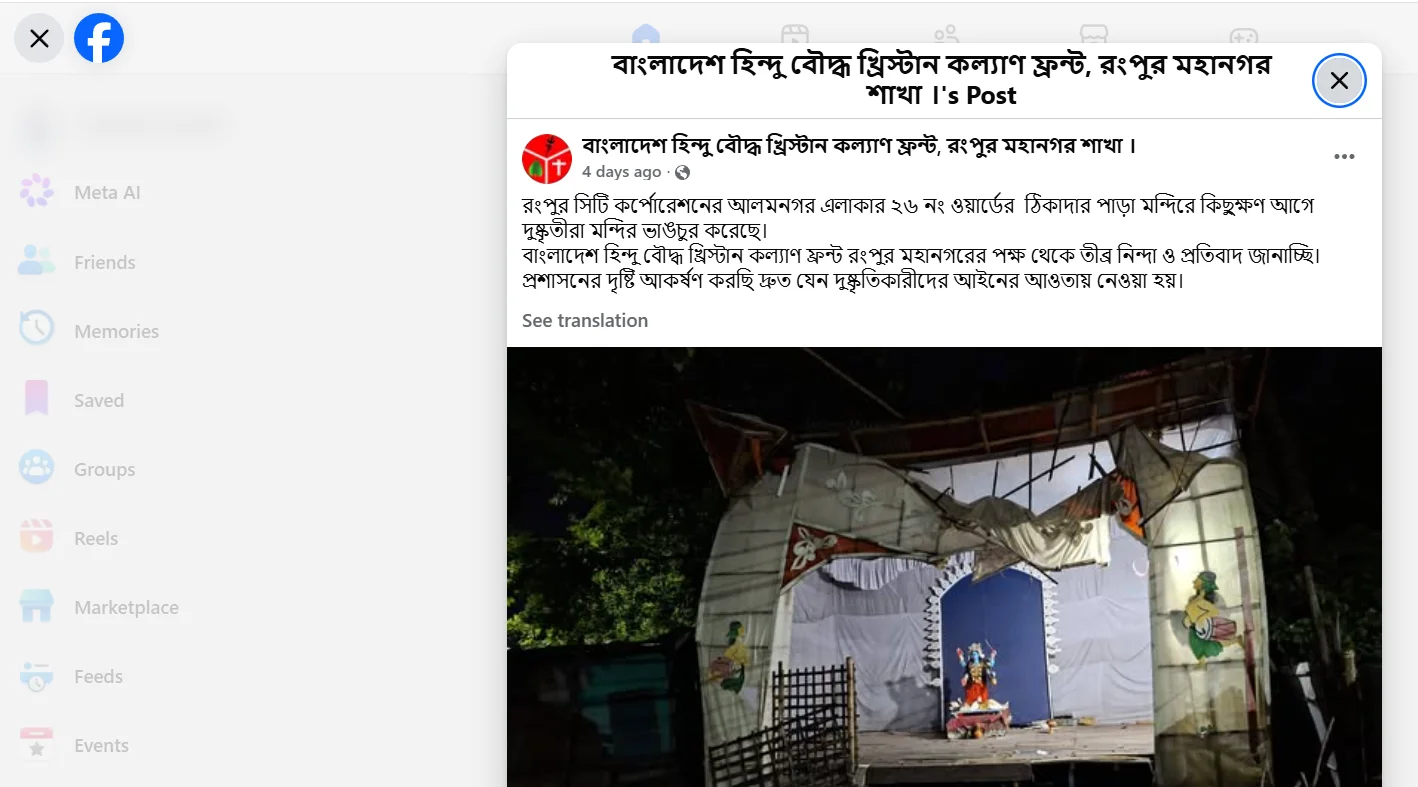
In Alamnagar, Rangpur, Bangladesh, a Hindu temple dedicated to Goddess Kali was vandalised by unidentified miscreants. The temple is located in the Contractor Para area of Ward No. 26 under Rangpur City Corporation. The incident took place during the night at the temple, which was a place of worship for followers of Sanatan Dharma. The perpetrators vandalised the Hindu place of worship, prompting condemnation from a minority rights group named 'Bangladesh Hindu Buddhist Christian Welfare Front', Rangpur Metropolitan Branch. The organisation strongly condemned and protested against the vandalism and called on the administration to identify those responsible and bring them to justice. It also urged the authorities to take immediate action against the perpetrators. This incident occurred against the broader backdrop of the historical persecution faced by Hindus in Bangladesh. While the Hindu minority has endured discrimination, targeted violence, and religious hostility over decades, such persecution has intensified in distinct spurts during periods of political and social instability. The latest major escalation began after the ouster of Sheikh Hasina’s government in August 2024, continued after the death of Sharif Osman Bin Hadi in December 2025, and resurfaced in the immediate aftermath of the 13th National Parliamentary Election in 2026. Following the ouster of Sheikh Hasina, multiple incidents involving attacks on Hindu homes, temples and religious institutions were documented, alongside intimidation, arson and mob violence targeting Hindu localities. The Hinduphobia Tracker recorded 336 incidents involving the Hindu minority during this period, reflecting the scale of the escalation and the continuing vulnerability of Hindus in Bangladesh. A further spurt of violence followed the death of Sharif Osman Bin Hadi, a Muslim political activist and student leader known for his anti-Hindu and anti-India rhetoric, in December 2025. In the aftermath, Hindu communities were subjected to retaliatory violence, with Hindu homes and properties selectively attacked and several families forced to flee. Among the victims was Dipu Chandra Das, who was lynched and whose body was subsequently set ablaze by a Muslim mob over false blasphemy allegations. The Hinduphobia Tracker documented 51 incidents of anti-Hindu violence in the period following Hadi’s death alone, further illustrating how existing hostility towards the Hindu minority intensified during moments of communal mobilisation. During the same period, posters and written material calling for the extermination of Hindus were also displayed in public spaces. Such rhetoric, when viewed alongside incidents of arson, vandalism, assault and targeted intimidation, reflected an environment in which hostility towards Hindus was not merely episodic but repeatedly resurfaced in more intense forms during periods of unrest. The most recent escalation followed the 13th National Parliamentary Election in 2026. In the immediate aftermath of the election results, Hindu families in districts including Noakhali, Rangpur, Nilphamari, Sylhet, Thakurgaon and Dinajpur faced attacks involving arson, looting, assault and vandalism of Hindu homes and temples. In several instances, Hindu properties were selectively targeted, and families were threatened with displacement. The present incident therefore occurred within a much longer history of persecution of Hindus in Bangladesh, where hostility towards the community has persisted over time and intensified in repeated spurts. The latest cycle began after Sheikh Hasina's ouster. It continued through subsequent periods of political and communal upheaval, leaving the Hindu minority increasingly vulnerable to targeted violence, intimidation and religious hostility.
Case Images

Why it is Hate Crime ?
This case is being added to the tracker under the primary category: Attack on Hindu religious representations. The subcategory selected is: Attack on Temples. In Hinduism, a temple is the abode of the Deity. The Deity in the Temple is consecrated, thereby, making it a real, breathing entity. Hindus believe that not just the Deity but the temple premises itself are sacred to Hindus since Hindus hold the faith that the entire Temple space is an amalgamation of the divine energy of the deity. Given the central significance of Temples in Hindu Dharma, any attack against a Hindu Temple or its peripheral premises is an attack on the faith itself and is born out of animosity towards the faith, of which, the Temple is a central tenet. Any manner of attack against a Temple and/or its premises would therefore be considered a religiously motivated hate crime. This case was a clear example of a religiously motivated hate crime because the perpetrators vandalised a sacred Hindu temple dedicated to Goddess Kali. By deliberately targeting a Hindu place of worship, they desecrated a site of profound religious significance and demonstrated hostility towards Hinduism and its devotees. Hindu temples are sacred spaces where devotees worship deities, offer prayers, perform rituals and observe religious traditions. A Kali temple is dedicated to Goddess Kali, a revered manifestation of the Divine Mother and a powerful form of Shakti. Goddess Kali is worshipped as a protector of devotees and as a divine force associated with the destruction of evil, transformation and the triumph of righteousness. A temple dedicated to her therefore holds deep religious significance as a place where devotees offer worship, seek her blessings and invoke her divine presence. Vandalising the temple was therefore not merely an act of damage to property or a physical structure. It was an attack on a sacred Hindu space and on the religious sentiments of the community that revered and worshipped there. The deliberate desecration of the temple undermined its sanctity and created fear among Hindus regarding the safety of their places of worship. Targeting such a sacred site demonstrated disdain towards Hinduism and its religious practices, constituting clear religious hostility towards the Hindu community and its faith. The incident also occurred within a broader and well-documented pattern of attacks against Hindus and other religious minorities in Bangladesh. Hindu communities have faced recurring violence, vandalism and attacks on their homes, businesses, temples and other religious sites for years. This pattern intensified following the political upheaval and Sheikh Hasina’s departure from Bangladesh in August 2024, when Hindu communities and religious sites were targeted in several parts of the country. The continued attacks on Hindu temples and communities demonstrate that the long-standing pattern of anti-Hindu hostility and persecution in Bangladesh has persisted despite the political transition. Although the identities of the perpetrators remained unknown at the time of documentation, the deliberate vandalism of a sacred Hindu temple clearly demonstrated hostility towards Hinduism. Therefore, the incident was added to the hate crime database of the Hinduphobia Tracker. Disclaimer: The Hinduphobia Tracker records incident dates based on when the crime occurred, rather than when it was reported by the media. However, in this case, the media reports did not state the exact date on which the crime occurred. The earliest known documentation of the incident was a post published by the Bangladesh Hindu Buddhist Christian Welfare Front, Rangpur Metropolitan Branch, on its social media handle on 1 October 2026. Hence, 1 October 2026 was selected as the indicative incident date for documentation purposes only.


Case Status
Unknown


Perpetrators Details
Perpetrators
Unknown
Perpetrators Range
Unknown
Perpetrators Gender
unknown
 Sources




