Hindu religious site targeted; woman calls for demolition of Hindu temple, mocks Hanuman idol as a ‘stone’
 Chhatarpur, Madhya Pradesh, India
  26 September, 2026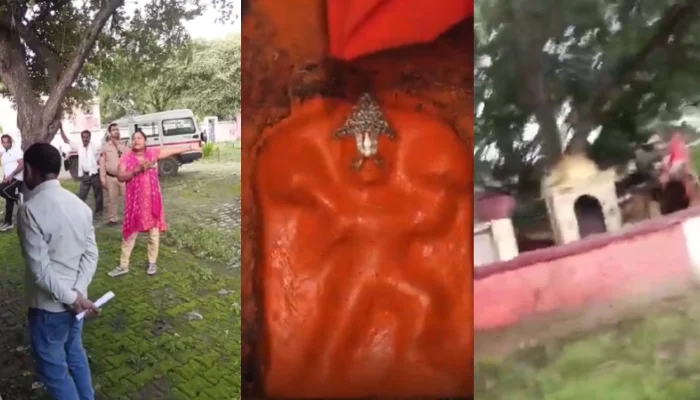
Case Summary
In Navgaon, Chhatarpur, Madhya Pradesh, a Hanuman temple was targeted by a woman who called for its demolition and mocked the deity’s idol by referring to it as a mere ‘stone’. A video of the incident went viral on 27 September 2026, showing the woman in the presence of police officers, local administration officials and Hindu locals. The incident took place when she was asked by the local administration to vacate government land that she had encroached upon. Instead of responding to the demand to vacate the encroached land, the woman pointed towards the Hanuman temple and called for its demolition, claiming that it was illegal. She mockingly said that she was a human being while the temple and the deity were merely ‘stone’, adding that the stone had no life. She further mocked the idol by repeatedly reducing it to a mere stone and called for the temple’s demolition. In the same video, Hindu locals and activists objected to the woman’s remarks. They stated that while she might consider the deity to be a stone, it was their revered deity, and said that she had repeatedly called for the temple’s demolition and mocked the idol. They called on the local administration to take action against her and warned of protests if action was not taken.
Why it is Hate Crime ?
This case is being added to the tracker under the primary category: Hate Speech against Hindus. The subcategory selected is: Anti-Hindu slurs, mocking faith. Anti-Hindu slurs and the deliberate mocking of the Hindu faith owing to religious animosity involve the usage of derogatory terms, stereotypes, or offensive references to religious practices, symbols, or figures. One of the common anti-Hindu slurs used against Hindus is “cow-worshipper” and “cow piss drinker”. The intention of using this term is to demean and mock Hindus as a group and their religious beliefs since Hindus consider the cow holy. Additionally, some symbols and the slurs attached to them have a historical context that exacerbates the insult, hate, stereotyping, dehumanisation and oppression against Hindus. Cow worship has been used for centuries to denigrate Hindus, insult their faith and oppress Hindus specifically as a religious group. There has been overwhelming documentation about how cow slaughter has been used to persecute Hindus with cow meat being thrown in temples and places of worship. There has also been overwhelming documentation where cow meat (beef) has been force-fed to Hindus to either forcefully convert them to Islam or denigrate their faith. Apart from cow worship, the Swastika – which holds deep religious significance for the Hindus – has also been misinterpreted and distorted to use as a slur against Hindus. Similarly, the worship of the Shivling has been used by supremacist ideologies and religions to denigrate Hindus owing to religious animosity. Such slurs and denigration stem out of inherent animosity and hate towards Hindus and their faith, therefore, it is categorised as hate speech targeted at Hindus specifically owing to their religious identity. This case was a clear example of religiously motivated hate speech because the perpetrator targeted a Hindu temple, called for its demolition, and mocked Lord Hanuman and his sacred idol. Her remarks directly denigrated a Hindu place of worship and a revered Hindu deity, demonstrating hostility towards Hinduism and its religious practices. Hindu temples are sacred spaces dedicated to the worship of deities and the observance of Hindu religious practices. They are places where devotees offer prayers, perform rituals and seek the blessings of the deities. The murtis installed and consecrated within temples are also sacred, as they serve as the form through which devotees worship the divine presence of the deity. Lord Hanuman is a widely revered Hindu deity associated with devotion, strength, courage and unwavering devotion to Lord Rama. Therefore, targeting a Hanuman temple and denigrating the deity worshipped within it directly attacked objects and spaces of deep religious significance to Hindus. Calling for the demolition of a Hindu temple while describing it as illegal, without establishing any basis for that assertion, demonstrated hostility towards a Hindu place of worship. The conduct went beyond the issue of government land and specifically targeted the temple and its religious character. At the same time, referring to Lord Hanuman’s sacred idol as a mere ‘stone’ demeaned a revered Hindu deity and insulted the religious sentiments of Hindu devotees. The combination of demanding the destruction of a Hindu temple and ridiculing the deity worshipped there established a clear religious dimension to the incident. The description of the idol as a mere ‘stone’ was particularly significant because it directly mocked a fundamental aspect of Hindu worship. Hindus do not worship a consecrated murti as an ordinary object or piece of stone. Through religious consecration (prana pratishta), the divine presence of the deity is ritually invoked and established in the murti, which is then worshipped as the sacred manifestation of that deity. Reducing such a murti of Lord Hanuman to a mere stone therefore deliberately dismissed the religious significance attached to the deity’s sacred form and ridiculed Hindu worship. Mocking Hindu murtis as mere stones is a recurring form of denigration directed at Hindu religious beliefs and practices. In this context, the remark constituted a direct insult to the faith of Hindus and demonstrated religious hostility towards their worship and sacred traditions. The circumstances of the incident further established that the conduct was not merely a dispute over government land. If the perpetrator had a grievance regarding the action of the local administration concerning the encroached land, she could have challenged it through appropriate legal or administrative channels. Instead, she directed her response towards a Hindu temple, called for its demolition and mocked the deity worshipped there. Her conduct therefore specifically targeted a Hindu place of worship and its sacred deity, demonstrating hostility towards Hindu religious spaces and practices. Since the case met the parameters of a hate crime, it was added to the Hinduphobia Tracker's hate crime database. Disclaimer: The Hinduphobia Tracker records incident dates based on when the crime occurred, rather than when it was reported by the media or went viral on social media. In this case, the exact date on which the incident occurred was not stated. The video of the incident went viral on 27 September 2026; therefore, 27 September 2026 was selected as the indicative incident date for documentation purposes only.


Case Status
Unknown


Perpetrators Details
Perpetrators
Unknown
Perpetrators Range
One Person
Perpetrators Gender
female
 Sources




