Hindu deity targeted with offensive and derogatory remarks by Muslim man on Instagram
 Hathras, Uttar Pradesh, India
  2 October, 2026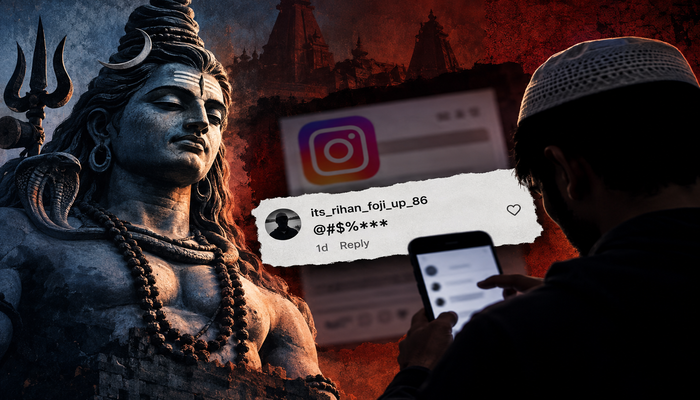
Case Summary
In Hathras, Uttar Pradesh, Hindu deity Lord Shiva was targeted with offensive and derogatory remarks by a Muslim man, Rehan Khan. On 3 October 2026, a complaint was filed at the Sasni police station by Bharatiya Yoddha Dal, a Hindu organisation, against Instagram user Rehan Khan, whose account was identified as its_rihan_foji_up_86. According to the complaint, Khan had posted the objectionable comment against Lord Shiva under a video, and the organisation submitted a screenshot of the comment to the police as evidence. His address was listed as Chhora Gadua in Sasni tehsil. The Bharatiya Yoddha Dal sought police action against Khan under Section 299 of the Bharatiya Nyaya Sanhita, 2023, which concerns deliberate and malicious acts intended to outrage religious feelings by insulting a religion or religious beliefs. Sasni Kotwali in-charge Vipin Chaudhary said that the matter was being investigated.
Why it is Hate Crime ?
This case has been added to the tracker under the primary category of - Hate speech against Hindus. Within it, the sub-category selected here is - Anti-Hindu slurs, mocking faith. Anti-Hindu slurs and the deliberate mocking of the Hindu faith owing to religious animosity involve the usage of derogatory terms, stereotypes, or offensive references to religious practices, symbols, or figures. One of the common anti-Hindu slurs used against Hindus is “cow-worshipper” and “cow piss drinker”. The intention of using this term is to demean and mock Hindus as a group and their religious beliefs since Hindus consider the cow holy. Additionally, some symbols and the slurs attached to them have a historical context that exacerbates the insult, hate, stereotyping, dehumanisation and oppression against Hindus. Cow worship has been used for centuries to denigrate Hindus, insult their faith and oppress Hindus specifically as a religious group. There has been overwhelming documentation about how cow slaughter has been used to persecute Hindus with cow meat being thrown in temples and places of worship. There has also been overwhelming documentation where cow meat (beef) has been force-fed to Hindus to either forcefully convert them to Islam or denigrate their faith. Apart from cow worship, the Swastika – which holds deep religious significance for the Hindus – has also been misinterpreted and distorted to use as a slur against Hindus. Similarly, the worship of the Shivling has been used by supremacist ideologies and religions to denigrate Hindus owing to religious animosity. Such slurs and denigration stem out of inherent animosity and hate towards Hindus and their faith, therefore, it is categorised as hate speech targeted at Hindus specifically owing to their religious identity. This case qualifies as a religiously motivated hate crime because the objectionable social media comment specifically targeted Lord Shiva, a revered Hindu deity and a central object of Hindu worship. The incident did not arise from an ordinary personal dispute or criticism of an individual’s conduct; instead, the offensive expression was directed at a sacred figure of the Hindu faith. The religious identity of the target was therefore central to the nature of the offence, making the conduct relevant from a hate-crime perspective. Lord Shiva occupies a foundational place in Hindu religious belief and is worshipped by millions of Hindus through prayers, rituals, festivals, temple worship and other devotional practices. As a revered deity, references to Lord Shiva carry an explicitly religious significance. An offensive comment directed at Lord Shiva therefore did not merely constitute general abusive speech but targeted a sacred figure who is deeply associated with Hindu faith and worship. By making Lord Shiva the subject of an objectionable social media comment, the accused directed the offensive expression towards an element of Hindu religious belief rather than towards a private individual. Insulting or ridiculing a revered deity attacks a core component of the religious beliefs held by Hindus and can offend the religious sentiments associated with that deity. The fact that the expression was made publicly on social media further extended the potential impact beyond an individual interaction to members of the wider Hindu community who encountered the content. In recent times, social media has increasingly become a platform for anti-Hindu hate, with derogatory memes, videos, and messages targeting Hindu religious symbols, practices, and deities. Such content is recognised as part of a broader pattern of Hinduphobia and religious hate crimes online. This deliberate targeting of revered religious icons firmly establishes this act as a religiously motivated hate crime; therefore, it is being categorised under the hate crime database


Case Status
Complaint filed


Perpetrators Details
Perpetrators
Muslim Extremists
Perpetrators Range
One Person
Perpetrators Gender
male
 Sources




