Brutal killing of pregnant cow and unborn calf sparks outrage; nine held in Damoh, Madhya Pradesh
 Damoh, Madhya Pradesh, India
  2 October, 2026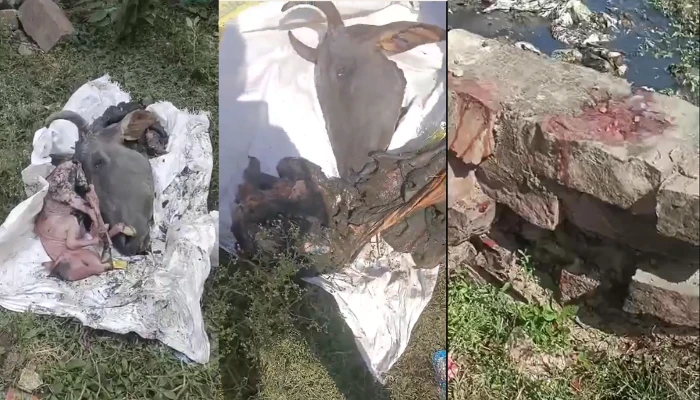
Case Summary
In Damoh district, Madhya Pradesh, a pregnant cow was brutally slaughtered and beheaded in the Noor Nagar-Sitabawari area by a group of men, triggering protests by Hindu organisations and Gau Sevaks. The incident took place on the morning of 3 October 2026. Another cow was also rescued from the location. According to Vishwa Hindu Parishad district president Ajay Khatri and Gau Sevaks present at the location, the remains of a pregnant cow and her unborn calf were found in an open field in the Kasai Mandi area. They stated that another cow was rescued from the spot and taken to Ghantaghar, where protesters raised slogans in support of Gau Mata and recited the Hanuman Chalisa. Khatri further stated that a similar incident had previously occurred in the area, with the latest remains being found around 200 metres from the earlier location. Following the discovery, Gau Sevaks and members of Hindu organisations gathered at Ghantaghar and staged a protest demanding the arrest of the perpetrators. A road blockade was also held, temporarily affecting traffic. The Vyapar Mahasangh also supported the bandh, resulting in the closure of shops around Ghantaghar and adjoining markets. Police forces were deployed in the area and appealed to protesters and traders to maintain peace. Police recovered the remains from the site and initiated an investigation. As the investigation progressed, police identified a total of 10 unknown men as being involved in the incident. Of these, nine were arrested and produced before a court on Monday evening. Police also took the nine arrested accused out in a public procession following their arrest, while efforts continued to trace the remaining accused. Police had also obtained information about a blue auto used in connection with the incident. Following the protests, Sagar Range DIG Shashindra Singh Chauhan reached Damoh and inspected the Noor Nagar, Sitabawari and Kasai Mandi areas. Acting on his directions, a joint team comprising the police, municipal administration and electricity department barricaded the area from Noor Nagar to Kasai Mandi and initiated action against identified encroachments and unauthorised constructions. The in-charge of the local police outpost was immediately suspended for negligence. According to the report, around 10 houses and structures were removed with the assistance of JCB machinery. Action was also taken against unauthorised electricity connections and identified encroachments. The administrative action followed demands from Hindu organisations for strict measures against those responsible for the incident and against alleged illegal activities in the area. The protests continued for around two hours, after which Collector Pratap Narayan Yadav and Additional SP Sujeet Singh Bhadoria met the demonstrators and heard their demands. The Collector directed officials to expedite the arrest of the accused and ordered action against identified encroachments in the Kasai Mandi area. He also directed the municipal authorities to act against open meat-selling establishments and ordered action against the in-charge of the Kasai Mandi police outpost. Following assurances from the administration, the protesters called off the road blockade. The incident also drew public opposition during a Shrimad Bhagwat Katha at Shri Dev Janki Raman Boondabahu Temple, where Bhagwat Acharya Rasraj Das expressed concern over the incident and called for strict action against those responsible. VHP district president Ajay Khatri also accused the administration of inadequate monitoring, stating that a similar incident had previously occurred in the area despite measures intended to strengthen surveillance. Gau Sevaks questioned the effectiveness of police patrolling and monitoring and demanded stronger preventive measures. National Human Rights Commission member Priyank Kanoongo also raised the matter through a social media post and demanded strict action against those responsible. In his post, he referred to the illegal slaughterhouses and constructions in the Noor Nagar area and called for an investigation and administrative action. The Hinduphobia Tracker had previously documented a similar incident in March 2025 in Damoh, in which a pregnant cow was beheaded. The recurrence of an incident involving a pregnant cow in the same district heightened concerns among local Hindu organisations and Gau Sevaks, who demanded stronger action to prevent such incidents. Following the arrests, police continued investigating the circumstances of the slaughter and the involvement of all persons connected with the incident.
Why it is Hate Crime ?
The incident has been added to the tracker under the primary category: Attack on Hindu religious representations. Within this, the sub-category selected is: Desecration of Hindu religious symbol. Icons and symbols, or religious representations of a spiritual ideal, are widely revered in Hinduism. Iconography is of vital significance in the Hindu milieu. It helps connect people’s spiritual beliefs with the real world. Iconography in the Hindu faith takes several forms. Murtis are most significant to Hindus, and daily rituals, prayers, and offerings are performed before them. Besides the murtis, there are several other symbols which have deep significance in the Hindu faith – the Om and Swastika, for example. Since these Hindu religious symbols hold paramount importance in Hinduism, any desecration of symbols, icons, murtis, religious representations and manifestations is driven by animosity towards the faith itself, which manifests itself through these murtis, icons and symbols. Therefore, any desecration of these Hindu religious symbols and representations is considered religiously motivated hate crimes under this category. This case was included in the Hinduphobia Tracker because the deliberate and exceptionally brutal killing of a pregnant cow, a sacred being revered by Hindus as gau mata, directly violated a deeply held Hindu religious belief. The slaughter of a cow is inherently offensive to Hindu religious sentiments because of the sacred status accorded to the animal in Hindu tradition. However, the Hinduphobia Tracker does not automatically classify every instance of cow slaughter as a hate crime. Where a cow is slaughtered for trade, meat or other commercial purposes, and there is no evidence establishing underlying religious hostility towards Hindus, such cases are placed under the Undecided category because the religious motive cannot be sufficiently established. This case was different because of the circumstances and the exceptionally brutal manner in which the cow was killed. The cow has long held profound religious significance in Hinduism. It is regarded as sacred and is associated with motherhood, purity and sustenance, and is revered as gau mata. Harming or killing a cow is therefore not viewed by Hindus as an ordinary act involving an animal, but as a violation of a deeply held religious belief. In this context, the deliberate slaughter and beheading of a pregnant cow directly struck at an animal that Hindus revere as sacred and maternal. The manner in which the killing was carried out further distinguished the incident from an ordinary act undertaken for commercial purposes. The cow was not merely slaughtered; she was beheaded, and her unborn calf was also killed. The extreme nature of the violence demonstrated a disregard for the religious sanctity associated with gau mata and intensified the offence to Hindu religious sentiments. The killing of the unborn calf added another dimension to the act, as it violated not only the reverence accorded to the cow but also the Hindu veneration of motherhood and life. The local Hindu community's reaction further demonstrated the incident's religious impact. The discovery caused immediate distress among Hindu devotees and led to protests, a market shutdown and demands for stronger protection. The community's response reflected a perception that a sacred Hindu belief had been violated. The incident therefore affected Hindus not merely as members of the wider public, but specifically because something they regarded as sacred had been subjected to extreme violence. The recurrence of a similar incident also added significance to the case. The Hinduphobia Tracker had previously documented an incident in Damoh in March 2025 in which a pregnant cow was beheaded on the first day of Navratri. The occurrence of another incident involving the brutal killing of a pregnant cow in the same district heightened concerns within the Hindu community and provided an important contextual indicator. It showed that the present incident was not occurring in an entirely isolated setting, but followed an earlier documented case involving the violent targeting of an animal of particular religious significance to Hindus. Taken together, the sacred status of the cow, the deliberate targeting of a pregnant animal, the killing of her unborn calf, the extreme brutality involved, the resulting distress among Hindu devotees and the recurrence of a similar incident distinguish this case from an ordinary instance of cattle slaughter. While the Hinduphobia Tracker recognises that the slaughter of cows can be offensive to Hindu faith even when undertaken for commercial reasons, the absence of evidence of religious hostility in such cases makes a hate-crime classification difficult. Here, however, the circumstances surrounding the killing provided sufficient religious indicators to go beyond that threshold. The act therefore constituted more than the killing of an animal. It involved the exceptionally brutal destruction of an animal that occupies a sacred position in Hindu belief and caused direct religious offence to the Hindu community. These circumstances placed the incident within the Hinduphobia Tracker's parameters as a hate crime targeting Hindu religious sentiments. Disclaimer: The perpetrator count was kept as unknown because the source did not identify the perpetrators by name. Although one perpetrator was referred to as “Guddu”, this nickname did not establish his identity or religious affiliation.


Case Status
Arrested


Perpetrators Details
Perpetrators
Unknown
Perpetrators Range
From 5 to 10
Perpetrators Gender
male
 Sources




