Hindu students falsely accused of burning Quran; subjected to fear, trauma and vilification in Illinois, United States
 Naperville, Illinois, United States
  2 October, 2023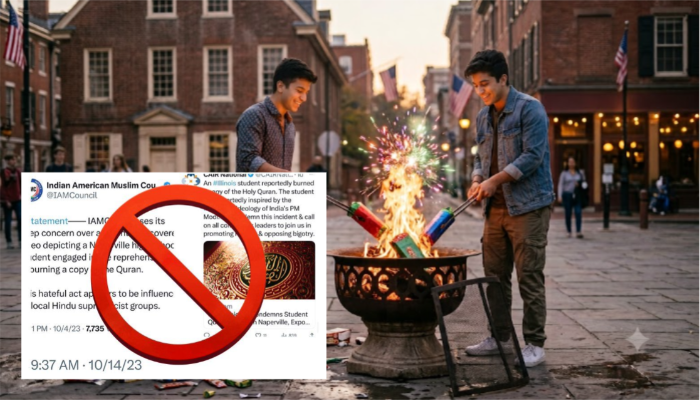
Case Summary
In Naperville, Illinois, United States, two Hindu high school students were falsely accused of burning the Quran and subjected to religious vilification, anti-Hindu propaganda, bullying, fear, anxiety, trauma and threats to their safety. The accusations portrayed the students as influenced by “Hindu supremacist” ideology and sought to associate them with Hindu nationalist organisations and extremist groups, while Hindu organisations and the wider Hindu community were also targeted through the controversy. The incident emerged in September 2023, when the Indian American Muslim Council (IAMC) and the Chicago chapter of the Council on American-Islamic Relations (CAIR) became involved in accusations against the students. The Islamic Centre of Naperville (ICN) and the Council of Islamic Organisations of Greater Chicago (CIOGC) also became involved, while liberal leaders joined calls to condemn what was presented as an “Islamophobic” act before the facts had fully emerged. The accusations created serious concerns for the students’ safety because even a suggestion of blasphemy could have dangerous consequences for those accused and people around them. On 26 September 2023 at 8 am, one of the students was confronted after stepping off his school bus by a group of 40 high school students who bullied and pressured him to admit that he had burned the holy book. He was surprised and shocked by the confrontation. The students had neither uploaded the video nor shared it with anyone, publicly or privately, and had made no comments about the book or the incident. At the time, no video of the incident had been circulating. On 27 September 2023, the terrified parents contacted local leader Nag Jaiswal, and he later said that the parents and students were visibly disturbed and had not slept because of fear and anxiety. On 3 October 2023, IAMC issued an official statement about a video that it said showed a Naperville high school student burning a copy of the Quran. The statement said the act had been influenced by local Hindu supremacist groups connected to extremist Hindu nationalist organisations in India. It declared the student responsible, stated that he had confessed, and connected the incident to Hindu outfits. IAMC said the video had been recorded in June 2023 and had only recently surfaced on social media, showing a student holding a lighter to a copy of the Quran, fanning the flames and throwing the book to the ground. It also stated that the student had confessed because he believed the Quran said to kill all non-Muslims and slandered other religions, and described this as an anti-Muslim myth he had encountered on social media. The statement referred to a comment opposing construction of a new mosque in Naperville in 2021 and used it to portray the student as influenced by “Hindu supremacist” ideology. It further stated that his language resembled rhetoric used by Hindu extremists in India and referred to Instagram, Twitter, WhatsApp and Facebook as platforms where such rhetoric was disseminated. IAMC also cited similar language attributed to prominent Hindu far-right groups in the United States, including a reference to Muslims as “barbaric” invaders of India on the website of the Vishwa Hindu Parishad of America (VHPA), which it described as an offshoot of the India-based Vishwa Hindu Parishad. On 10 October 2023, CAIR-Chicago issued a statement warning of a “troubling connection” with the Rashtriya Swayamsevak Sangh (RSS) Hindutva movement, which it described as internationally condemned for anti-minority ideology and human rights abuses. Ahmed Rehab, executive director of CAIR-Chicago, described the incident as part of a wider trend of Hindutva-inspired Islamophobia in Naperville and other communities. He described it as a reminder of ideological extremism being imported into America and called for it to be confronted urgently. The statement also noted that the student had commented twice in opposition to the mosque. IAMC and CAIR’s actions repeatedly linked the incident to “Hindutva” and “right-wing” rhetoric and extended the accusations beyond the students to Hindu organisations and the wider community. On 14 October 2023, Jaiswal challenged the accusations after reviewing the student’s testimony and the video footage. He said the evidence showed that the allegations were false and that the students had “vehemently denied that the burned book is the Quran”. The students had voluntarily shared the footage with CIOGC and ICN imams after they requested it to verify its authenticity. Jaiswal participated in a fact-finding meeting involving the parents of the Waubonsie Valley High School students and representatives of ICN Naperville, CIOGC and CAIR. The CIOGC President moderated the meeting, CAIR was represented by its attorney and operations manager, and the parents and students attended without legal representation. Jaiswal said there was no factual basis for the accusation and described the episode as speculative and based on hearsay. He said students at a graduation party could have spread the rumour and that no one knew how the accusation had arisen without anyone having a video. Jaiswal explained that during a random summer afternoon in the week after 4 July 2023, two children had gone to an open field in South Naperville to burst firecrackers. After the firecrackers, they burned random rubbish, including a book, took photographs and videos, and went home. The incident was not discussed again apart from once at a graduation party at the end of July 2023. Jaiswal said the students were confused about how the unrelated book-burning incident had become an accusation of Quran burning. He also criticised press releases, blogs, news articles and reactions from members of the public, religious organisations, political organisations and community leaders, saying that statements linking Hinduism with hate crimes without a formal investigation were disturbing and that one-sided political reactions were resulting in Hinduphobia. The Hindu American Foundation responded by stating that the story circulated on social media by CAIR and IAMC was “fake news”. It stated that there had been no intention to target Muslims and that endangering a family’s life over false charges was unacceptable. The organisation called for the national groups involved to apologise. No apology followed from those who initiated or repeated the accusations for the distress, agony, fear and trauma experienced by the students and their families. In November 2023, Jaiswal met an ICN member and raised concerns about the school’s handling of the events of 26 September 2023 and its role in placing the lives of the two children at risk. He also criticised leaders who had repeated and endorsed the accusations through tweets and public statements, questioning why elected officials representing a large electorate in Illinois US District 11 and Naperville City had done so. He further questioned why the school principal had contacted an external religious organisation and distributed confidential student information when, according to ICN, the accusations were based on the principal’s statements. He identified the disclosure as a violation of privacy. The episode also unfolded against wider tensions involving IAMC, CAIR, Hinduism and India. IAMC and CAIR had been involved in activities concerning Hinduism and India and had reacted to RSS chief Mohan Bhagwat’s visit to the United States. The organisations were also described in connection with extremist and jihadi groups, including Jamaat-e-Islami, and with providing platforms to figures known for Hinduphobic and anti-India views. The incident ultimately left the two Hindu students and their families facing public condemnation, bullying, fear and threats to their safety, while Hindu organisations and the wider Hindu community were drawn into the controversy.
Why it is Hate Crime ?
The primary category selected in this case is: Hate speech against Hindus. The subcategory selected is: Anti Hindu subversion and prejudice. The tertiary category selected is: Anti-Hindu Fake News or Downplaying. Hate speech is defined as any speech, gesture, conduct, writing, or display that is prejudicial against a specific individual and/or group of people, which is leading to or may lead to violence, prejudicial action or hate against that individual and/or group. Media plays a specific and overarching reach in perpetuating prejudicial attitudes towards a community owing to unfair, untrue coverage and/or misrepresentation/misinterpretation, selective coverage and/or omission of facts of/pertaining to issues affecting a specific religious group. This type of bias can dehumanise the victim group, making it easier for others to justify harmful actions against them, which aligns with the objectives of hate speech laws aimed at preventing such harm. It is often observed that the media takes a prejudicial stand against the Hindu community driven by their need to shield the aggressor community which happens to be a numeric minority, however, is the one perpetrating violence against Hindus. For example, the media is often quick to contextualise religiously motivated crimes against Hindus, omit or misrepresent facts that point towards religiously motivated hate crimes, justify and/or downplay religiously motivated hate crimes or simply present fake news to stereotype Hindus. Such media bias leads to the denial of persecution and is often used to dehumanise Hindus, leading to justification for violence against them. For example, the media covered several fake allegations of Hindus targeting Muslims and forcing them to chant Jai Shree Ram. Most of these cases were proved false and fabricated after police investigation. These fake news reports were subsequently never retracted or clarified. Such fake news led to the justification of violence and dehumanisation of Hindus based on the argument that since Hindus targeted Muslims and forced them to chant Jai Shree Ram, the dehumanisation of Hindus and violence against them was par for the course and merely a retaliation. Such media bias leads to prejudicial portrayal of Hindus and offers a justification for violence against them and therefore is considered hate speech under this category. The other subcategory selected is: Anti-Hindu slurs, mocking faith. Anti-Hindu slurs and the deliberate mocking of the Hindu faith owing to religious animosity involve the usage of derogatory terms, stereotypes, or offensive references to religious practices, symbols, or figures. One of the common anti-Hindu slurs used against Hindus is “cow-worshipper” and “cow piss drinker”. The intention of using this term is to demean and mock Hindus as a group and their religious beliefs since Hindus consider the cow holy. Additionally, some symbols and the slurs attached to them have a historical context that exacerbates the insult, hate, stereotyping, dehumanisation and oppression against Hindus. Cow worship has been used for centuries to denigrate Hindus, insult their faith and oppress Hindus specifically as a religious group. There has been overwhelming documentation about how cow slaughter has been used to persecute Hindus with cow meat being thrown in temples and places of worship. There has also been overwhelming documentation that cow meat (beef) has been force-fed to Hindus to either forcefully convert them to Islam or denigrate their faith. Apart from cow worship, the Swastika – which holds deep religious significance for the Hindus – has also been misinterpreted and distorted to use as a slur against Hindus. Similarly, the worship of the Shivling has been used by supremacist ideologies and religions to denigrate Hindus owing to religious animosity. Such slurs and denigration stem from inherent animosity and hate towards Hindus and their faith, therefore, it is categorised as hate speech targeted at Hindus specifically owing to their religious identity. The other category relevant here is- Attack not resulting in death, and within this, the subcategory selected is- Attacked over 'blasphemy' Blasphemy essentially refers to the desecration of anything which is held sacred/holy to a group of people. However, for religious supremacist groups, the elements of ‘blasphemy’ are ever-changing, shifting and expanding – leading to infringement on the rights of other religious groups, freedom of speech and expression, threats and even physical violence. There are instances where blasphemy is also used as a dog whistle to target Hindus owing to intrinsic animosity towards Hinduism. There are several instances where stating truths as mentioned in the non-Hindu doctrine itself has led to unmitigated violence against Hindus. There have also been instances where non-Hindus have themselves created a ‘blasphemous’ situation, like placing a Quran in a temple, to use it as an excuse to attack Hindus. Essentially, Blasphemy charges are often made up and/or are used to shut down any form of criticism of non-Hindu faiths and as a tool to target Hindus. Any physical violence over Blasphemy charges against Hindus are foundationally based on animosity for Hindus and their faith owing to religious supremacist ideologies, therefore, such attacks would be documented as religious motivated hate crimes under this category. This is a clear example of anti-Hindu rhetoric targeting Hindu students through false accusations and religiously charged narratives. By portraying the students as influenced by “Hindu supremacist” ideology and linking the incident to Hindu nationalist organisations, IAMC and CAIR amplified an accusation that placed the students and their families under fear, bullying and public vilification. The episode resulted in the dismissal of the students’ account, the targeting of Hindu organisations, and serious risks to the students’ safety, despite subsequent findings that the burned book was not the Quran. Firstly, the accusation that the Hindu students had burned the Quran itself constituted a blasphemy accusation. By attributing the alleged desecration of Islam’s sacred text to two Hindu students, the accusation placed them at the centre of a charge that could carry severe religious and social consequences. As seen in several cases, blasphemy accusations can become tools of oppression and violence, resulting in false allegations, mob justice and social ostracisation of those accused. In Muslim-majority countries such as Pakistan and Bangladesh, blasphemy laws have repeatedly been invoked in cases involving members of Hindu minorities, with accusations sometimes becoming a pretext for intimidation and violence. Similar allegations have also emerged in India, where claims of blasphemy or religious desecration can be weaponised against Hindus and used to settle personal or communal disputes. When such accusations are directed at Hindus because of their religious identity, the misuse of blasphemy allegations becomes an important indicator of religiously motivated targeting. The religious dimension in this case was therefore not incidental: the accusation specifically portrayed Hindu students as having committed an act of religious desecration against Islam. This becomes particularly significant because the accusation was subsequently challenged. The students denied that the burned book was the Quran, while the Hindu American Foundation stated that the book was not a Quran and that there had been no intention to target Muslims. Secondly, describing the students as influenced by “Hindu supremacist” ideology, and associating them with local Hindu supremacist groups, extremist Hindu nationalist organisations and Hindu outfits, attached an extremist religious character to their Hindu identity. The language did not remain confined to the conduct of the students; it extended the accusation towards Hindu organisations and the broader Hindu community by suggesting that their Hindu identity and associations provided the ideological basis for the incident. IAMC further connected the students’ language with what it described as rhetoric used by Hindu extremists in India and referred to Hindu far-right groups in the United States. This framing placed Hindu religious and community identity alongside terms such as “supremacist”, “extremist” and “far-right”, thereby creating a negative religious association around the students and the Hindu organisations mentioned in connection with them. Thirdly, linking the incident to “Hindutva” and the Rashtriya Swayamsevak Sangh (RSS) created another religious and ideological association around the Hindu students. CAIR-Chicago described the Rashtriya Swayamsevak Sangh Hindutva movement as “Islamophobic and extremist” and associated it with anti-minority ideology and human-rights abuses. Ahmed Rehab further presented the incident as part of a wider pattern of Hindutva-inspired Islamophobia, while the student’s opposition to the construction of a mosque in Naperville was incorporated into that narrative. The effect of this framing was to connect a disputed incident involving two Hindu students with a broader ideology portrayed as hostile towards Muslims. It consequently extended the negative characterisation from the individual students to Hindu political and religious identity, particularly through the repeated use of terms such as “Hindutva”, “Islamophobic”, “extremist” and “anti-minority”. Overall, the three markers operated at different levels: the Quran-burning accusation placed the Hindu students in the position of religious offenders; the “Hindu supremacist” and Hindu nationalist framing characterised their Hindu identity and associations as extremist; and the Hindutva-Rashtriya Swayamsevak Sangh framing broadened that characterisation into a wider narrative about Hindu ideology. The religious significance of the episode therefore extended beyond the individual accusation and affected how the students, Hindu organisations and the wider Hindu community were portrayed. Accordingly, this case has been documented in the Hinduphobia Tracker's Hate Crime Database as an instance of religiously motivated hostility directed against Hinduism and the religious identity of the Hindu community.
Victim Details
Total Victim
2
Deceased
0
Gender
- Male 2
- Female 0
- Third Gender 0
- Unknown 0
Caste
- SC/ST 0
- OBC 0
- General 0
- Unknown 2
Age Group
- Minor 2
- Adult 0
- Senior Citizen 0
- Unknown 0


Case Status
Unknown


Perpetrators Details
Perpetrators
Unknown
Perpetrators Range
Unknown
Perpetrators Gender
unknown
 Sources




