Hindu idol vandalised and thrown into pond ahead of Durga Puja in Panchagarh, Bangladesh
 Panchagarh District, Bangladesh
  30 September, 2026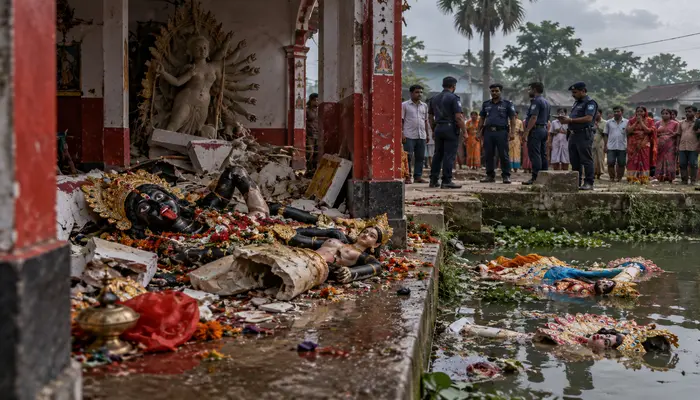
Case Summary
In Atwari, Panchagarh district, Bangladesh, idols of Hindu deities were vandalised and desecrated just ahead of Durga Puja by unknown miscreants. The incident occurred on 1 October 2026, when the idols of the Hindu deities, along with an idol being prepared for the upcoming Durga Puja festival, were deliberately destroyed. According to police and local residents, an unidentified person pushed the idol from outside using a bamboo pole, causing it to fall and break. Following the desecration, the perpetrator threw the vandalised idols into a pond, prematurely immersing them before the religious festival could commence. Following the attack, personnel from Atwari Police Station, the Upazila Nirbahi Officer (UNO) and other law enforcement agencies visited the site. The damaged idol was subsequently immersed in water in accordance with Hindu religious customs. The sudden desecration generated intense panic and a deep sense of insecurity among the local Hindu community just ahead of their sacred festival. Atwari Police Station Officer-in-Charge Matiar Rahman said that no case had been filed in connection with the incident at that point. He said police had begun a preliminary investigation into the vandalism. This incident occurred against the broader backdrop of the historical persecution faced by Hindus in Bangladesh. While the Hindu minority has endured discrimination, targeted violence, and religious hostility over decades, such persecution has intensified in distinct spurts during periods of political and social instability. The latest major escalation began and continued after the ouster of Sheikh Hasina’s government in August 2024, followed by another surge after the death of Sharif Osman Bin Hadi in December 2025, and subsequently in the immediate aftermath of the 13th National Parliamentary Election in 2026. Following the ouster of Sheikh Hasina, multiple incidents involving attacks on Hindu homes, temples and religious institutions were documented, alongside intimidation, arson and mob violence targeting Hindu localities. The Hinduphobia Tracker recorded 336 incidents involving the Hindu minority during this period, reflecting the scale of the escalation and the continuing vulnerability of Hindus in Bangladesh. A further spurt of violence followed the death of Sharif Osman Bin Hadi, a Muslim political activist and student leader known for his anti-Hindu and anti-India rhetoric, in December 2025. In the aftermath, Hindu communities were subjected to retaliatory violence, with Hindu homes and properties selectively attacked and several families forced to flee. Among the victims was Dipu Chandra Das, who was lynched and whose body was subsequently set ablaze by a Muslim mob over false blasphemy allegations. The Hinduphobia Tracker documented 51 incidents of anti-Hindu violence in the period following Hadi’s death alone, further illustrating how existing hostility towards the Hindu minority intensified during moments of communal mobilisation. During the same period, posters and written material calling for the extermination of Hindus were also displayed in public spaces. Such rhetoric, when viewed alongside incidents of arson, vandalism, assault and targeted intimidation, reflected an environment in which hostility towards Hindus was not merely episodic but repeatedly resurfaced in more intense forms during periods of unrest. The most recent escalation followed the 13th National Parliamentary Election in 2026. In the immediate aftermath of the election results, Hindu families in districts including Noakhali, Rangpur, Nilphamari, Sylhet, Thakurgaon and Dinajpur faced attacks involving arson, looting, assault and vandalism of Hindu homes and temples. In several instances, Hindu properties were selectively targeted, and families were threatened with displacement. The present incident therefore occurred within a much longer history of persecution of Hindus in Bangladesh, where hostility towards the community has persisted over time and intensified in repeated spurts. The latest cycle began after the ouster of Sheikh Hasina and continued through subsequent periods of political and communal upheaval, leaving the Hindu minority increasingly vulnerable to targeted violence, intimidation and religious hostility.
Why it is Hate Crime ?
This case is being added to the tracker under the primary category- Attack on Hindu religious representations. The subcategory selected is- Desecration of Hindu religious symbol. Icons and symbols or a religious representation of a spiritual ideal are widely revered in Hinduism. Iconography is of vital significance in the Hindu milieu. It helps connect people’s spiritual beliefs with the real world. Iconography within the Hindu faith takes several shapes and forms. Murtis are of most significance to Hindus, to which daily rituals, prayers and offerings are done. Besides the murtis, there are several other symbols which have deep significance in the Hindu faith – the Om and Swastika for example. Since these Hindu religious symbols hold paramount importance in Hinduism, any desecration of symbols, icons, murtis, religious representations and manifestations, is driven by animosity towards the faith itself which manifests itself through these murtis, icons and symbols. Therefore, any desecration of these Hindu religious symbols and representations is considered religiously motivated hate crimes under this category. This incident qualified as a religiously motivated hate crime because it directly targeted the core sacred representations of the Hindu faith. The act focused on the intentional destruction and premature disposal of venerated deities, striking directly at the devotional and liturgical life of the Hindu community. In Hinduism, idols are sacred representations through which devotees establish a tangible focus for worship and offer prayers, rituals and devotion to the deity. They are not merely decorative objects but occupy an important place within Hindu religious practice, with them being treated with reverence and incorporated into the ritual life of a temple. The destruction of such idols therefore carries religious significance because it violates objects regarded as sacred by the Hindu community. Furthermore, Durga Puja is one of the most significant Hindu festivals dedicated to Goddess Durga and commemorates her worship through elaborate rituals, prayers and ceremonial observances. During the festival, specially prepared idols of Hindu deities are installed and worshipped as part of the religious celebrations. The preparation, installation and worship of these idols form an integral part of the devotional and ceremonial observance of Durga Puja, making the idols being prepared for the festival religiously significant even before the celebrations formally begin. By deliberately desecrating these deities and submerging them prior to the commencement of Durga Puja, the perpetrators targeted the essential religious symbols that define the community's worship, demonstrating that the hostility was aimed squarely at Hindu faith and culture. The timing and nature of the act underscored a clear intent to disrupt religious observance and assert communal dominance. Desecrating deities immediately ahead of the most significant festival in the Hindu calendar was designed to produce acute psychological distress, induce fear, and prevent the community from exercising their right to worship freely. The conduct went far beyond material destruction; it functioned as a targeted message of intimidation aimed at marginalising the local Hindu minority. The incident aligned with a wider, documented pattern of attacks on Hindu religious infrastructure and festivities in Bangladesh, where Durga Puja pandals, temples, and murtis have repeatedly been targeted during festival periods. Such recurring hostility creates an atmosphere of vulnerability and insecurity for the religious minority, signalling an intolerance toward the visible, public practice of their ancestral faith. Because the targets were sacred Hindu deities, chosen specifically to insult religious feelings and suppress the religious life of the community, the incident was driven by anti-Hindu animosity. The exclusive focus on desecrating holy symbols to sabotage a major religious celebration established this act as a clear hate crime. Although the identities of the miscreants remained unknown at the time of reporting, their fixation on desecrating sacred Hindu idols demonstrated deep-seated anti-Hindu animosity. This was not another act of vandalism, but a premeditated strike rooted directly in hostility towards the Hindu faith. Consequently, even without confirmed perpetrator identities, the targeted destruction established a clear religious motive, and the incident has been documented as a hate crime in the Hinduphobia Tracker.


Case Status
Unknown


Perpetrators Details
Perpetrators
Unknown
Perpetrators Range
One Person
Perpetrators Gender
unknown
 Sources




