Hindus targeted for conversion through repeated prayer meetings, faith-healing and material inducements by Christian missionaries
 Purba Medinipur district, West Bengal, India
  29 September, 2023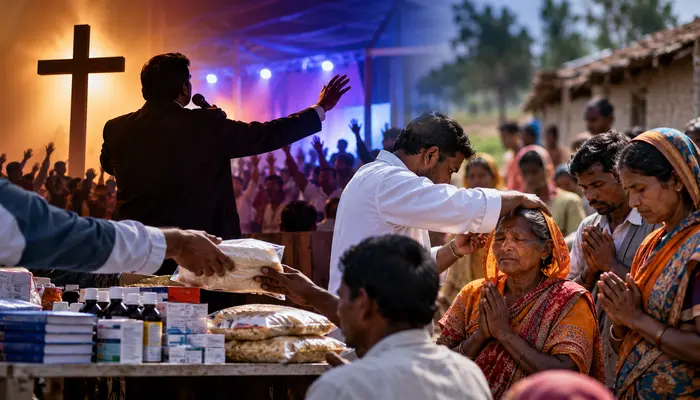
Case Summary
In Mecheda, East Midnapore district, West Bengal, Hindu families were targeted for Christian conversion through supposed faith-healing, prayer meetings and material inducements. Vulnerable people were approached under the guise of free or inexpensive treatment, medicines, groceries, educational assistance and other forms of assistance. The activities involved The Church of Glory and Wisdom and The Church of Signs and Wonders, with Christian prayer being incorporated into the healing process. The campaign was conducted with the aim of religious conversion through increasingly frequent gatherings, including evening meetings, and involved inducements connected with hopes of miracles, cures, employment and financial benefits. According to residents and representatives of the Hindu organisations that led the 27 September 2026 protest against the proselytisation, the two Pentecostal ministries, The Church of Glory and Wisdom and The Church of Signs and Wonders, were organising two or more prayer meetings every month, with thousands of people attending. The West Bengal government was called upon to investigate the operations of both ministries independently and transparently. Reports of such activity in the Mecheda region had begun surfacing as early as 2023 under the banner of “faith healing” and “free treatment”. A group of 50–60 villagers travelled to pray to Jesus for relief from illness. The gatherings involved people seeking relief from illness and other personal difficulties, with treatment and assistance forming part of the circumstances surrounding the prayer meetings. Subsequent investigation into these activities in West Bengal documented the manner in which treatment and faith-healing services were presented to vulnerable villagers. The investigation involved a covert telephone call to a service provider after reports emerged from South Bengal of ‘miracle healers’ offering relief from chronic pain, infertility and mental distress. During the call, the person seeking treatment was directed away from conventional medical treatment and towards prayer and acceptance of Christian faith. Free or inexpensive treatment was presented initially, followed by prayer sessions as part of the healing process. The interaction also included references to groceries, medicine kits and educational assistance for children being available to regular participants. Those seeking help were then invited to evening group prayer meetings, where Christian belief and participation in the religious gatherings were gradually introduced. The investigation further reported that the person handling the call asked about the caller’s symptoms, family size, financial circumstances and household difficulties. Local residents also stated that large gatherings of more than 3,000 people took place in Mecheda more than once or twice a month for healing sessions centred on prayer to Jesus. In April 2023, the Income Tax Department conducted simultaneous raids at more than a dozen premises linked to the ministry of Punjab-based pastor Ankur Narula in Punjab in connection with financial irregularities, including possession of unaccounted-for foreign funds. The Church of Signs and Wonders was headed by Ankur Narula. The regional branch of The Church of Glory and Wisdom was located at the Regal Guest House in Mecheda, while The Church of Signs and Wonders had its local branch at Star Village Resort Private Limited near Kolaghat Railway Station. Pastor Baljinder Singh was the leader of The Church of Glory and Wisdom. In 2025, Pastor Baljinder Singh was convicted in a rape case and sentenced to life imprisonment until death. On 27 September 2026, Mecheda witnessed a large street protest organised by the Bajrang Dal and other local Hindu organisations. The protesters demanded an investigation into the activities of The Church of Glory and Wisdom and The Church of Signs and Wonders and sought scrutiny of whether the two Pentecostal ministries were conducting an organised campaign of deceptive proselytisation. The matters identified for investigation included fraudulent medical claims, material assistance being conditional upon religious conversion, the systematic targeting of vulnerable households, the proper accounting of foreign or domestic funding, and any conversion carried out through force, fraud or unlawful inducement. The demand also called for religious organisations not to receive immunity merely because their activities were presented as charity, prayer or miraculous healing, and for swift and exemplary justice if wrongdoing were established. The Punjab and Haryana High Court had also sought the government’s response to a public interest litigation concerning conversion through inducement and deceptive practices.
Why it is Hate Crime ?
The primary category selected in this case is: Predatory Proselytisation. The subcategory selected is: Conversion/ attempts to convert by inducement. Predatory Proselytisation is not just limited to threat, harassment, force and violence, but it also has contours of stealth. In several cases, the Hindu victim is exploited to convert, with non-Hindus taking advantage of their poverty. In such cases, the Hindu victim who is suffering financially is offered monetary benefits, including lucrative offers for jobs, health treatment, education, etc, to induce the victim into changing his/her religion. In such cases, the religious identity of the victim and the aim to disenfranchise him from his faith form the heart of the crime. Also, taking advantage of and exploiting an individual’s economic vulnerabilities is widely acknowledged as exploitation, forms of which are often penalised by law. Such cases therefore are considered religiously motivated hate crimes since the victim’s religious identity forms the very heart of the crime itself. The other sub-category selected here is - Proselytisation by grooming, brainwashing, manipulation or subtle indoctrination, with the tertiary category being - Pattern of targeting Hindus. Religious brainwashing essentially means the often subtle and forcible indoctrination to induce someone to give up their religious beliefs to accept contrasting regimented ideas. Religious grooming or brainwashing also involves propaganda and manipulation. It involves the systematic effort, driven by religious malice and indoctrination, to persuade “non-believers’ to accept allegiance, command, or doctrine to and of a contrasting faith. Cases of such grooming or brainwashing are far more nuanced than direct threats, coercion, inducement and violence. In such cases, it is often seen that there is repeated, subtle and continual manipulation of the victim to induce disaffection towards their own faith and acceptance of the contrasting faith of the perpetrator. While subtle indoctrination is widely acknowledged as predatory, an element which is often understated in such conversions or the attempts of such conversion is the role of loyalty and trust which might develop between the perpetrator and the victim. Fiduciary relationships are often abused to affect such religious conversion. For example, an educator transmitting religious doctrine of a competing faith to a Hindu student. The Hindu student is likely to accept what the teacher is transmitting owing to existence of the fiduciary relationship. The exploitation of the fiduciary relationship to religiously indoctrinate victims would also be included in this category. Since the underlying animosity towards the victim’s faith forms the basis of predatory proselytization, such cases are considered religiously motivated hate crimes. This case is a clear example of a religiously driven hate crime, as Hindu families in Mecheda, West Bengal, were specifically approached through faith-healing, prayer meetings and material inducements in an effort to convert them to Christianity. At the centre of the matter was the approach towards Hindu families in connection with efforts to convert them to Christianity. Material inducements formed a significant part of the conversion mechanism in this case, as vulnerable Hindu individuals were attracted through offers of treatment, medicines, groceries, educational assistance and other forms of help before being drawn into Christian prayer and conversion-oriented gatherings. These offers were particularly significant for people facing illness, financial hardship or other personal difficulties, as the prospect of receiving much-needed assistance could encourage them to participate in the religious activities. The concern therefore arose from the reported use of material needs as an entry point for Christian religious engagement, where assistance was presented alongside prayer, faith-healing and efforts towards conversion. In this context, material inducements functioned as a means of attracting vulnerable Hindu individuals towards Christian religious participation and ultimately encouraging a change in their religious affiliation. Another significant aspect of the case was the use of faith-healing to attract people towards Christianity. People who were seeking relief from illness were encouraged to pray to Jesus as part of the healing process. This meant that the search for medical or spiritual relief was being used as an opportunity to introduce people to Christian beliefs and prayer. The religious element was therefore not simply the promise of healing, but the use of healing activities to bring people into Christian religious practices and towards conversion. Furthermore, the progression towards increasingly frequent prayer gatherings, including evening meetings, where Christian belief and conversion were introduced. Repeated participation created sustained contact with Christian religious teaching and practice. What began in the context of prayer or healing therefore developed into continued involvement in gatherings centred on another faith. The concern arose from this gradual movement from seeking assistance to repeated participation in Christian religious settings and exposure to conversion. The activities particularly focused on people facing illness, debt, unemployment or family difficulties. These people were more vulnerable because they were in need of immediate help and relief. Approaching Hindu individuals during such difficult circumstances through healing, prayer and material assistance gave an opportunity to introduce them to Christian religious practices and conversion. The concern was that people seeking help for serious personal or financial problems were being drawn into Christian religious settings when they were especially vulnerable to religious persuasion. In this way, their difficult circumstances were reportedly being used as an entry point to encourage them towards Christianity. Collectively, these religious markers showed how the targeting of Hindu families extended beyond a single act of religious persuasion and encompassed a wider pattern in which faith, healing, material assistance and the prospect of personal relief were brought together around Christian conversion. The nature of the conversion efforts and the wider impact on the Hindu community all indicate a targeted action against Hindus as a collectivity. When individuals or groups focus their efforts on converting members of a particular religion, in this case, Hindus, then it demonstrates a fundamental disregard for the Hindu faith. Conversion, especially when not based on personal conviction but rather on external persuasion or pressure, is not simply about sharing a different belief system. It is an attempt to undermine the values, traditions, and identity of the Hindu community. In this context, the Christian perpetrators specifically targeted Hindus, which demonstrates a lack of respect for Hinduism and its followers. Additionally, this was not an isolated case in which Ankur Narula and his ministry were associated with efforts to convert Hindus through faith-healing, inducements or manipulation. The Hinduphobia Tracker had documented several other cases involving similar methods. For example, in a case from Jalandhar, Punjab, poor and financially vulnerable Hindus were targeted through purported miraculous healing and anointing oil, with the Church of Signs and Wonders, Ankur Narula and his wife Sonia Narula named in the case. In another case from Udaipur, Rajasthan, an organised interstate conversion network was found to have links with Ankur Narula and had targeted Hindu villagers, including members of tribal communities, through conversion camps. A case from Jabalpur, Madhya Pradesh, documented how a Hindu couple were taken to prayer gatherings at Ankur Narula’s church after being approached with promises of healing. The couple subsequently faced pressure to convert, financial exploitation and threats. Taken together, these cases demonstrated a recurring method in which illness, financial hardship and personal vulnerability were used as points of entry into Christian religious activity, making the religious identity of Hindu victims central to the conversion process. The recurrence of faith-healing, material inducements, prayer gatherings and sustained religious persuasion across these documented cases indicated a broader pattern of targeting Hindus for conversion rather than isolated religious outreach. Disclaimer: The Hinduphobia Tracker records incidents based on the date on which an event occurred or the date on which the victim’s ordeal began. None of the media sources covering this case specified the exact date on which the incident occurred. Accordingly, 30 September 2023 has been used as the indicative incident date, based on the documented year in which the ordeal began and aligned with the 30 September publication date of the 2026 report. This date has been recorded for documentation purposes only.


Case Status
Unknown


Perpetrators Details
Perpetrators
Christian Extremists
Perpetrators Range
Unknown
Perpetrators Gender
unknown
 Sources




